Jasper Abandons Suicide and Seeks Biotechnology Treatment
Made for LoveJasper Abandons Suicide and Seeks Biotechnology Treatment marks a turn from a suicide plan toward a costly, uncertain attempt at intervention. In the aftermath of losing his chance to reach Bella, Jasper prepares to die; a Biotech Medical advertisement interrupts that plan by offering the possibility of a customized solution. The change is not a recovery or a promised cure: it is a decision to keep seeking a way forward, made when Jasper believes he has almost nothing left to lose.
Despair After the Failed Rescue
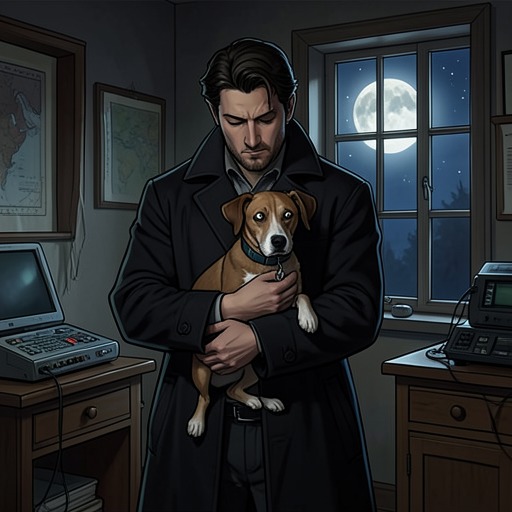
On the drive back to his studio, Jasper weeps and careens between lanes. His modified station wagon carries a large cooler that seems to him filled not with anything useful but with his dead dreams. He imagines driving into the ocean, then recognizes that the car would stop before it reached the water and that beach patrol could demand identification. Even that imagined exit collapses into practical obstacles, including the prospect that his license might be identified as stolen. He also believes he may have been about to lose his job for fraud. The sequence makes his despair concrete: the law, his precarious work, and the unreliable car intrude even on his fantasy of escape.
At home, the tub he had filled for Bella that morning remains. Jasper drains it and fills it again with warm water, climbs in, and places a razor on the nightstand. He intends to cut himself underwater, imagining the reddening water as an attack that would repeat the violence that changed him. Since the dolphin attack, he has understood himself as a different person; he does not want to continue living in that altered condition. His thought that he might have managed a life with Bella if he could have felt satisfied ties the crisis to both his failed rescue and the sexual change he attributes to the attack. But he also recognizes that such a life would not necessarily have been easy or carefree.
The Advertisement and the Interruption
Jasper turns to the Dolphin Savior’s hit song on a Gogol tablet he had permanently borrowed from an educational classroom at the Oceanarium. An advertisement appears, showing a woman in a bikini. Her face reminds him of women from earlier cons, though he cannot settle on a name. Taking the interruption as a possible sign, he clicks through and makes one last attempt to become aroused by a human woman, explicitly treating the test as a matter of life or death. The tablet that once belonged to the Oceanarium’s educational setting now mediates a private crisis, bringing a commercial promise into the room where Jasper has prepared to die.
The advertisement first presents individualized care in polished language and hopeful music. Jasper lowers the volume because the sales pitch itself does not arouse him, though he continues to focus on the woman’s body. As it plays, he has to stop himself from watching the water ripple; he realizes that he is hoping a dolphin will appear. The small distraction exposes the persistence of his fixation even while he is trying to test whether desire for a human woman can return.
The commercial then shifts to a beach scene: a bikini-clad woman pushes an older quadriplegic male amputee in a wheelchair, while two women in goggles and open lab coats carry a rigid suit-like device. They fasten it around the back of his body, and he stands upright. After he whistles, an unmanned Jet Ski comes to shore; he climbs aboard, and the women join him as they ride away together. The ad frames the device as a means of enabling a dramatic experience, presenting bodily transformation as both technological demonstration and spectacle. It ends by offering the future through Biotech Medical, identified as a subsidiary of Gogol. Jasper’s attention has shifted from an attempted sexual test to the prospect of a technological solution.
Choosing Treatment
Jasper’s subsequent arrival at Gogol turns the moment of interruption into action. Ordinarily, the intake process would have made him flee: entering the facility means surrendering his anonymity for the rest of his life. This time he proceeds because, as he sees it, he has nothing to lose. He is prepared to spend the cash that remains of his life savings, and he has driven through the night to secure the earliest appointment available the following day. The decision is not casual optimism; it is a deliberate exchange of privacy and money for access to treatment.
The route to the appointment reinforces the distance between Jasper and the institution. The facility sits in the middle of a field and is guarded like a fort. After arriving, he is directed into an eerie unmanned vehicle that carries him from the front gate to the building. He has repeatedly wondered whether he is lost during the long drive, and the approach offers little reassurance: Gogol’s care begins behind remote machinery and formidable security.
At intake, Jasper learns that the procedures are prohibitively expensive for an average person. The operator explains that fundraising drives and charity walks often help people in average income brackets pay for them. Jasper does not seek a solution that would prompt a crowd to run a 5K on his behalf. When the initial survey reveals no physical assets and no employment record, the operator hesitates to schedule him. He insists that his life savings will cover the cost, agrees to pay a hefty consulting fee on arrival, and prepays for the procedure in cash. His willingness to pay is thus not simply a declaration of hope: it is the practical condition that gets him past the intake barrier.
An Uncertain Turn
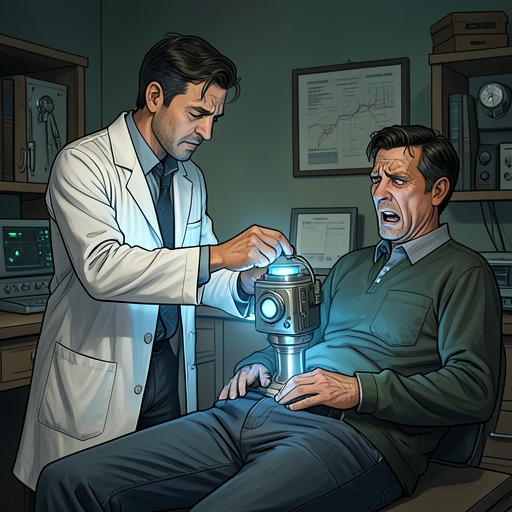
The diagnostic wing’s steel-colored exterior and silver doors, thin as giant razor blades, give Jasper the feeling that he is about to be sliced in half. The image carries the event’s unresolved tension: the institution he has chosen as an alternative to suicide also appears forbidding and potentially dangerous. A woman with a file calls him Mr. Kesper and beckons him inside. The scene ends at the threshold of assessment, not with a diagnosis, procedure, or cure. Jasper has abandoned the immediate plan to die and committed his remaining resources to treatment, but what that treatment will do remains unknown.