Natural mortality versus technological life extension
Made for LoveNatural mortality versus technological life extension is a conflict over whether the body’s decline is a defect to eliminate or an unavoidable condition that gives human life its limits and meaning. The contrast takes shape through Hazel’s father’s refusal of further cancer treatment, Byron’s faith in technological progress, and Hazel’s struggle to understand what her father’s final days demand of her. His death does not settle the argument: it becomes, at once, an intimate loss and an occasion Byron tries to absorb into his future-facing project.
Competing Accounts of Bodily Decline
Hazel’s father has cancer, but he declines further treatment. When Hazel urges him to seek more care, he says, “I’m done with treatment.” He distinguishes his decision from any judgment about his relationship with her: even if they had got along better, he says, he still would not want to live forever. For Hazel, the refusal is painful partly because it forecloses the course she wants to take. She insists that what he has tried is basic compared with what may be possible, and that he cannot simply give up and die. His choice, however, is not presented as a dispute about treatment options alone; it is also a refusal of life extension as an overriding goal.
His explanation makes that refusal concrete. He wants to spend the short time left in his own home, among the women represented by his dolls, rather than pursue more treatment. He also describes bodily breakdown and death as part of an orderly process: a body left in the woods eventually deteriorates, and human beings, in his account, are guests who clean up after themselves. He struggles to name what is valuable in this process, revising his description from special to orderly and perhaps benevolent. The emphasis falls not on the body as an ideal state to preserve, but on its eventual return to the world from which it came.
That view unsettles Hazel because she wants her father to affirm that the traditional life cycle has inherent worth. She has hoped that tending to him through his decline might reveal a wisdom in nature that Byron’s engineering outlook denies. Yet she also fears the experience may feel empty: if Byron sees her care for her father until death and treats it as proof that human life is a problem to solve, his position will seem further confirmed. Her uncertainty is not simply about whether treatment works. It concerns whether a finite life can be meaningful without being repaired into indefinite vitality.
Hazel Between Acceptance and Intervention
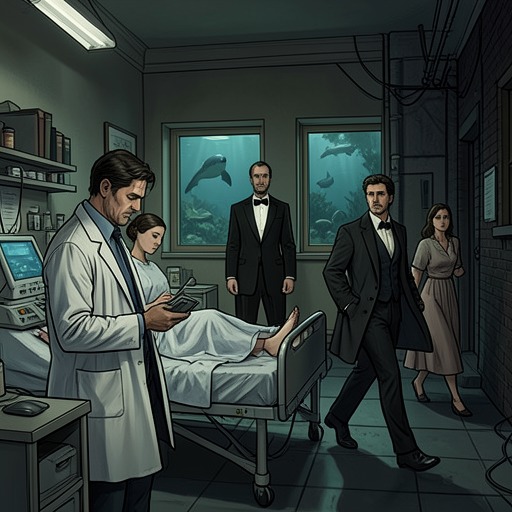
Hazel’s efforts to persuade her father to seek care draw on her knowledge of what technology may offer and her fear of losing him. She points him toward the Gogol Diagnostic Facility and argues that his condition should be investigated rather than accepted as inevitable. When she connects his refusal to her mother, Phyllis, and to what he saw during her treatments, she is searching for a reason she can bear. He does not give her the explanation she wants; he repeats that he is finished with treatment and wants to remain at home.
The prospect of technological life extension also changes how Hazel reads past deaths. She thinks the possibility that technology could flatten life’s circle and keep vitality going makes earlier losses, including Phyllis’s death, feel more tragic. The thought complicates rather than relieves grief: if an alternative to decline might soon exist, each death can appear newly preventable, while Hazel’s own finite life seems harder to justify. Her anxiety reaches beyond her father’s prognosis to the question of whether a natural lifespan could contain enough meaning, let alone whether she could endure an eternity.
Her father’s manner offers a contrasting model without resolving that anxiety. Hazel is moved when he smiles instead of rebuking her, and she tells him she will stay with him until the end. He takes the hands of his dolls and says he will not be alone. His preference is for the company and surroundings he has chosen, not for a technologically extended future. Hazel can accept being present with him while still resisting the idea that his decision proves nature’s way is sufficient or that further care would have been wrong.
Byron’s Technological Future
Byron represents the opposing conviction that decline is a failure technology should overcome. Hazel understands that he regards natural processes as defects and asks herself whether her father’s final days will give Byron another argument for engineering beyond humanity. The conflict is therefore also about how death is interpreted: the same deterioration that her father regards as a natural ending can appear to Byron as evidence that bodies need technological correction.
That disagreement is intensified by Byron’s internal surveillance of Hazel. She feels pressure to achieve happiness because he can observe her emotional failures, a pressure she recognizes as counterproductive. Her caregiving is no longer only a private relationship between daughter and father; she imagines it being watched and converted into evidence for Byron’s beliefs. The possibility of extending life is thus entangled with the means of monitoring it. A technology that promises to overcome the body’s limits also threatens the privacy in which Hazel might otherwise grieve, care, and decide what matters.
After her father’s death, a television message from Byron tries to give the loss a technological meaning. It tells Hazel to return to The Hub once her father is gone, presenting his death as the final step before her devotion to a major medical and technological achievement and a shared neurological future with Byron. The message recasts a person’s death as a marker of progress and as the prelude to ending isolated thought. Its confident promise sharply contrasts with the unrepeatable fact of the individual life that has ended.
Death, Privacy, and the Limits of Progress
Hazel’s father dies at home. She does not experience the moment as a sudden transformation or a profound revelation; instead, she registers an anticlimax and tries to make herself feel more upset. She looks at the time and calculates that she may have twenty hours before Byron learns what has happened. She also fears that, if she does not return to The Hub, no one still alive whom she might care about will be safe. The death that her father chose to meet at home immediately becomes a crisis shaped by Byron’s reach and Hazel’s constrained choices.
Hazel then takes a bottle of her father’s opioids with water and drinks his whiskey. She hopes that dying might prevent another download and keep Byron from seeing her father’s last moments, or her own. In that wish, death is not only the natural limit Byron’s technology aims to defeat; it is also imagined as a possible last refuge from technological access. Her act cannot be reduced to a settled philosophical endorsement of mortality. It follows her father’s death, her fear of being drawn back into Byron’s project, and her desire for a private ending beyond his surveillance.
She lies beside her father, placing the dolls’ eye masks over him and herself. The arrangement brings her close to his body after death, though she recognizes the awkwardness of that closeness and the difficulty of such intimacy while he was alive and conscious. The dolls make the scene neither an unmediated human farewell nor a technological solution: they are manufactured companions beside two mortal bodies, one dead and one endangered. The image holds the concept’s central tension in a domestic space. Technological and manufactured things already belong to human life, but their presence does not erase bodily death, guarantee companionship, or resolve what a finite life is worth.