Oceanarium
Made for LoveThe Oceanarium is a public marine attraction and Jasper’s workplace, but in his plans it becomes something more troubling: the first stage of a life he imagines sharing with Bella, one of the dolphins held there. Its pools, veterinary equipment, staff access, and surveillance systems supply the practical details of his scheme, while the animals’ confinement and his own fixation make the institution a place where care, captivity, and possession become dangerously entangled.
Setting and Facilities
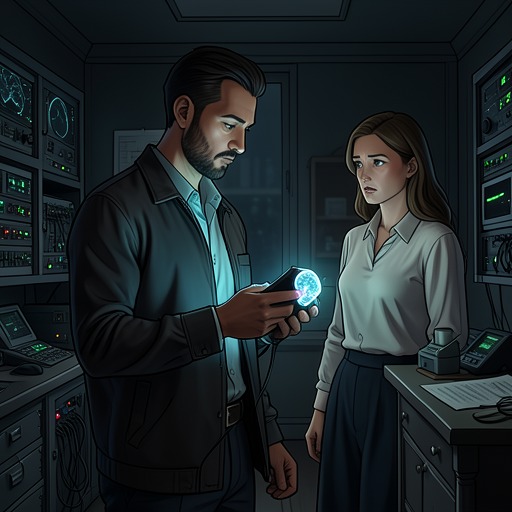
The Oceanarium keeps five dolphins and presents aquatic life to visitors through exhibits and performances. Its public-facing spaces include a main convention hall and an auditorium, while a veterinary center holds equipment used to lift dolphins from the water. The holding-tank room, where the dolphins are kept overnight, is a more restricted part of the facility. These different areas matter to Jasper not as a visitor but as a custodian: his access lets him imagine routes between the tanks, service areas, and the parking lot.
The attraction also includes Gogol-built robotic dolphins capable of answering questions about aquatic biology in more than fifty languages. Their presence places technological replicas beside the living animals, offering visitors an educational display while giving Jasper another reminder of the Oceanarium’s manufactured environment. For him, however, the robots are not equivalent to Bella. His attention remains fixed on the individual living dolphin, whose presence he invests with a future the evidence does not show her choosing.
Jasper’s Workplace
After the incident with Calla, Jasper travels north along the coast and uses stolen identification belonging to Larry Winkler to obtain a custodial position at the Oceanarium. The false identity is plausible enough for him to work under the name Winkler, although he sometimes needs a moment to respond when Tiny calls him by it. By the time of his plan, he has held the job for more than a year. Employment gives him both a cover and routine access to the grounds; Jasper also treats his working relationship with Tiny as something he may be able to turn into a future favor.
The work schedule shapes Jasper’s opportunities. When Tiny asks whether he can stay late on a Saturday, Jasper agrees, partly because he wants Tiny to feel indebted to him and partly because work distracts him from his fixation. An after-hours event could leave him near Bella’s tank once visitors have gone. But the location of the event changes what the shift means: a gathering in the convention hall might leave the pool area quiet, whereas an auditorium performance would mean the dolphins were moved to their nighttime tank. In that case, Jasper expects to clean beside an empty pool, still watching for the impossible possibility that Bella might somehow appear.
That Saturday’s performance is a concert by Dolphin Savior (Impostor Singer), with a special dolphin performance being choreographed to accompany it. For Jasper, the show turns the Oceanarium’s public schedule into a logistical obstacle. He has to wait for his shift to end and work around the movement of the animals, even as the event brings the dolphins into the very spectacle that sustains his attention.
The Planned Escape
Jasper’s scheme depends on equipment and access acquired through his job. He has bought a large, nondescript station wagon with cash and removed its back seats to make room for an elongated tailgating cooler. He has studied the measurements posted beside Bella’s tank and planned to keep her submerged during transport, then bring her to the bathtub in his studio apartment. From there, he imagines a temporary stay at a remote rental with a screened-in pool. He has paid a year’s rent and deposit in cash, using a crude prosthetic disguise when meeting the landlord; the rental’s advertisement suggests it might suit people evading substantial tax debts. Jasper imagines this as one stop in a repeated pattern of temporary homes, not a permanent settlement.
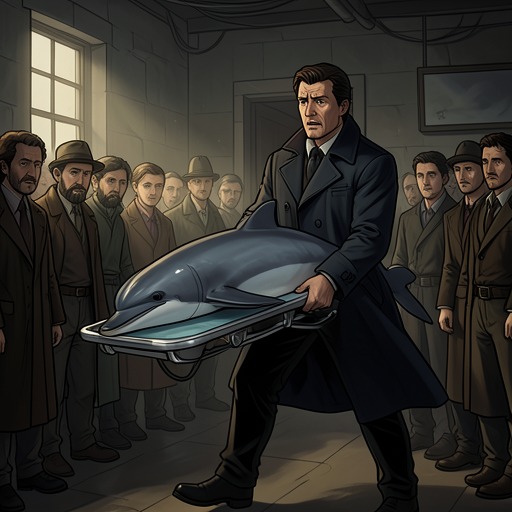
To move Bella, Jasper intends to use a dolphin-transport sling kept in the veterinary center, where his custodial keys can provide access. He plans to cover it with a tarp and avoid the security cameras where possible, trusting that his uniform may make the equipment look like discarded material when avoidance fails. He has also lined his bathroom with sound-capturing foam and acquired Gogol noise machines, hoping their static will conceal any sounds of distress. The preparations are meticulous, but they serve a plan built around Jasper’s wishes, not evidence of Bella’s consent or ability to share the life he has pictured.
Surveillance and the Unresolved Plan
Jasper has cultivated the daytime security guard, bringing him coffee, listening to his bowling jokes, and using friendly conversation to study the camera views displayed on the control panels. He learns that remodeling has created a blind spot beside an extended lip of the holding tank. His intended method is to draw the dolphins toward that area with sardines, place Bella in the sling while they are distracted, and move her to a car he estimates is only a three-minute trip away. He recognizes that her four-hundred-pound weight will make the journey difficult and has considered using the sling’s muzzle, though he dislikes the idea and wonders whether feeding her could keep her quiet instead.
When the time comes, Jasper covers the sling and himself with sheets and moves in brief stages, pausing between each action to evade the entrance camera. He rolls the frame beyond its field of view, reassembles it in the shadows, and pushes it along the tree line to the auditorium before reaching the holding-tank room. The dolphins are asleep. Seeing Bella in repose intensifies his arousal and disrupts his concentration; he goes to fetch buckets of treat fish, but finds walking difficult and questions whether he can proceed while so affected. The scene leaves the Oceanarium’s security breach—and Jasper’s intended removal of Bella—unresolved. Its back corridors and blind spots have made his plan imaginable, but the living animal at its center remains more than a piece of cargo in his imagined escape.