Roxy
Made for LoveRoxy is the redheaded doll Herbert names as one of the two companions who, he says, will keep him from being alone. She is not given dialogue, independent action, or a separate history; instead, the story makes her significance visible through Herbert’s attachment to the dolls and Hazel’s uneasy efforts to understand their place beside him. As a manufactured companion at the bedside of a terminally ill man, Roxy stands at the uneasy meeting point of artificial intimacy and human mortality.
Identity and Introduction
Herbert’s wish for another doll begins as something he refuses to explain. When Hazel asks what has changed, he fidgets with his robe and says that he needs another one; pressed no further, he insists that the decision is not up for discussion. Hazel, distracted by the apparent damage to Diane, initially misunderstands what he means. Herbert clarifies that Diane is fine: he wants two dolls. The exchange establishes Roxy’s place in the household through a request rather than through any action of her own. Herbert has stated a desire for a second companion before Roxy is named.
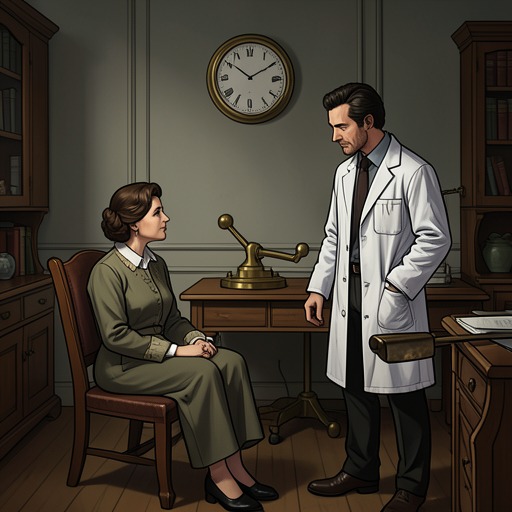
Later, Hazel arrives at Herbert’s house and finds him sitting between Diane and his newest doll, who is also a redhead. He rebukes Hazel for failing to knock. She puts a brick of cash on the coffee table and offers him roughly a year’s rent, then proposes taking him to Gogol’s medical facilities for cancer care. The new doll is present during this attempt to persuade him, but does not intervene or respond. Herbert’s attention remains on asserting control over his own life and explaining the company he has chosen.
Herbert’s Companions
Herbert takes Diane’s left hand and the other doll’s right, introduces the new arrival as Roxy, and says that he will not be alone because that is what the dolls are for. The gesture gives Roxy a place in a small, carefully composed group: Herbert holds a hand from each doll while rejecting Hazel’s appeal to accompany him for treatment. His announcement is both a naming and a declaration of how he intends to meet his isolation. The scene does not show Roxy answering him; her presence matters because he counts her as company.
The dolls’ stillness is especially conspicuous in Hazel’s account. Their expressions remain bubbly and unchanged while Herbert and Hazel discuss his cancer, his refusal of medical care, and the family’s strained history. Hazel imagines that they seem to have mistaken the argument for a cheerful conversation, or are trying to keep a party going despite the scuffle. Her response draws attention to the distance between a manufactured expression and the shifting emotional demands of the room. Roxy shares that fixed quality with Diane; the narrative offers no evidence that she can read or reflect the people around her.
Roxy at the Bedside
As Herbert’s condition deteriorates, his fever does not break and he cannot keep anything down. Hazel continues asking him to go to a medical center, but he refuses, even spitting on the floor to make his refusal emphatic. He tells her that he is not leaving and that no one is asking her to stay. Hazel wishes he would ask her to remain, yet recognizes that his decline is not producing the emotional delicacy she wants from him. In this strained interval, he has Hazel place Diane and Roxy in bed with him.
The arrangement gives Roxy a specific role in Herbert’s final illness: she remains at his side when he has chosen the dolls as his company. Hazel anticipates that his periods of unconsciousness will deepen and lengthen, and considers calling Byron when the time comes. She also knows Herbert would prefer to approach death alone rather than have his embarrassment witnessed by a living person. The dolls can stay with him without requiring care themselves, a quality Hazel considers while imagining whether lifelike mannequins could be adapted for hospice. She speculates that Roxy’s torso might open on command to serve as a bedpan chamber. This is Hazel’s bleak, practical imagining of a possible design, not a function the story establishes Roxy actually possesses.
Narrative Significance
Roxy’s limited characterization is part of her narrative function. She is named and physically placed among Herbert’s companions, but the available scenes provide no speech or expressed feelings from her. Instead, the contrast between her fixed, bubbly face and the family’s fear, frustration, and approaching loss makes the dolls’ artificiality visible. They can be present without asking anything of Herbert, while Hazel struggles to remain emotionally close to a father who resists both treatment and her company.
For Hazel, this proximity does not resolve her ambivalence. She finds it depressing, or perhaps personally disappointing, that even with her father fatally ill she remains unable to appreciate him as she wishes she could. She tries watching television on the bed with Herbert and the dolls, putting eye masks on them so they seem to be resting, peaceful and waxen. The tableau makes Herbert appear to Hazel as though he, too, were turning into a doll. Roxy therefore belongs not only to Herbert’s chosen household but also to Hazel’s perception of a deathbed where manufactured stillness and human bodily decline lie side by side. The narrative does not make Roxy a substitute for a human caregiver or claim that she understands grief; its force comes from the fact that Herbert accepts her presence while Hazel confronts what that presence can, and cannot, mean.