The Summer of the Dolphin Savior Search
Made for LoveThe Summer of the Dolphin Savior Search is the media spectacle that grows from Jasper’s rescue of a dolphin on the beach: an ordinary act becomes a viral image, a nationwide hunt for the rescuer, and an opportunity for an impostor to manufacture celebrity. Its central irony is that Jasper’s wish to vanish and the public’s hunger to identify a hero develop at the same time, while the person who ultimately benefits from the story is not its real participant.
From Beach Rescue to Public Search
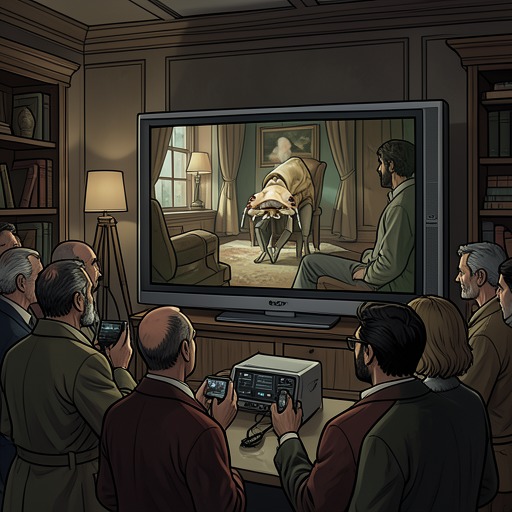
The search begins with footage and photographs of Jasper holding the dolphin after helping it ashore. People on the beach raise their Gogol cell phones to record him, and a woman calls out that he has saved the animal. Jasper responds modestly, but the moment is already being turned into a public image. News outlets report that the dolphin is healthy and had become separated from its pod; they give the unidentified rescuer the name Dolphin Savior.
The image travels quickly. A photograph of Jasper with the dolphin, captioned with his dismissive response, circulates as a meme, while a five-second clip attracts millions of views. Jasper has not yet been identified, but viewers want to know who he is. The coverage makes his appearance part of the story: commentators describe him as attractive, and some joke about staging a water emergency to draw him out. The rescue’s public meaning thus expands beyond the dolphin’s condition into entertainment, speculation, and fantasies about the anonymous man.
Jasper Disappears, Others Claim His Identity
Jasper leaves the beach as onlookers gather around the dolphin, and the crowd’s attention gives him a chance to get away. He returns to his motel room without being followed. There, the news of his sudden notoriety sharpens a more personal fear: that someone he previously deceived might recognize him and come after him. The search is not merely a story he can watch from a distance; it threatens to connect his public image to the identity he is trying to conceal.
As the hunt continues, multiple men come forward claiming to be the rescuer. Some resemble Jasper more than others, and a televised claimant is challenged over the absence of tattoos visible in the beach photographs. Women also appear on television saying that they know the man and that he dated them and took their money. Their accounts point toward a pattern of similar-looking men using different names, complicating the public’s effort to match one face to one identity. Jasper takes some reassurance from the confusion: the search has not made him easy to find, and the competing claims may have helped keep attention from settling on him.
The Impostor’s Song and Manufactured Fame
A struggling musician eventually claims to be Dolphin Savior. His explanation, repeated in the story Tiny tells Jasper, is that a concussion caused temporary amnesia and that he remembered the rescue only later. He says he had written a personal song about the experience without intending to release it. Jasper recognizes the account as a fabrication, but the story offers the public the emotional arc it wants: a rescuer who disappears, forgets, then returns with a song.
The musician’s video, titled Saving You Saved Me, makes that account into a polished spectacle. It depicts a dolphin receiving hospital treatment and presents the singer as a dramatic, attractive rescuer. The song itself has already been playing in the Oceanarium food court, though Jasper had not paid attention to it before realizing what it was about. The impostor’s version does not simply claim Jasper’s identity; it converts the rescue into a marketable narrative and gives the supposed rescuer a platform.
The celebrity story acquires a quasi-religious following. The musician’s fans call themselves melon heads and call him their followers; some travel along the coast to his concerts, while their stated mission is to find things to save. Tiny describes the movement as increasingly cultlike, with examples ranging from collecting discarded objects to capturing insects for release elsewhere. The rescue has become a flexible symbol that supports a commercial music career, a fan identity, and a broader performance of goodness.
Consequences and Narrative Significance
At the Oceanarium, Tiny recounts the summer’s events to Jasper, who is working to arrange a new life and plan Bella’s rescue. Jasper is distressed that the false claimant has taken over the public story, but he is also relieved that the search has not exposed him. His private knowledge—that the musician’s account is false—stands against the more satisfying story accepted by viewers. The gap between truth and fame protects Jasper even as it frustrates him.
The episode shows how public visibility can detach a person’s image from the person himself. Beach footage supplies a recognizable figure; news coverage names him; claimants and witnesses compete to explain who he is; and a musician turns the resulting uncertainty into a hit and a following. Later, Hazel also avoids searching for her own name or for Byron and Fiffany online, wary that searches could make her easier for Byron’s algorithms to locate. That later caution gives the search’s publicity a darker counterpoint: in this world, attention can create celebrity, but it can also make a person trackable. The summer’s media frenzy therefore belongs both to a comic impersonation story and to a larger narrative in which identities circulate beyond their owners’ control.