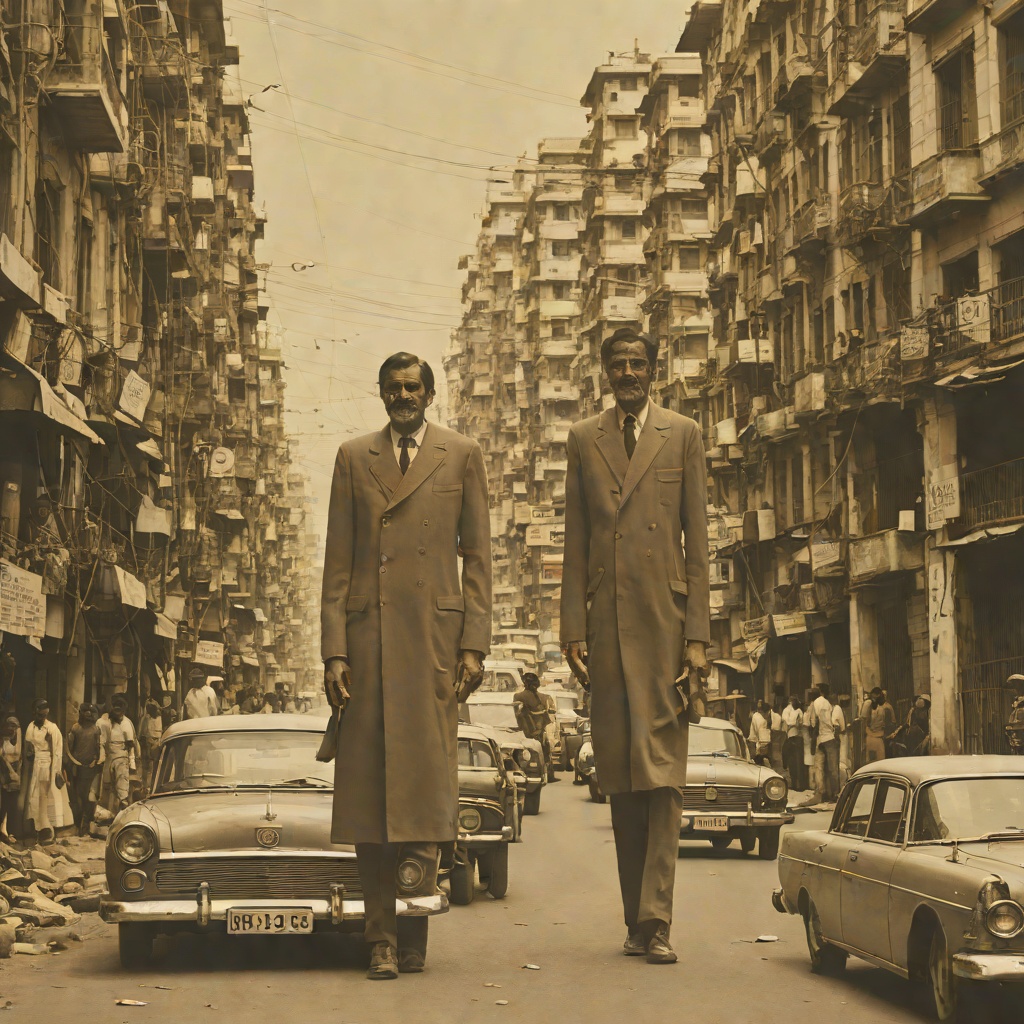
Belassis Road
Mafia Queens of MumbaiBelassis Road, also rendered as Bellasis Road, is a central Mumbai artery that runs through the city's most contested criminal geography. The road lies at the precise intersection of the territories controlled by the Pathan gang and the Ibrahim brothers, making it a strategic prize in the underworld's shifting balance of power. Its significance in the history of the Mumbai mafia is defined less by what happens on its surface than by what it represents: a boundary line between rival factions, a site of legal and illegal contestation, and a threshold between the respectable city and the red-light district of Kamathipura that abuts it.
Location and Urban Context
Belassis Road sits at the centre of a triangle formed by three of Mumbai's most notorious criminal strongholds. To one side lies Grant Road and VP Road, the domain of the Pathans, while to the other lies Nagpada, the stronghold of the Ibrahim brothers. The road itself runs through the area that connects these territories, and its position made it a natural flashpoint for gang rivalry. The area around Belassis Road is part of the larger Dongri region, which was originally part of the island of Mumbai before the hills were levelled in the mid-1700s to merge the city's seven islands. After the levelling, the low-lying patch of uneven land between Crawford Market in the north and the reclaimed lands of Kamathipura in the south came to be called Dongri, and Belassis Road runs through this historically contested ground.
The road's proximity to Kamathipura, the city's most famous red-light district, further defined its character. In the 1950s and '60s, commercial sex workers occupied the western strip of Kamathipura between Suklaji Street, Manaji Rauji Street and part of Foras Road, and the area's boundaries were strictly observed. Sex workers did not cross Manaji Rauji Street or pass through the central and eastern areas of Kamathipura, as people in the area did not like it. Belassis Road marked the edge of this world, a liminal space where the respectable city met the underworld.
The Property Dispute and the Alliance of Gangs
The most consequential event associated with Belassis Road occurred when Haji Mastan, one of Mumbai's most dangerous personalities, set his sights on a huge property on the road in Bombay Central. The land was owned by the Chiliyas, who refused to budge, and Mastan saw the plot as a gold mine that would allow him to repay all his debts and be set for life. He brought his problem to Jenabai Daaruwali, the woman he called Aapa, who had become his trusted counsellor and sister figure.
Jenabai's solution was audacious. She proposed that Mastan bring together the two rival gangs — the Pathans and the Ibrahim brothers — as one force against the Chiliyas. Mastan was astonished at the suggestion, believing that a truce between the two gangs was impossible in the present scenario. But Jenabai pointed out that the Belassis Road property lay exactly in the centre of Grant Road, VP Road and Nagpada, and that uniting the gangs would create a force that even the government would stand no chance against. The alliance would not only help Mastan secure the property but also ensure that it was well protected. Mastan was surprised at her observation and conceded that she was right.
The scheme revealed the strategic logic of Belassis Road's location. Whoever controlled the road controlled the junction of the city's criminal territories, and Jenabai's plan to unite the gangs was a recognition that the property's value lay not just in the land itself but in the power it conferred over the surrounding neighbourhoods.
The School and the Red-Light District
Belassis Road was also the site of a very different kind of contestation. St Anthony's Girls' High School, built in the early 1920s, had its entrance from Bellasis Road, and the school building at the rear overlooked Kamathipura 14th Street, which was then inhabited by over 250 sex workers who could be seen from the upper floor of the building. In early 1960, the school authorities and locals living in the vicinity of Kamathipura wanted part of the red-light belt evacuated, arguing that sex workers could have a negative influence on the minds of young students. The school authorities cited that prostitution could not be carried out within two hundred yards from an educational institution.
A strong movement picked up against the presence of the red-light zone, with constant agitations and meetings with the civic authorities, but both parties refused to budge from their position. When the anti-prostitution sentiment swelled, the sex workers sought Gangubai Kathiawadi's help, and she successfully spearheaded the movement against the evacuation of sex workers from the belt. The confrontation on Belassis Road thus became a defining moment in Gangubai's rise to prominence, as her speech was reported widely in several regional newspapers and she rose suddenly to stardom. Several ministers and journalists visited her, impressed by her courage in fighting the system and trying to decriminalise prostitution.
The Road in the Underworld's Wider Geography
Belassis Road's significance extends beyond its own boundaries, as it connects to the broader geography of Mumbai's underworld that the book maps in detail. The road lies in the same urban fabric as Bada Qabrastan, the sprawling 7.5-acre cemetery near Marine Lines that serves as a reminder of man's mortality and a resting place for the city's gangsters. It is also connected to the network of slums and criminal hubs that dot the city, from Sonapur Lane near Reay Road station, where Jyoti Adiramalingam reigned as the drug baronness, to the Sion-Koliwada slum, where Mahalaxmi Papamani built her drug empire.
The road's position at the centre of the city's criminal geography made it a natural reference point for the movements of the underworld's most powerful figures. Haji Mastan, who had come to Mumbai in 1934 and started as a mechanic before becoming a coolie at the docks in 1944, had built his fortune smuggling gold, silver ingots and electronic goods, and his villa, his Mercedes and his tremendous influence were all off-shoots of the enormous wealth he had hoarded illegally. The Belassis Road property was to be the culmination of this rags-to-riches trajectory, a legitimate anchor for his illicit empire.
Significance
Belassis Road functions in the book as a synecdoche for the Mumbai underworld itself: a place where the city's criminal factions meet, where the law is contested, and where the boundaries between the respectable and the illicit are constantly being redrawn. Its dual role — as the site of Mastan's property ambitions and as the location of the school that sought to push out the sex workers — captures the tension at the heart of the city's relationship with its underworld. The road is both a prize to be won and a line to be defended, a place where the forces of criminal enterprise and social respectability collide. In the book's mapping of Mumbai's criminal geography, Belassis Road stands as a reminder that the city's most significant battles are often fought not in the open but at the margins, where the territories of gangs, the claims of institutions, and the lives of the marginalised all intersect.