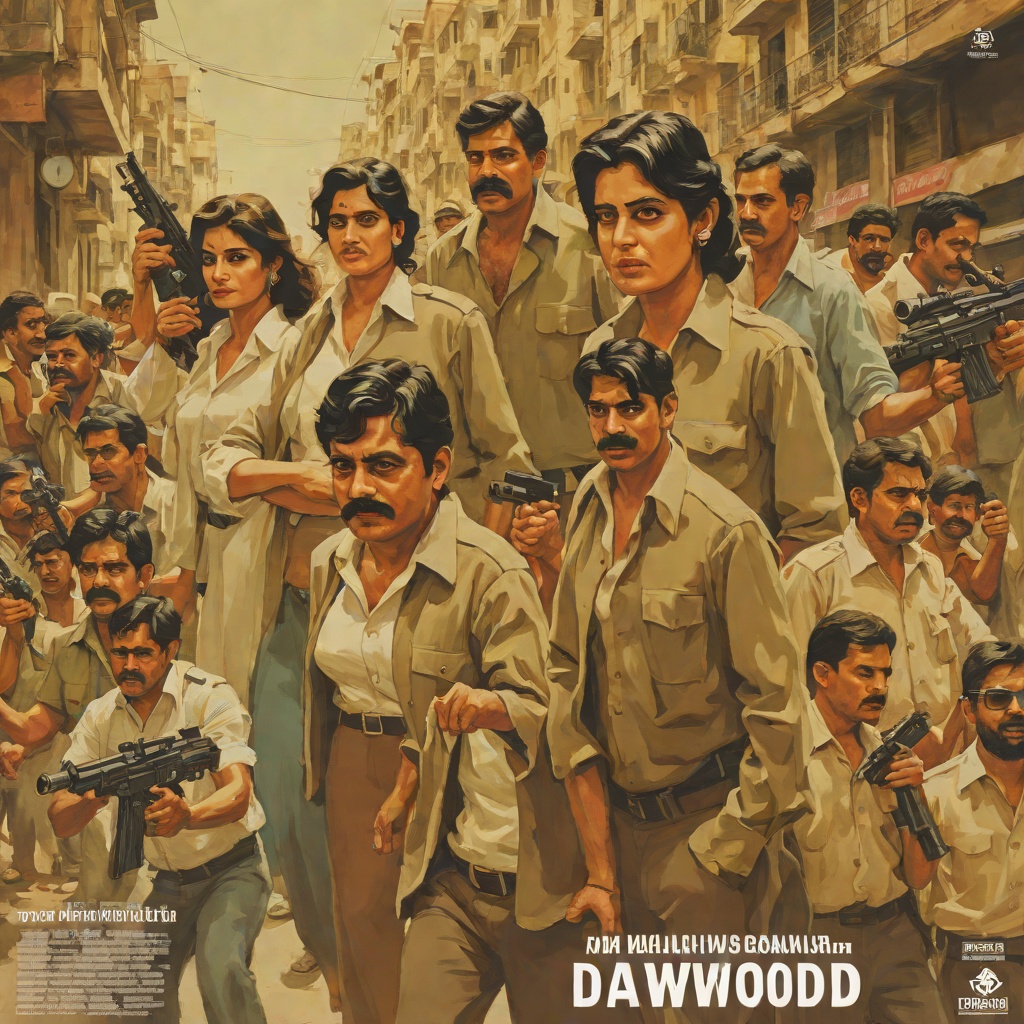
D-Company
Mafia Queens of MumbaiD-Company, the underworld syndicate built by Dawood Ibrahim, stands at the center of Mumbai's criminal history as the organization that consolidated the city's fragmented gang power into a single transnational enterprise. Known interchangeably as the D-gang or the Dawood gang, it emerged from the same smuggling milieu that produced the city's earlier don generation, yet surpassed them all in scale, wealth, and reach. The organization's story is inseparable from the women who orbited it, resisted it, and ultimately ran its affairs, making it both a masculine empire of violence and a structure that depended on female labor, loyalty, and leadership.
Origins and Rise
The roots of D-Company lie in the smuggling economy that flourished in Mumbai after the Partition of India, when the city became a hub for illicit trade across the Arabian Sea. The generation that preceded Dawood established the template: Haji Mastan, who arrived in Mumbai in 1934 and worked as a cycle mechanic before becoming a dock coolie in 1944, amassed millions from smuggling gold, silver ingots, and electronic goods, and joined with Karim Lala and Vardharajan Mudaliar to form one of the city's most formidable gangs. This older network, built on the docks and the gold trade, created the infrastructure of corruption, violence, and cross-border connections that Dawood would inherit and expand. The D-gang's power was thus not a rupture but an intensification of existing patterns, with Dawood taking the smuggling enterprise to a new level of organization and ruthlessness.
Structure and Operations
At its height, D-Company operated as a diversified criminal corporation with interests spanning the Indian Ocean world. Its smuggling routes connected Mumbai to Dubai, Hong Kong, and Aden, moving gold, electronics, and eventually arms across borders. The organization's reach extended into Nepal, where its consignments of weaponry were channelled through the town of Birganj, a route that required passing through Raxaul in Bihar, a hub for cross-border smuggling of arms, electronic goods, drugs, and fake currency. Within Mumbai, the gang's influence penetrated the slums, where drug networks flourished under its protection. The Sion-Koliwada slum, built by Vardharajan Mudaliar's illicit hooch distillery and his recruitment of impoverished Tamilians from Salem, became a drug den where heroin was divided into small packets and sold for profit, a trade that D-Company's associates controlled and taxed. The organization's power was also spatial, rooted in the Muslim neighborhoods of Bhendi Bazaar, Dongri, Nagpada, Dharavi, and Mumbra, areas that the state labelled 'sensitive zones' during the 1992-93 riots, where the gang's presence was both a source of protection and a target of police suspicion.
The 1993 Fracture
The defining moment in D-Company's history came in 1993, when Chhota Rajan, Dawood's most trusted lieutenant, split from the organization and went into hiding in Southeast Asia. Rajan had risen through the ranks after taking over the gang of Rajan Nair, alias Bada Rajan, and affiliating himself with Dawood, at whose behest he handled all the D-gang's activities in Mumbai. His defection was a catastrophic blow, dividing the underworld into warring factions and triggering a series of betrayals and killings that would reshape the city's criminal landscape. The split also had profound consequences for the women connected to the gang. Rajan's wife, Sujata Nikhalje, flew back to India with her three young daughters and was pushed into taking up the reins of her husband's illegitimate empire, expanding his extortion business and supervising his gang from her home in Tilak Nagar. The fracture thus transformed a housewife into a corporate don wife, a transformation that would have been unthinkable within the unified D-Company structure.
Women and the Gang's Economy
The women of D-Company's orbit were not passive bystanders but active participants in its economy, often out of necessity. Sujata, known as Nani because she was the wife of Rajan, alias Nana, built her own construction company, Khushi Developers Private Ltd, named after her youngest daughter, and used her husband's goons to terrorise builders into selling their homes, transforming Tilak Nagar into a plush suburban locality. Her brother-in-law, Deepak Nikhalje, had earlier faced allegations of using his brother's money to fund the film Vaastav, a scandal that deterred Sujata from investing in Bollywood and pushed her toward real estate instead. The gang's violence also created widows and victims, as when Sapna Didi, a woman who dared to stand up against Dawood, was given a dastardly death by the don's acolytes, her twenty-two stab wounds including four specifically targeted at her private parts, a grisly warning to other women not to dally with the mafia. The organization's gender dynamics were stark: it was much easier to be a Dawood Ibrahim than a Jenabai Daaruwali, and while the gangs of the Chhotas produced clones galore, a woman like Sapna was rare and paid for her audacity with her life.
Legacy and Decline
The legacy of D-Company is one of immense power and inevitable decay. The organization that once controlled Mumbai's underworld from Dubai, with Dawood relocating there while his rivals aged and died, eventually saw its empire fragment into the Chhota Rajan gang and the Chhota Shakeel gang, each a shadow of the original. The state's response, from the Directorate of Revenue Intelligence to the Crime Branch and the Enforcement Directorate, kept constant tabs on the gang's associates, and the police tapped phone lines and filed complaints that slowly closed in on its operations. The organization's transnational reach, which once made it seem invincible, also made it vulnerable, as international cooperation led to arrests and extraditions that dismantled its networks. Yet the D-gang's impact on Mumbai endures, not only in the buildings and slums it shaped but in the women it made and unmade, from the wives who ran its finances to the victims who defied it and died. The organization stands as a testament to the brutal logic of the underworld, where power is built on violence and sustained by the labor of those who are never credited with it.