Demolition of the Babri Masjid
Mafia Queens of MumbaiThe Demolition of the Babri Masjid on 6 December 1992 stands as the catastrophic historical rupture that frames the book's account of Mumbai's underworld and its women. The event, which occurred in Ayodhya, sent violent aftershocks through the island city of Bombay, shattering its reputation as a smorgasbord of diverse religions and plunging it into politically-motivated and planned rioting between Hindus and Muslims. The demolition is not merely background noise; it is the catalyst that exposes the fragility of the city's communal fabric and forces the book's central figures—particularly the aging bootlegger Jenabai Daaruwali—into their most consequential and revealing actions.
The Communal Aftershock in Bombay
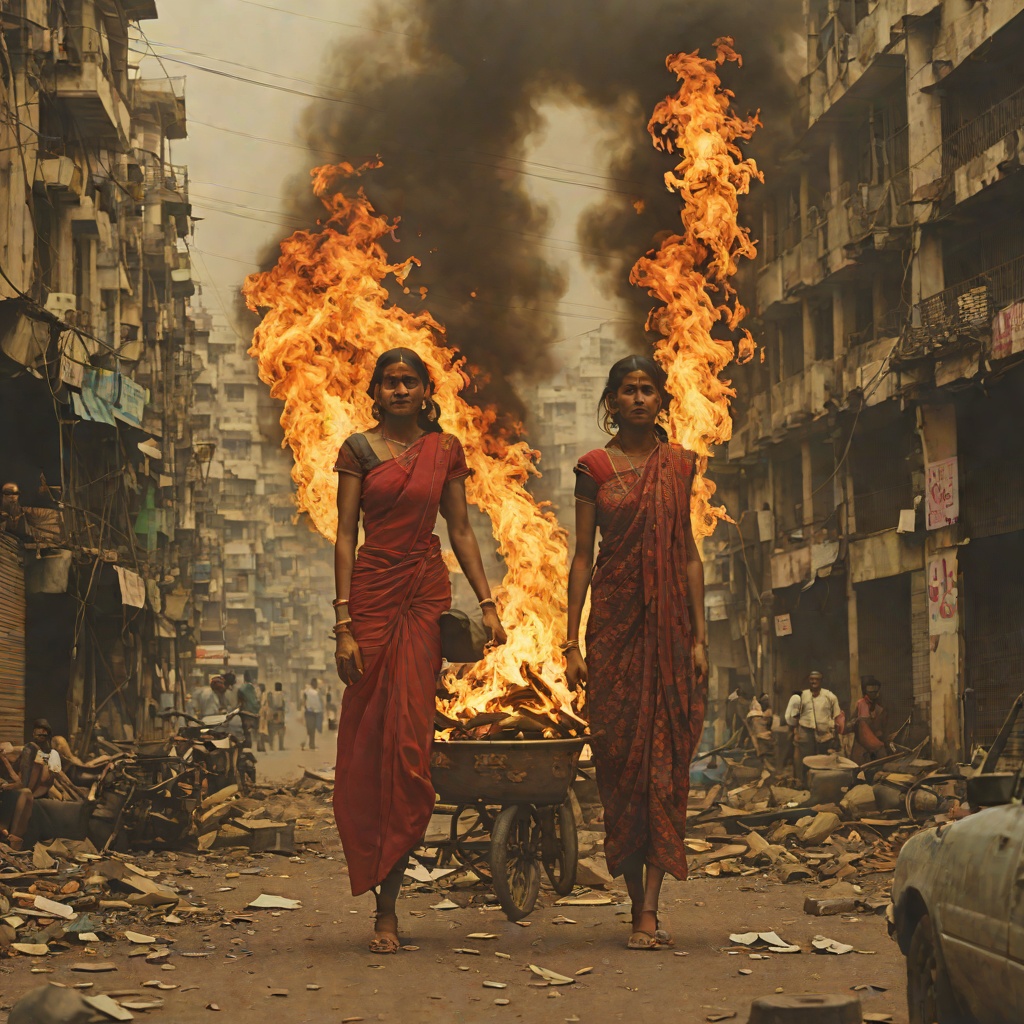
The demolition of the Babri Masjid triggered what the book describes as violent aftershocks in Bombay, leading to the systematic slaughtering of people from both communities. Several hundreds were killed and thousands rendered homeless by rampaging, angry mobs, with the city literally burning in the fire of religious discord. The army, unable to control the riots, was forced to declare curfew. Specific Muslim locations—Bhendi Bazaar, Dongri, Nagpada, Dharavi, and Mumbra—became epicentres for all the wrong things that occurred in the city. Labelled as 'sensitive zones', these areas saw tremendous bloodshed and destruction. The riots thus redrew the map of Bombay along communal lines, turning neighborhoods that had once been mixed into battlegrounds and transforming the everyday spaces of the city into sites of terror.
Jenabai's Last Stand in Dongri
Amidst this chaos, an old, fragile-looking, seventy-two-year-old woman alone took the lead in bringing peace back to Dongri. Jenabai Daaruwali, whose power centres in the underworld were fading fast, found herself stripped of the authority she had once wielded. Top mafia bosses Karim Lala and Mastan were old and ailing and living a retired existence, while Vardharajan Mudaliar had long since died after retreating to Chennai in 1988. Reigning ganglord Dawood Ibrahim had also relocated to Dubai. As far as wielding power was concerned, she was left with nothing. Yet it was precisely at this moment of powerlessness that Jenabai's moral authority emerged most forcefully, as she stepped into a vacuum left by the men who had once dominated the city's criminal landscape.
The Suleman Usman Bakery firing on 9 January 1993 was the last straw for her. The Special Operation Squad (SOS), suspecting terrorists were holed up on the terrace of Suleman Usman Bakery, had—under the direction of joint commissioner of police R.D. Tyagi—opened fire inside the bakery. Jenabai had peered through her windows and heard the gunshots and helpless cries of people from inside the bakery; she was spectator to one of the most gruesome and unwarranted killings by the police. The firing had resulted in the death of nine Muslims, but the police failed to apprehend terrorists or seize firearms from the spot; the truth being that there were neither. This police action, which killed innocent civilians under the pretext of counter-terrorism, transformed Jenabai's grief into determination.
Now, even a hundred warnings by the forces would not shake her determination to step out of her home. In her long white chikan nightgown and a shawl that covered the grey in her hair, this fair and heavily jewelled lady, with a rosary in one hand and a white flag in the other, went out onto the street. In a few seconds, a group of young men had gathered behind her as she led the demonstration. She walked between the torched lanes of Dongri towards the Pydhonie junction, unconcerned about danger. The junction with the Hamidiya Masjid on the right, Khatri Masjid on the left and three Jain Derasars, had become the dividing line for the two wounded communities. The Pydhonie police station, a gift of the British era, stood at right angles from these religious houses. When she reached the junction, she stopped. This image—an elderly woman in a nightgown carrying a white flag and a rosary, walking unarmed into the heart of communal violence—stands as the book's most powerful counterpoint to the masculine violence of the riots and the underworld alike.
The Broader Context of Communal and Criminal History
The demolition and its aftermath must be understood against the longer history of communal and criminal dynamics in Bombay that the book traces. Dongri, where Jenabai lived and marched, was initially part of the original island of Mumbai, which stretched from Malabar Hill to the Dongri hills. In the mid-1700s, the Dongri hills were levelled as part of the plan to merge the different islands of Mumbai, and the low-lying patch of uneven land between Crawford Market in the north and the reclaimed lands of Kamathipura in the south came to be called Dongri. By the time of the riots, Dongri was choc-a-block with rickety, old buildings, falling partially below the gigantic JJ Flyover and primarily dominated by Muslims. The area's bazaar, with its Iranian and Afghani restaurants, bakeries and sweetmeat shops selling mawa cakes, hot jalebis, kheer and gulab jaamuns, represented a vibrant Muslim commercial culture that the riots threatened to destroy.
The book's broader project—understanding the complex minds and psyche of women criminals—is directly shaped by the communal violence that the demolition unleashed. The author notes that these women were not blank slates written upon by dangerous male mafia members, and that crime was not only a way of transcending their poverty and limitations but also a life-saving concept. The riots, by destabilizing the city and its communities, created both new dangers and new opportunities for these women. Jenabai's peace march, in particular, shows how a woman criminal could transcend her criminal identity to become a moral leader in a moment of communal crisis, pushing the boundaries of the dominant moral codes that the book seeks to examine.
The Legacy of the Demolition in the Book's World
The demolition of the Babri Masjid and the subsequent riots left a lasting imprint on the world the book describes. The communal divisions it exposed and deepened would continue to shape Mumbai's underworld and its politics long after the fires were extinguished. The event also serves as a temporal marker in the book's narrative, occurring just a few years before the island city of Bombay became Mumbai. This renaming, which the book notes with a kind of elegiac precision, signals the end of an era—the era of the old underworld bosses like Karim Lala and Mastan, the era of Jenabai's kind of power, and the beginning of a new, more fragmented and more violent phase in the city's criminal history. The demolition thus functions as both a historical event and a symbolic rupture, marking the transition from one world to another and providing the backdrop against which the book's thirteen women criminals must be understood.