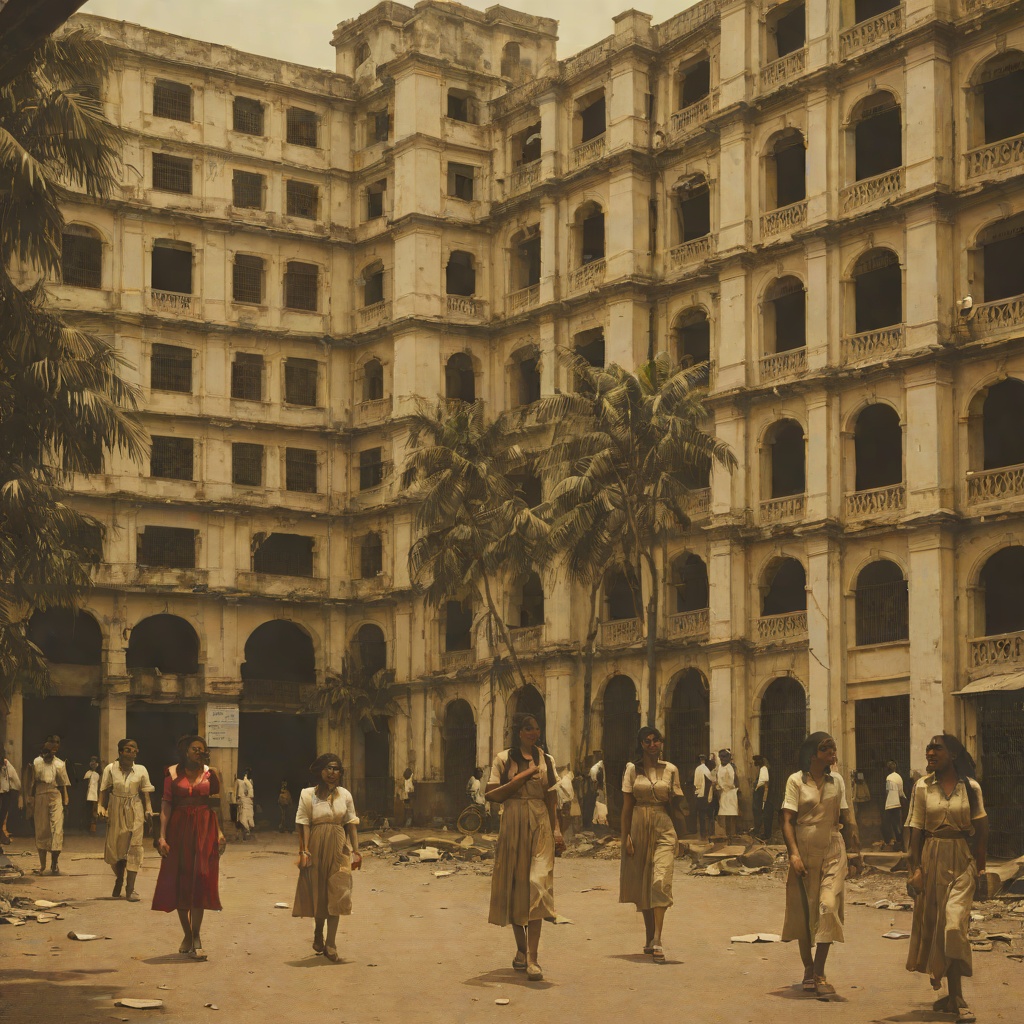
Gharwali, not ghar todnewali
Mafia Queens of MumbaiGharwali, not ghar todnewali is the defiant self-declaration made by Gangubai Kathiawadi, the brothel madam of Kamathipura, in her landmark speech at Azad Maidan. The phrase, which translates as 'I am a brothel madam, not a home wrecker,' became the cornerstone of her public identity and a powerful reclamation of a stigmatized title, framing sex work as a protective social institution rather than a moral failing. It is a statement that encapsulates the book's central argument that these women were not passive victims but active agents who pushed the boundaries of dominant moral codes, using crime as a means of transcending poverty and even as a life-saving concept.
The Speech at Azad Maidan
The phrase was born in a moment of public confrontation. Gangubai had been invited to speak at a women's conference at Azad Maidan, a meeting called in support of the girl child and the empowerment of women, attended by women from several leading political parties, NGOs, and other organizations. The organizers had asked her to speak on the condition of women in brothels, but when she was introduced as the 'president of Kamathipura,' she was met with suspicion. Dressed in a white cotton saree, Gangubai sensed the animosity of the crowd. She had been nervous when she ascended the stairs to the podium, having never spoken in public before and having rehearsed her speech several times during the day. Yet, standing before the large crowd and hearing the murmurings against her, she felt unprepared but also more determined to prove her point, and her nervousness subsided.
It was then that she stunned her organizers and the audience with her opening line: 'I am a gharwali (a brothel madam) not a ghar todnewali (home wrecker). Several people among you look at this title as a stigma on womanhood but it is this stigma that has saved the chastity, integrity and morality of several thousands of women.' The crowd grew silent. She continued, arguing that the streets of Mumbai were safer than other Indian cities because the 'notorious women of Kamathipura' should be partly credited for this. She claimed that by catering to the carnal pursuits of men, sex workers were doing a big favour to all women in society, protecting them from attack and blunting 'bestial male aggression.' She drew a parallel between prostitutes and the jawans of the country, who fight endlessly in the battlefield so that others remain unharmed, asking why one is rewarded with national honours while the other is looked down upon.
Reclaiming the Title
The power of the phrase lies in its reclamation of a stigmatized identity. Gangubai did not reject the label of 'gharwali' but embraced it, redefining it as a position of social utility rather than shame. She positioned herself and her fellow sex workers as 'second to the legitimately married gharwalis (housewives),' arguing that their work was a form of protection for the institution of marriage and the safety of other women. This rhetorical move transformed a term of abuse into a badge of honour, asserting that the stigma attached to their title was, in fact, the very thing that preserved the 'chastity, integrity and morality' of thousands of women. The declaration was a direct challenge to the moral codes of the society that condemned them, and it established Gangubai as a formidable public figure who could command a crowd's attention and silence its hostility.
A Life of Advocacy and Authority
The speech was not an isolated act but a culmination of Gangubai's established authority. She was a renowned brothel madam who owned several brothels and had immense influence over the women who worked in them. Her power was visible in her daily interactions, as when she visited the recalcitrant sex worker Madhu. A five-foot-tall Gangubai, dressed in a white saree, got out of her car and climbed the steps to Madhu's room, while other sex workers bowed in respect when they saw her enter the building. She entered the room, latched the door, and ordered everyone to give her privacy, ignoring the specially placed chair to sit beside Madhu on the cot. This authority extended beyond the brothels. When anti-prostitution sentiment swelled in the early 1960s, with the authorities of St Anthony's Girls' High School and locals wanting part of the red-light belt evacuated, sex workers sought Gangubai's help, and she successfully spearheaded the movement against their eviction. Her political connections were so strong that she won an appointment with the then prime minister of India, Jawaharlal Nehru, at his residence in New Delhi, becoming the only local brothel madam to secure an appointment with the head of the country.
The Legacy of the Phrase
The spirit of Gangubai's declaration resonates throughout the book's other portraits of women who defied convention. It echoes in the story of Tarannum Khan, the pin-up girl of Mumbai's Deepa Bar and Restaurant, who captivated her audience with her performance, drawing the attention of every admirer in the room. It is present in the figure of Rubina Siraj Sayyed, the 'Pathan' woman in Byculla Women's Jail, who was addressed as 'heroine' by her fellow jail mates despite her brusque demeanor. The phrase also finds a parallel in the transformation of ganglords' wives, who shed their timid and cocooned selves to become conniving, ambitious, and sharp women, taking their place in the world of organized crime. Gangubai's declaration, therefore, stands as a foundational statement of female agency in the underworld, a refusal to be defined by the men who sought to control them or the society that condemned them. It is a testament to her unique ability to turn the language of her oppressors into a weapon of self-assertion, a legacy that outlived her and defined her as the Queen of Kamathipura.