Indian independence movement
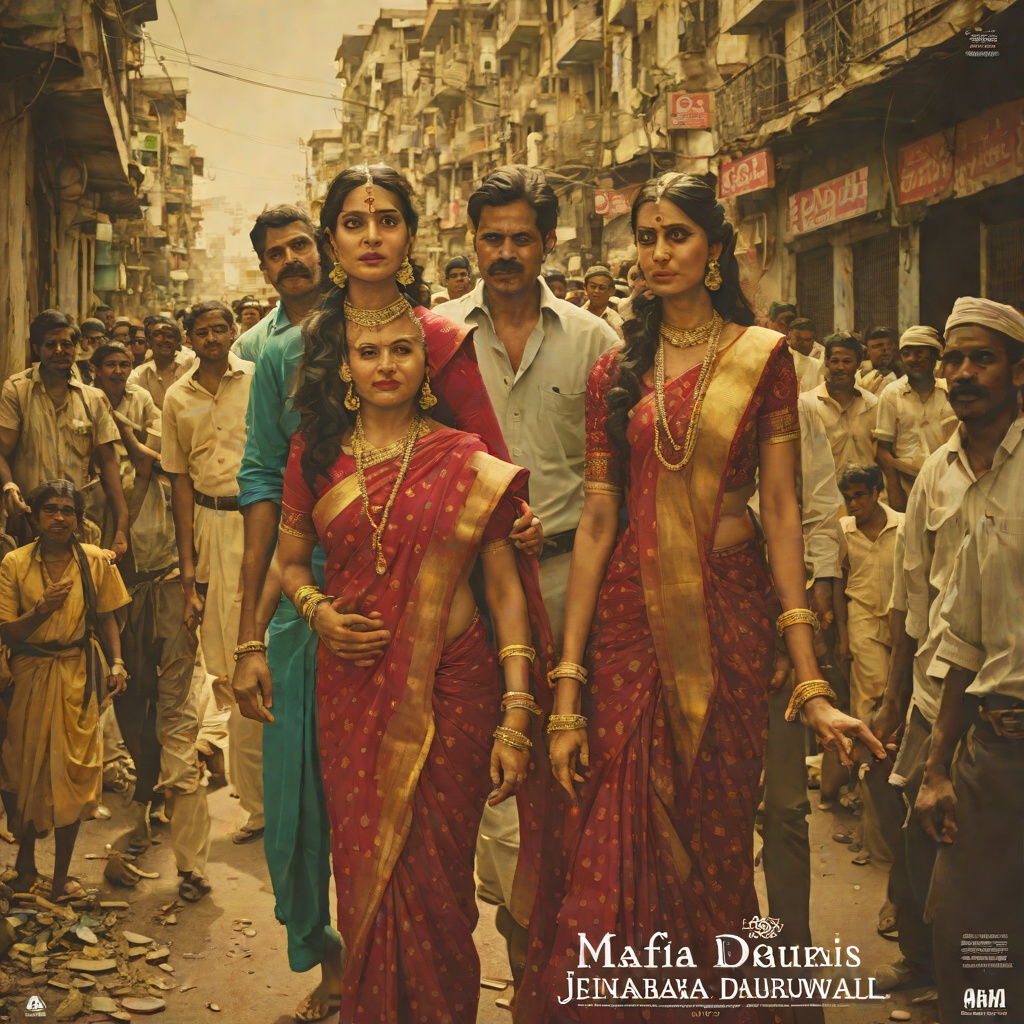
Mafia Queens of MumbaiThe Indian independence movement, the decades-long struggle against British colonial rule, forms the foundational historical context for the lives of the women chronicled in Mafia Queens of Mumbai. The book repeatedly returns to this era not merely as background, but as a formative force that shaped the moral and political identities of its subjects. For the women of the underworld, the movement was a crucible in which their earliest public identities were forged, long before they became figures of crime. The narrative draws a direct line from the streets of the freedom struggle to the lanes of the Mumbai underworld, suggesting that the courage and defiance these women later displayed in criminal enterprises were first honed in the service of national liberation.
Jenabai Daaruwali and the Gandhian Struggle
The most direct and detailed connection between the independence movement and the book's subjects is found in the life of Jenabai Daaruwali. Born in the early 1920s to a Muslim Memon Halai family in Dongri, Jenabai was a young girl during the height of the Gandhian movement. Her conservative Muslim background did not deter her from participating in the struggle for freedom. Since she did not attend school, she spent most of her day in sloganeering, ardently supporting the cause of Independence. Dongri itself was one of the hubs for the independence movement in the early 1920s and '30s, where both men and women, regardless of religion, took to the streets for the cause of freedom. Jenabai was one among them, and her participation continued even after her marriage at fourteen to Mohammad Shah Darwesh. Her husband, who ran a small timber business, would often beat her for protecting Hindus during the communal turmoil triggered by the British policy of divide and rule.
The movement's climax, the Partition of India in 1947, became a defining moment in Jenabai's life. When her husband decided to move to Pakistan, Jenabai, who had spent much of her childhood and youth struggling for Independence, refused to leave Mumbai. Her husband moved to Pakistan without her, leaving her alone to fend for herself and her five children. This refusal to abandon the city she had fought for marked the beginning of her independent life, which would eventually lead her to become a bootlegger and a powerful figure in the Mumbai underworld. The irony is stark: the same woman who participated in the freedom struggle with Mahatma Gandhi would later be remembered as the queen of the underworld, a transformation that astonished even the journalist who uncovered her past.
The Movement as a Moral Counterpoint
The book uses the independence movement as a moral counterpoint to the criminal lives of its subjects. When the journalist first learns of Jenabai's past as a freedom fighter, her reaction is one of disbelief: 'What are you saying? Then how did she become the queen of the underworld?' This question encapsulates the book's central tension. The author's introduction explicitly states that the book is an attempt to understand the complex minds and psyche of women criminals, and that these women were not blank slates written upon by dangerous male mafia members. The independence movement provides a legitimate, heroic origin for these women, complicating any simple moral judgment. Jenabai's later status as a figure held in high esteem by both the police and the mafia, and her role as a surrogate mother to Dawood Ibrahim, can be traced back to the moral authority she cultivated during the freedom struggle.
The contrast between the noble cause of independence and the criminal enterprises of the women is a recurring theme. The book suggests that for these women, crime was not only a way of transcending their poverty and limitations but also a life-saving concept. The independence movement, with its promise of a new nation, stands in ironic contrast to the realities of post-independence Mumbai, where poverty and lack of opportunity drove women into the underworld. The movement's ideals of justice and freedom are implicitly measured against the harsh conditions that followed, conditions that made crime a rational choice for survival.
The Legacy of the Movement in Later Generations
The influence of the independence movement extends beyond Jenabai to shape the political ambitions of later generations of underworld figures. The book notes that in 1996, when Arun Gawli was imprisoned under the Terrorist and Disruptive Activities Act, he mentioned his aspirations to join politics, specifically to save himself from a police encounter. His wife, Asha Gawli, had stood for civic corporation elections the previous year, hoping her political standing would help her husband, but she lost. This turn toward politics echoes the earlier participation of figures like Jenabai in the independence movement, suggesting a continuity of political engagement, albeit with vastly different motives. The movement's legacy of political activism is thus repurposed by the underworld, as figures like Gawli and his wife sought to use the political system for protection and legitimacy.
Asha Gawli's later political work, including filing her husband's nomination papers for the Legislative Assembly elections of 2009 and campaigning on his behalf, further illustrates this repurposing. While Arun spent most of his time as an MLA in jail, Asha redressed the grievances of the people in the locality, knowing that only their satisfaction could give her husband another shot at the seat. This grassroots political work, reminiscent of the door-to-door activism of the independence era, was nonetheless funded by the gang's resources. The movement's legacy of political mobilization is thus transformed into a tool for criminal self-preservation, a development that underscores the book's complex view of how the ideals of the independence movement were absorbed and distorted in the decades that followed.
The Movement as a Spatial and Historical Marker
The independence movement also functions as a spatial and historical marker in the book's geography of Mumbai. Dongri, where Jenabai lived, was initially part of the original island of Mumbai, and its hills were levelled in the mid-1700s as part of the plan to merge the different islands. By the early 1920s and '30s, it had become a hub for the independence movement. The book's detailed descriptions of Mumbai's neighborhoods—Dongri, Kamathipura, Sonapur Lane, and the Sion-Koliwada slum—are all situated within a historical timeline that begins with the colonial era and the freedom struggle. The movement serves as a temporal anchor, marking the period before the rise of the underworld and the transformation of these areas into centers of crime. The contrast between the patriotic fervor of the independence era and the later notoriety of these same streets is a quiet but persistent theme, reinforcing the book's sense of historical decline and moral complexity.
The book's own framing as a work of journalism, relying on court documents, police records, and published news stories, is itself a legacy of the independent press that the movement helped establish. The author's stated intention to raise questions rather than sit in judgment reflects a journalistic ethos that emerged from the struggle for a free press in India. The independence movement, therefore, is not merely a historical backdrop but a foundational element of the book's own methodology and moral perspective, shaping how the stories of these women are told and understood.