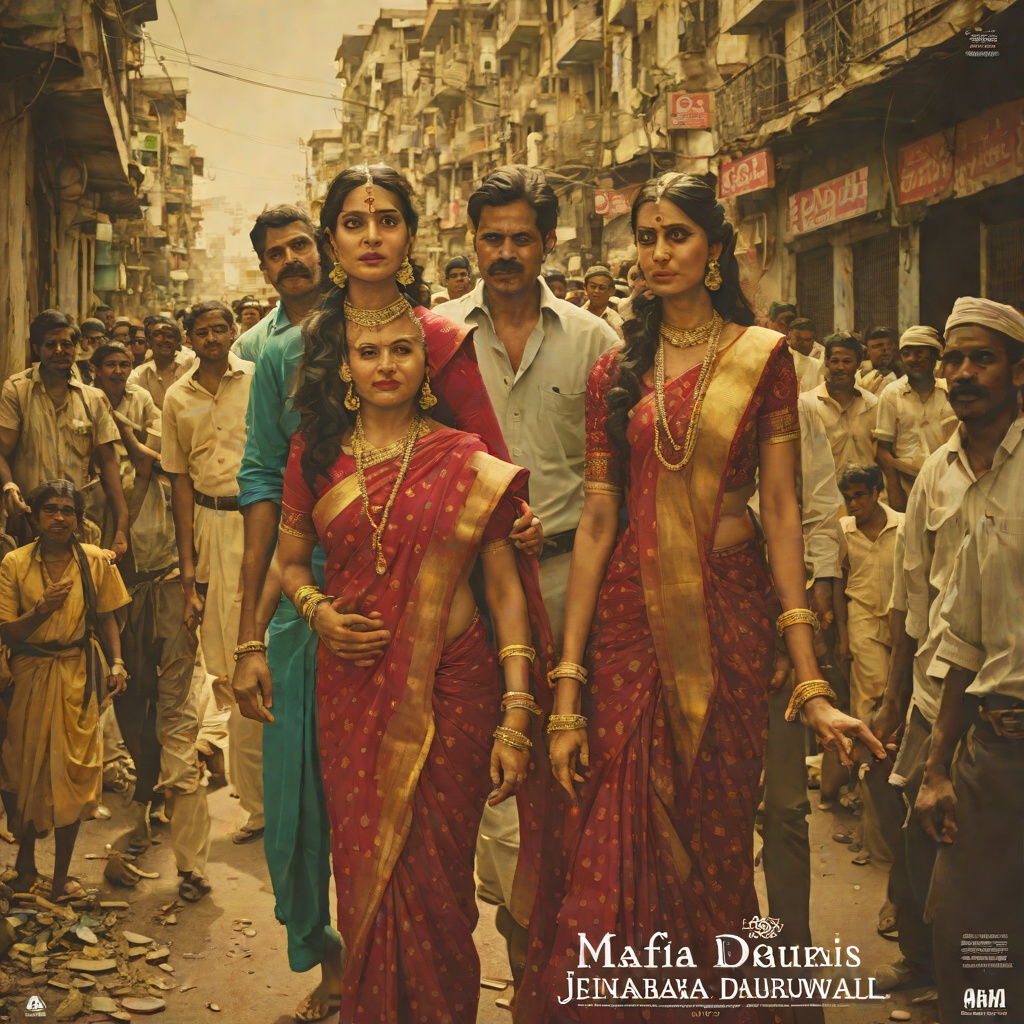
Mohammad Shah Darwesh
Mafia Queens of MumbaiMohammad Shah Darwesh occupies a small but decisive place in the story of Jenabai Daaruwali, the woman who would become one of Mumbai's most formidable bootleggers and, later, a peacemaker capable of bringing the city's warring gangsters to a truce. He is remembered not for any deed of his own, but for the marriage that shaped Jenabai's early life and for the abandonment that forced her into the independence and criminality that defined her. A small-time businessman with a modest timber trade, Darwesh was the man Jenabai married at fourteen, the father of her five children, and ultimately the husband who left her to survive alone when the subcontinent was partitioned.
Marriage and Family Life in Dongri
When Jenabai was fourteen, she was married to Mohammad Shah Darwesh and moved with him to the Chunawala building in Dongri, the same neighbourhood where she had grown up. Darwesh ran a small timber business, a modest trade that placed the family firmly within the working-class milieu of the area. The marriage produced five children: Khadija, Iqbal, Salim, Kamaal and Shammi. Even after marriage, Jenabai continued to participate in the freedom struggle, a commitment that predated her wedding and that she refused to surrender. Her husband would often beat her for protecting Hindus during the communal turmoil triggered by the divide-and-rule policy of the British. The violence was a direct consequence of her political activism: Darwesh resented her defence of Hindus, and his beatings were an attempt to discipline a wife whose loyalties he saw as dangerously misplaced. Jenabai first shifted to the first floor of the Chunawala building at fourteen, when she married Darwesh in the early '40s, and though she later made enough money as an informer and bootlegger, she refused to leave the building and breathed her last there in 1993.
The Partition and the Rupture
Partition took place in 1947, and Muslims and Hindus in the country redistributed themselves in the quest to find a new home after the British re-drew the map of the Indian subcontinent. Darwesh decided to move to Pakistan, but Jenabai, who had spent much of her childhood and youth struggling for Independence, refused to leave Mumbai. Her husband refused to give in and moved to Pakistan, leaving her alone to fend for herself and her five children. The decision was a stark one: Darwesh chose the new nation of Pakistan, while Jenabai chose the city she had fought for. The abandonment left her completely lost, unsure of how or where to begin. It was in this state of destitution that she encountered the scarcity of grains in Mumbai, as most of the country's farmlands had gone to Pakistan and the middle-classes began to feel the lack of grains and lentils. The rationing system was prevalent in Mumbai, and the government distributed limited food essentials to ration-card holders. Rice, especially basmati, was the staple diet of the Muslim community, integral in dishes like pulao and biryani, and the scarcity of foodgrain, lentils and wheat forced many to buy smuggled grain. It was this crisis that pushed Jenabai into the world of bootlegging and smuggling, the trade that would make her name.
Legacy and Significance
Darwesh's significance in the narrative is almost entirely negative: he is the husband who beat his wife for her compassion, and the man who abandoned her and their five children at the moment of greatest national upheaval. His departure was the catalyst that transformed Jenabai from a housewife into a criminal entrepreneur, and ultimately into the woman who would bring Mumbai's warring gangsters together in 1980 at Haji Mastan's bungalow, Baitul Suroor, on Peddar Road, in order to have them come to a truce. The contrast between the two is stark: Darwesh, the small-time timber businessman who chose Pakistan and disappeared from the record, and Jenabai, who refused to leave Mumbai, built a fortune as an informer and bootlegger, and was still living in the same Chunawala building where she had arrived as a bride when she died in 1993. A front page interview of Jenabai in the prominent Urdu newspaper Akbhar-e-Alam in 1992, a year before her death, shows how far she had risen from the abandoned wife Darwesh left behind. His absence, more than his presence, defined her trajectory, and the book's account of her life is in part a testament to what she made of the freedom he forced upon her.