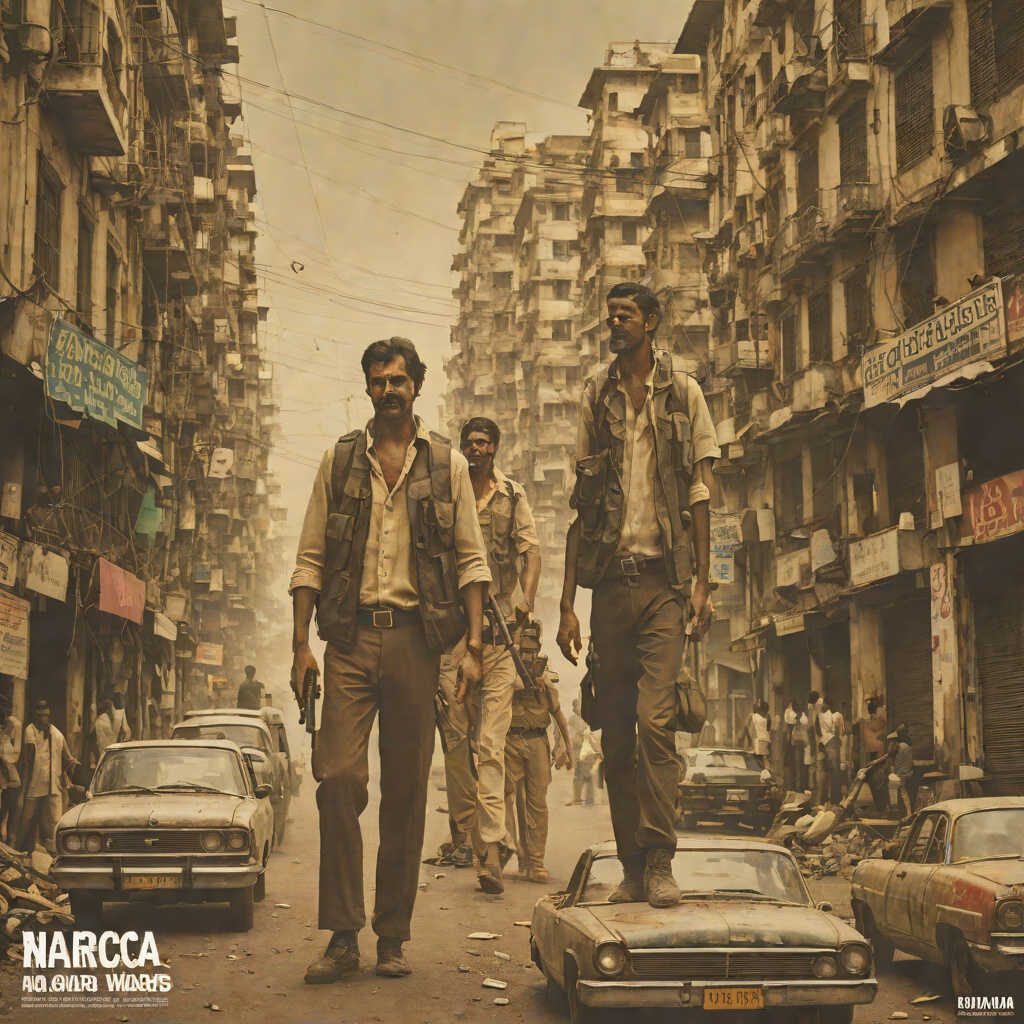
Mumbai drug trafficking network
Mafia Queens of MumbaiMumbai drug trafficking network is presented as a layered criminal economy rather than a single gang: a thousand-crore industry whose power is exercised through local streets, slums and railway-side settlements, while its supplies and money move through wider regional and international circuits. The network gives marginalized operators a route to wealth and authority, but also turns vulnerable communities into sites of addiction, coercion, surveillance and irreversible damage.
Scale and Geography
The network’s scale is stated in the dossiers of the Narcotics Control Bureau and the Anti-Narcotics Cell, which place it within an estimated Rs 1,000-crore drug-trafficking industry in Mumbai. The book describes its leading women as small but dominant cogs in a much larger machine, a formulation that captures the tension between their personal authority and the immense system in which they operate. Jyoti Adiramalingam, known as Jyoti amma, controls the trade around Reay Road with an iron fist and is described as one of the city’s most feared drug baronesses.
Its geography is intensely local. Sonapur Lane, also called Sonapur Galli, lies close to Reay Road railway station and contains roughly a thousand shanties. The name’s reference is not to gold but to death or sleep, reflecting the Muslim graveyards nearby; nevertheless, the district brings wealth to Jyoti, who makes the lane a domain where she sets the rules and alone possesses the authority to bend them. The neighborhood’s closeness to the railway line gives the network a dense urban setting in which movement, concealment and community knowledge are inseparable.
Sion-Koliwada forms the other major local center. The slum is built on a hill leading to a Hindu temple, and its crowded market is marked by Tamil-speaking vendors and residents. Before becoming a drug den under Mahalaxmi Papamani, it was known for the illicit hooch distillery owned by Vardharajan Mudaliar in the 1980s. The succession from liquor to heroin shows how criminal economies can remain rooted in the same deprived urban spaces even as their commodities and methods change.
Supply, Distribution and Business Method
The trade depends on chains extending beyond Mumbai. Raxaul, a small town in Bihar, is described as a hub for cross-border smuggling in arms, electronic goods, drugs and counterfeit currency, while the route onward to Birganj and Kathmandu demonstrates how illicit commodities can pass through the porous borderlands between India and Nepal. This wider circulation places Mumbai’s narcotics economy within a regional system of transport and brokerage rather than isolating it as a purely neighborhood crime.
At the street level, heroin is divided into small packets known as pudis. Savitri, a prominent drug peddler in the Sion-Koliwada slum, introduced Mahalaxmi Papamani to the business and also drew Jyoti Adiramalingam into it. Under Savitri’s instruction, Papamani and Jyoti divided large quantities of heroin into smaller pudis and distributed them to customers. Their work illustrates the network’s dependence on specialized, repetitive labor: bulk narcotics became numerous low-cost units that could circulate through personal contacts and crowded residential lanes.
Papamani later converted that method into an independent enterprise. In 1991 she separated from Savitri and worked with a loyal group of peddlers. She reportedly bought five kilograms of heroin for between one and three lakh rupees, turned ten grams into forty pudis, and sold each packet for twenty-five rupees, producing an estimated monthly profit of around three lakh rupees. She also supplied larger quantities to regular customers. The arithmetic reveals the business logic of the network: profit arose through fragmentation, volume and dependable retail distribution.
The consequences of that expansion were organizational as well as financial. The group working for Papamani tripled, and the illiterate slum resident built an empire with financial managers, peddlers and advisers, effectively converting Sion-Koliwada into a drug den. Her operation employed hundreds of unemployed men and women, tying household income to the narcotics trade. She kept liquid cash in several huts, was said to carry thirty to forty lakh rupees inside her sari, and lent money to poor families, becoming known as the poor man’s bank. Charity therefore did not stand outside the criminal economy: it helped make her wealth socially useful and her authority locally durable.
Power, Concealment and State Pressure
The network’s survival depends on secrecy as much as on force. When the narrator visits Sonapur Lane after Jyoti’s release from prison, most of the huts appear to be marked Room No. 70, although Jyoti actually lives in that numbered room. The repeated number is a deliberate device to confuse the police and give the godmother time to escape. In this setting, the built environment itself becomes part of the network’s defensive system, with residents, doors and misleading directions helping conceal its leadership.
Papamani’s authority is similarly protected by collective silence. When the narrator attempts to locate her in Sion-Koliwada, residents offer vague replies, suspicious looks and misleading directions. People who know Papamani refuse even to acknowledge her existence, much less discuss the goddess-like aura attached to her. Such evasiveness suggests that control is maintained not only through criminal profit but through fear, dependence and the practical benefits that the network distributes among deprived families.
The state appears through raids, imprisonment and intelligence files, but its reach is uneven. Police repeatedly attempted to arrest Papamani and failed to secure convictions for lack of evidence. Jyoti, by contrast, had served four and a half years in Mumbai’s Byculla Women’s Jail before returning to Sonapur Lane. The contrast between repeated evasion and eventual imprisonment underscores the difficulty of converting knowledge about a clandestine economy into a legally sustainable case.
Connections to Older Criminal Economies
The narcotics trade is part of a longer Mumbai history of smuggling and illicit brokerage. Haji Mastan began as a cycle mechanic, worked as a coolie unloading ships at the Mumbai docks, and later accumulated millions through smuggling gold, silver ingots and electronic goods. Alongside Karim Lala and Vardharajan Mudaliar, he formed one of Mumbai’s most formidable gangs. That history supplies a model for the later drug economy: dockside labor, smuggling routes, accumulated capital and territorial influence could combine into a criminal system with both local roots and international connections.
The earlier grain trade associated with Jenabai Daaruwali provides another parallel. After the Partition of India created food scarcity and Mumbai’s rationing system limited access to essentials, Jenabai Daaruwali brokered smuggled lentils, pulses, sugar and basmati rice from Daana Bazaar near Masjid Bunder. She bought in bulk on commission and sold to dealers or neighbors for a margin, despite the illegality of unlicensed hoarding and trading. Like the later heroin business, this economy grew from scarcity, brokerage and the conversion of bulk goods into accessible units; unlike heroin, its commodity was food. The comparison shows how illicit markets emerge where formal supply systems fail or exclude people.
Even prohibition offers a structural precedent. Prohibition was introduced in the city on 1 August 1939, and clashes erupted during its first week between supporters and opponents. The government created a special X Division, recruited and trained police for prohibition duty, and brought Excise Department personnel into the city police. When the Second World War began, however, the large prohibition force was diverted to security work at the docks, weakening enforcement. The episode demonstrates how state bans can generate specialized policing while remaining vulnerable to competing political and security priorities.
Urban and Economic Significance
Mumbai drug trafficking network joins marginal urban space to larger flows of capital. Its local centers are not abstract backdrops: Sonapur Lane’s graveyards, Reay Road’s railway proximity, and Sion-Koliwada’s hill settlement shape how commodities are hidden, divided, sold and defended. The network converts cramped neighborhoods into economic infrastructure, while the neighborhoods’ poverty supplies workers, customers, silence and political vulnerability.
At the same time, the network is connected to legitimate accumulation. Papamani invested proceeds in Bangalore, where she allegedly started a three-star hotel, and bought a house and four shops in Trichy in the Salem district, renting them out and appointing someone to collect the income. Her movement from packets of heroin to property and hospitality mirrors the broader criminal tendency to transform liquid illicit cash into durable assets.
That transition is also visible in the account of Sujata Nikhalje. In the late 1990s, rising real-estate and rental prices made Tilak Nagar attractive for redevelopment. As the wife of a gangster and a woman known as Nani, Sujata could pressure residents to sell their homes, then established Khushi Developers Private Ltd and assembled chartered accountants to manage its finances. Her planned replacement of old buildings with malls, high-rises and office complexes shows how criminal authority can enter formal construction markets. The narcotics network thus belongs to a wider political economy in which illicit wealth, intimidation, professional accounting and urban redevelopment can overlap.
The book’s final image of the network is therefore double-edged. It is adaptive, entrepreneurial and capable of generating employment, loans, charity and investments; it is also sustained by addiction, secrecy, coercion and the degradation of the communities that support it. Its power lies precisely in that entanglement. Mumbai drug trafficking network survives not as an isolated underworld beneath the city, but as an economy threaded through transport routes, police institutions, household survival and the city’s legitimate ambitions.