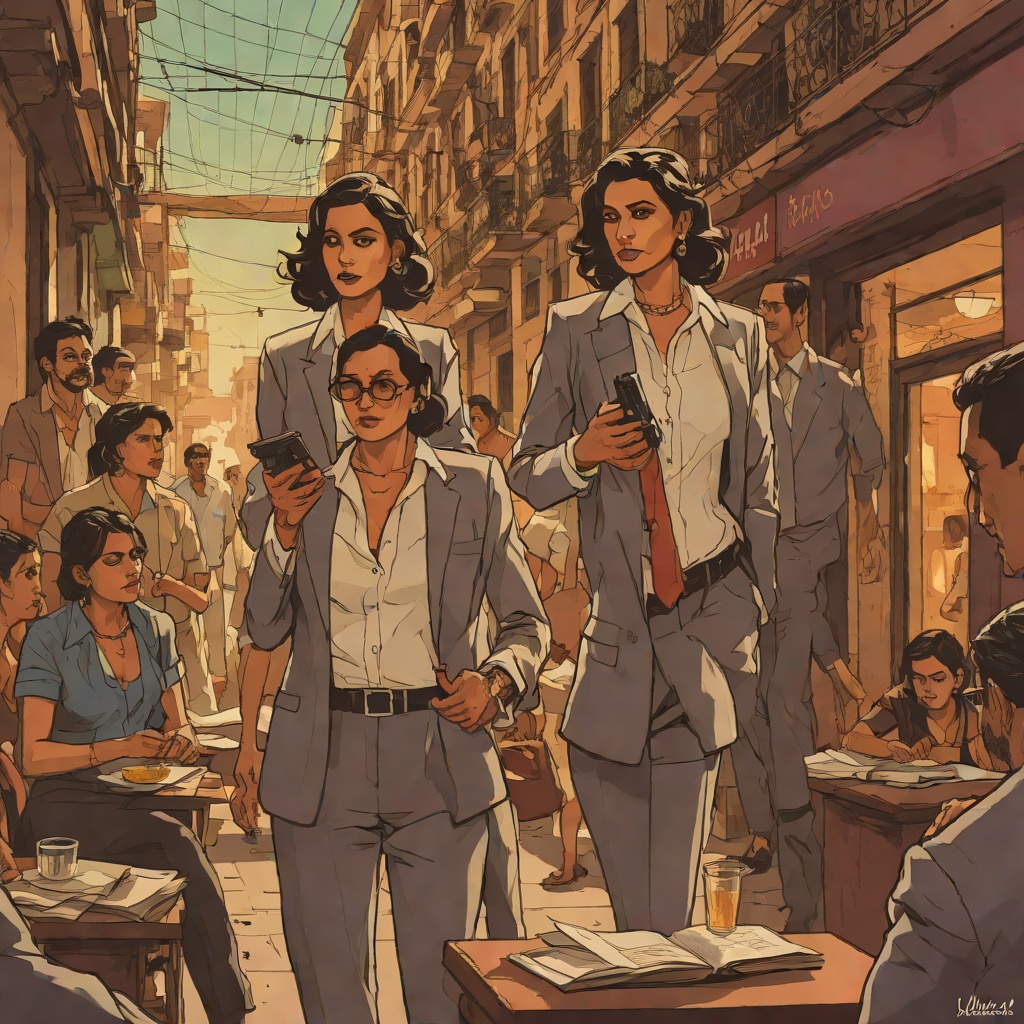
Mumbai ki queen kaun
Mafia Queens of MumbaiMumbai ki queen kaun? — "Who is Mumbai's queen?" — is the question that frames S. Hussain Zaidi's Mafia Queens of Mumbai, a collection of thirteen true stories about the women who carved out power in the city's underworld. The phrase appears in the book's introduction, where filmmaker Vishal Bhardwaj, after praising the collection's cinematic structure and its portraits of "beautiful, kind and cunning warring queens," poses the challenge directly to the reader: "Mumbai ki queen kaun? Turn the pages and make your choice." The question is not merely rhetorical; it is an invitation to weigh the claims of the book's many formidable women — gangsters, drug baronesses, molls, and madams — and to decide which of them most deserves the title of queen. In doing so, the phrase crystallizes the book's central ambition: to present these women not as victims or footnotes to male criminals, but as protagonists who broke through the glass ceiling of a world defined by brutal masculinity.
The Question as Framing Device
The question operates as both a marketing hook and a structural principle. Bhardwaj's introduction, which contains the phrase, positions the book as a competition among its subjects — a pageant of criminal royalty in which the reader serves as judge. The framing is deliberately playful, echoing the gossipy, speculative tone of the city itself, where the question of who reigns supreme in the underworld is a matter of constant public fascination. By posing the question directly to the reader, the book transforms the act of reading into an act of judgment, asking each person to measure the achievements, crimes, and charisma of figures as varied as Jenabai Daaruwali, the prohibition-era bootlegger; Gangubai Kathiawadi, the madam who became the "Queen of Kamathipura"; and Mahalaxmi Papamani, the drug baroness of Sion-Koliwada.
The Queens the Question Invokes
The women who populate the book come from every corner of Mumbai's underworld. Jenabai Daaruwali, born in the early 1920s to a Muslim Memon Halai family in Dongri, rose to prominence as a liquor smuggler during the city's prohibition era, which began on 1 August 1939. Jyoti Adiramalingam, known as Jyoti amma, ruled Sonapur Lane near Reay Road station, a slum of some thousand shanties that the Narcotics Control Bureau and the Anti-Narcotics Cell identified as a key node in the Rs 1,000-crore drug trafficking industry. Mahalaxmi Papamani presided over the Sion-Koliwada slum, a hilltop settlement where residents spoke Tamil and where, the book notes, most people refused even to acknowledge her existence. The question "Mumbai ki queen kaun?" implicitly asks the reader to compare these women across very different domains of crime — smuggling, drugs, prostitution, and political influence — and to decide which form of power is most queenly.
The City as Stage
The question gains its force from the specific geography of Mumbai, which the book renders in vivid ethnographic detail. The city's neighborhoods are not merely backdrops but active forces in the women's stories. Dongri, where Jenabai grew up, was originally part of the island of Mumbai, its hills levelled in the mid-1700s to merge the city's seven islands; by the book's present, it is a Muslim-dominated quarter of rickety buildings and bustling bazaars selling attar, henna, and hot jalebis. Marine Lines, where the book opens at the Bada Qabrastan cemetery, is a British legacy, named after the Marine Battalion Lines, a military establishment later converted to air force quarters. The graveyard itself — a hundred-and-fifty-year-old, 7.5-acre expanse abutting the station — serves as a reminder of mortality that hangs over all the city's criminal ambitions. The question of who is Mumbai's queen is thus also a question of who has mastered this particular city, with its specific history of colonial rule, prohibition, and communal violence.
The Question's Challenge to Gender Norms
The phrase also carries a pointed gender politics. The underworld, as the book repeatedly emphasizes, is "the absolute stronghold of brutal masculinity," a world where women are typically relegated to the role of the "mobster's moll" — a fair-skinned, scantily-clad figure who sways in nightclubs and plays mischief-maker on demand. The question "Mumbai ki queen kaun?" inverts this hierarchy, insisting that women can be not just companions to power but wielders of it. The book's subjects include women who commanded respect through violence, cunning, and political acumen: Gangubai, who gave a speech at Azad Maidan and met Jawaharlal Nehru; Tarannum Khan, the bar dancer whose cricket betting scandal made her a national figure; and Monica Bedi, the actress who, after her arrest and extradition with Abu Salem, reinvented herself on reality television. By asking who among them is the queen, the book refuses to let these women be defined solely by their relationships to men.
The Question as Invitation and Judgment
Ultimately, the question is left open. The book does not crown a single queen; instead, it presents thirteen stories and lets the reader decide. This openness is itself a statement about the nature of power in Mumbai's underworld — it is diffuse, contested, and constantly shifting. The question also reflects the book's own method, which blends journalism with storytelling. As one review in Mint put it, the book "peels back Mumbai's thin veneer of civilization," offering portraits that are "essential to completing the portrait of a corrupt city." The question "Mumbai ki queen kaun?" is thus not just a challenge to the reader but a challenge to the city itself, which has always been reluctant to acknowledge the women who helped build its criminal empires. By asking the question out loud, the book forces a reckoning with the hidden half of Mumbai's underworld history.