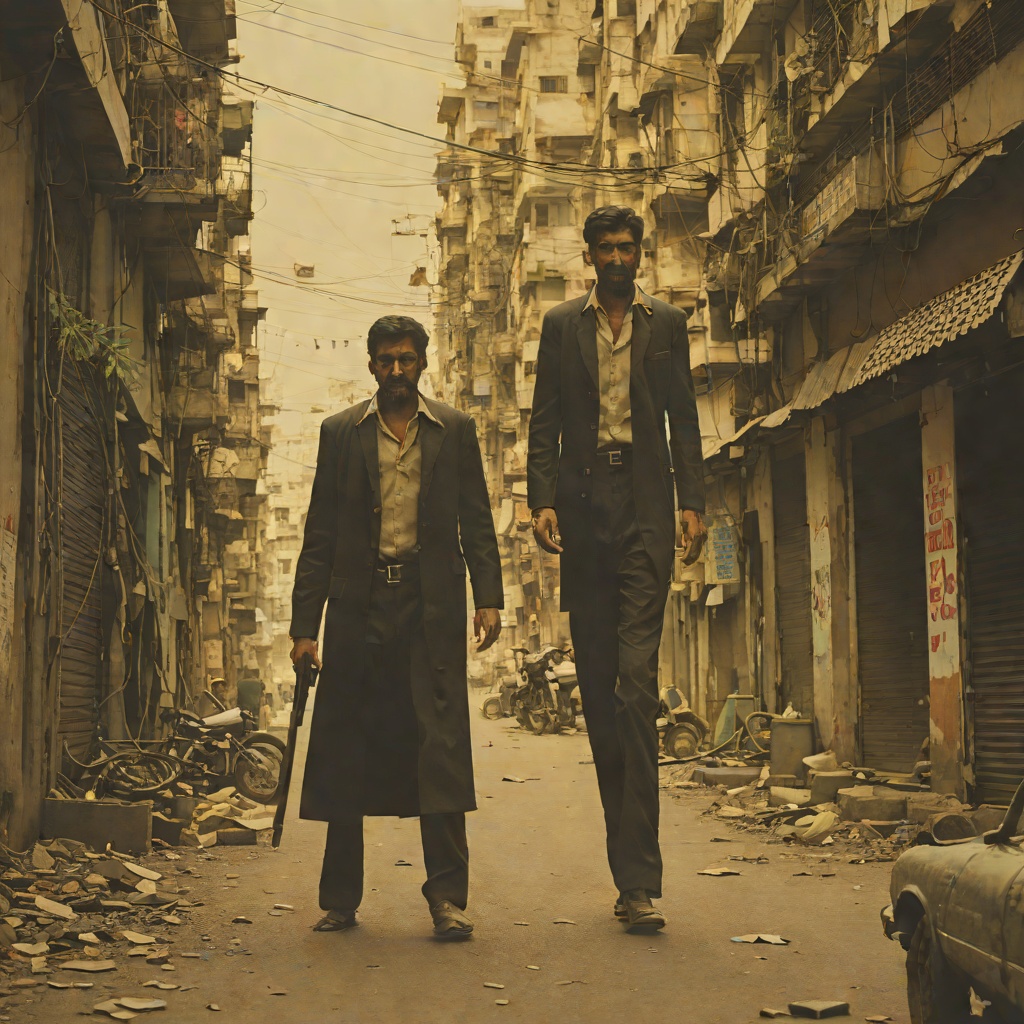
Nagpada
Mafia Queens of MumbaiNagpada is a dense, predominantly Muslim neighborhood in central Mumbai that serves as a crucial nexus in the city's underworld geography. It is not merely a backdrop but an active force in the lives of the criminals and women whose stories are told, functioning as a stronghold for powerful gangs, a site of intimate domesticity, and a stage for some of the most brutal acts of violence in the book. Its streets and buildings are repeatedly invoked as the setting for pivotal moments, from strategic alliances to fatal ambushes, cementing its role as a central artery of the Mumbai underworld.
A Stronghold of Criminal Power
Nagpada is identified as the primary stronghold of the Ibrahim brothers, the family that would produce the infamous Dawood Ibrahim. This territorial control is a key piece of strategic knowledge in the underworld's power calculations. When the bootlegger Jenabai Daaruwali sought to broker a peace between the warring Ibrahim brothers and the Pathan gang, she pointed out to the smuggler Haji Mastan that while the Pathans held sway in VP and Grant Road, it was "Ibrahim's sons" who had a stronghold in Nagpada. This observation was central to her argument that an alliance would be mutually beneficial, as the Belassis Road property Mastan coveted lay exactly at the center of these three territories. Nagpada, therefore, was not just a residential area but a strategic asset, a base of power that made the Ibrahim family a force to be reckoned with and a necessary partner in any larger consolidation of criminal influence.
The area's significance as a criminal hub is further underscored by its connection to Dawood's own family. Sapna Didi, a woman who dared to challenge Dawood, deliberately chose to move to a small house in Hujjrah Mohalla in Nagpada, a lane known for its clothing stores by day and its transformation into a den for small-time goons after eight in the evening. Her reason for this bold and risky move was chillingly strategic: her new home was barely a few meters away from Mussafir Khana, Dawood's paternal home. By housing herself so close to her enemy's den, she hoped to be alerted to any movement on his part. This decision transformed Nagpada from a place of safety into a high-stakes chessboard, where proximity to the enemy's heart was a calculated, and ultimately fatal, gamble.
A Stage for Violence and Death
Nagpada is also the site of some of the book's most harrowing acts of violence, marking it as a place where the underworld's codes of conduct are brutally enforced. It is the neighborhood from which Ashraf Khan, the wife of the gangster Mehmood Khan, set out on the day of her husband's death. On that day, she slipped the last of her gold bangles on her arms and headed out from her home in Nagpada to the main road, deciding to take a cab to the Santa Cruz airport to welcome him. The neighborhood is thus the point of origin for a journey that ends in tragedy, linking the domestic sphere of Nagpada to the state-sanctioned violence of a police encounter. Later, it is in Nagpada that Hussain Ustara, a sophisticated gunman who had promised to avenge Ashraf's death, meets his own end. On the evening of 11 September 1998, Ustara drove out from his den in Bapurao Pathe Marg to visit his girlfriend's house near Nagpada. This visit, made without his usual escort of sharpshooters, was the opportunity his rivals had been waiting for, and it was near Nagpada that he was ambushed and killed in a hail of bullets.
The most gruesome event in Nagpada, however, is the murder of Sapna Didi. In 1994, while she was down with a high fever and had asked her men to leave her alone, four men forced their way into her house in Hujjrah Mohalla. They woke her, dragged her to the floor, and began kicking her to prevent her from reaching a weapon. Then, instead of killing her quickly, they subjected her to an extreme level of torture, deliberately targeting her breasts and vagina with their daggers, inflicting over twenty-two stab wounds. The attack was a deliberate message, intended to make an example of her for anyone who dared to think of taking on Dawood. The people who gathered outside, drawn by her screams, stood by in silence, knowing the men were Dawood and Shakeel's and fearing to intervene. Nagpada, in this instance, becomes a space where the mafia's power over life and death is exercised with impunity, and where the community's fear ensures their silence.
A Place of Contrast and Connection
The neighborhood's character is defined by stark contrasts, a place where the mundane rhythms of daily life coexist with the ever-present threat of criminal violence. It is a residential area, a place of homes and families, yet it is also a strategic military outpost and a killing field. This duality is reflected in the way the book describes the area's atmosphere. The lane of Hujjrah Mohalla is bustling with commercial activity until around 7 p.m., selling readymade garments for women and children, but after 8 p.m., it becomes a den for goondas who gamble and plot robberies. This transformation from a commercial space to a criminal one mirrors the neighborhood's own dual nature as both a home and a battleground. The proximity of Sapna's house to Dawood's paternal home further emphasizes this contrast, placing the domestic and the criminal in direct, dangerous adjacency.
Nagpada's role in the narrative also connects it to the broader geography of the city's underworld. It is one of several key locations, like Dongri and Kamathipura, that anchor the stories of the women and men who populate the book. The area's identity as a Muslim-dominated neighborhood, a legacy of the city's historical development, places it within a specific communal and social context. The book's focus on Nagpada, alongside other areas like the Sion-Koliwada slum and Sonapur Lane, builds a detailed map of Mumbai's underbelly, showing how power, crime, and community are spatially organized. In this map, Nagpada stands out as a place of particular significance, a stronghold of the most powerful gang in the city and the site of some of its most consequential and brutal events.