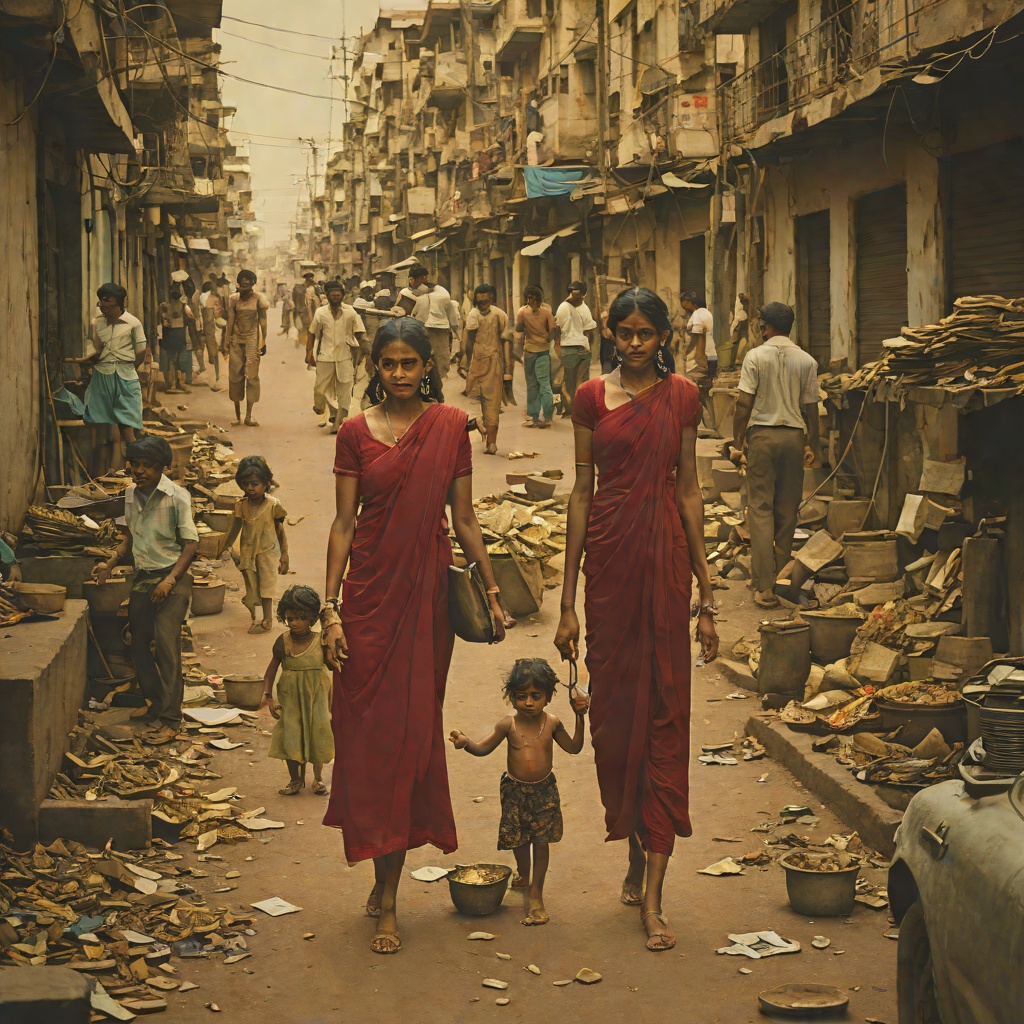
Savitri
Mafia Queens of MumbaiSavitri emerges from the evidence as a foundational but deliberately obscure figure in the Mumbai underworld's drug economy, a woman whose significance lies less in her own documented exploits than in her role as the catalyst for two of the city's most feared drug baronesses. She is introduced as a prominent drug peddler in the Sion-Koliwada slum, a neighborhood that would later become notorious as a drug den under her protégé's rule. Her precise origins, background, and personal history are never detailed in the surviving record; she exists in the narrative primarily through her relationships with the women she recruited and the business empire she helped to seed. This obscurity is itself telling, positioning Savitri as a figure of the informal, undocumented networks of female criminal enterprise that flourished in Mumbai's slums, where power was exercised through personal tutelage and local influence rather than public notoriety.
The Mentor of Sion-Koliwada
Savitri's defining act, as recorded in the evidence, is her recruitment of Mahalaxmi Papamani during a moment of acute personal crisis. Papamani, a resident of the Sion-Koliwada slum, had been driven to seek new income after her alcoholic husband was left paralysed for life by an accident, leaving her to raise five children alone. It was at this vulnerable juncture that Savitri, described as her neighbour and friend, approached her with an offer to enter the drug trade. Savitri's business was the sale of pudis, small packets of heroin, a trade she had established in the slum. She did not merely offer Papamani a job; she extended the same opportunity to Jyoti Adiramalingam, luring the future godmother of Reay Road away from her own territory to work under her tutelage. This act of recruitment reveals Savitri's method: she built her network not through coercion but by identifying capable women in desperate circumstances and offering them a path to economic survival, however illicit.
Under Savitri's direct instruction, Papamani and Jyoti were given the specific responsibility of dividing large quantities of heroin into smaller pudis and then distributing them to interested parties. This division of labour was the operational core of Savitri's enterprise, transforming raw heroin into a retail product that could be sold across the slum. The arrangement proved spectacularly successful. In no time, the troika of women—Savitri, Papamani, and Jyoti—had begun to control the pudi-selling business in Sion-Koliwada. The partnership was a formidable one, uniting three of the most enterprising women in the area under Savitri's leadership, and their collective control of the market marked the slum's emergence as a significant node in Mumbai's drug distribution network.
The Protégé's Rise and the Mentor's Fall
The partnership, however, contained the seeds of its own destruction. With profits running into lakhs of rupees, it was only a matter of time before Papamani, driven by her shrewd business acumen, outsmarted her own mentor. In 1991, Papamani made the decisive break, splitting from Savitri and beginning to run the business independently with the help of a loyal group of peddlers. The split was not merely a personal betrayal but a commercial coup. Papamani's independent strategy was ruthlessly efficient: she would buy five kilogrammes of heroin for between one and three lakh rupees, convert ten grams into forty pudis, and sell each pudi at twenty-five rupees, generating a profit of around three lakh rupees per month—a sum comparable to the salary of a Mumbai CEO. This business model, which she had learned and refined under Savitri's tutelage, allowed her to eclipse her mentor entirely, converting the Sion-Koliwada slum into a full-fledged drug den with her own financial managers, peddlers, and advisors.
The consequences of Papamani's rise for Savitri herself are not directly recorded, but the trajectory is clear: the mentor who had created the conditions for Papamani's success was displaced by the very empire she had helped to build. The evidence does, however, record one further, ironic connection between the two women. Years later, after Papamani had sent her children to study at the elite JR Cambridge boarding school in Salem—only to bring them back to Mumbai four years later after they failed repeatedly—she arranged marriages for three of her daughters. One of these daughters married the son of Papamani's mentor, Savitri. This union, a dynastic link between the two families, suggests that despite the commercial rupture of 1991, the personal and familial bonds between the women endured, weaving the story of their rivalry into the fabric of their children's lives.
Narrative Role and Significance
Within the larger narrative of women criminals in Mumbai, Savitri occupies a crucial but paradoxical position. She is the archetype of the female criminal as mentor, a woman who wielded power not through direct confrontation with the state or the male-dominated mafia, but through the cultivation of other women. Her story, as far as it can be reconstructed, exemplifies the book's central argument that these women were not blank slates written upon by dangerous male mafia members, but active agents who pushed the boundaries of dominant moral codes. Savitri's decision to recruit Papamani and Jyoti was an act of economic empowerment, however illicit, that enabled two other women to transcend their poverty and limitations. Yet her own story is one of displacement, a reminder that in the brutal economy of the underworld, even the most successful mentor could be rendered obsolete by a more ambitious protégé. Her legacy, ultimately, is not her own empire—which she lost—but the two empires she inadvertently created: Papamani's drug den in Sion-Koliwada and Jyoti's reign over Sonapur Lane in Reay Road. In this sense, Savitri is the hidden root of a branching tree of female criminal power in Mumbai, a figure whose importance is measured not by her own fame but by the formidable women she trained and set loose upon the city.