Arrest of Albert Falconi
Maigret and the Dead GirlThe arrest of Albert Falconi is the point at which Maigret’s reconstruction of Louise Laboine’s last movements becomes an accusation he can act on. He does not present his conclusion as a lucky guess: by comparing Falconi’s account with the postmortem and with what Louise was likely to do in an unfamiliar bar, he identifies details that do not fit. Falconi is taken from his bar to the Quai des Orfèvres, and Janvier is instructed to record his statement and have him sign it.
From the body to a working hypothesis
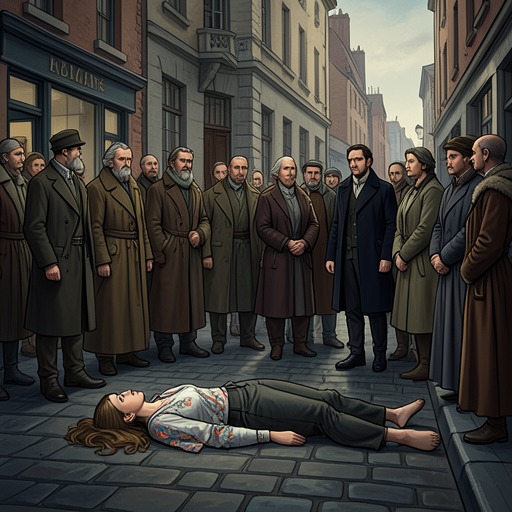
At the beginning of the investigation, Maigret does not yet know who killed the woman found at Place Vintimille. The blue dress is worn and tawdry, and the silver high-heeled shoe has a worn sole; both might suggest a bar girl from Montmartre. A robbery is an initial possibility, but it does not explain why one shoe is missing or why the woman’s coat has been removed. Those discrepancies lead Maigret to suspect that she was killed elsewhere. The scene supplies a question, not an answer: the clothing suggests one kind of life, while its arrangement complicates the simplest account of how she died.
Dr. Paul’s examination adds evidence without resolving every detail. He reports that death resulted from a fractured skull and that the woman had received at least three forceful blows. He cannot identify the weapon, offering only possibilities such as a tool, a brass andiron, or a candlestick. Dark wool caught beneath the woman’s fingernails indicates that she had clutched at someone’s clothing during a struggle; the material suggests a man’s garment, but does not by itself identify the person. The findings therefore support an encounter with an assailant while leaving the assailant’s identity to be established by other evidence.
Reconstructing Louise’s visit
A further line of inquiry concerns the alcohol in Louise’s stomach. Maigret’s review of Dr. Paul’s report establishes that she had consumed an appreciable quantity. The head waiter says she had no opportunity to drink during her relatively brief stay at the Roméo, so the drinking must have taken place either before the reception or after she left it. That timing matters because it puts the postmortem evidence into relation with her movements, rather than treating alcohol as an isolated fact.
Maigret tests Falconi’s account against Louise’s circumstances and behavior. He imagines her arriving at a crowded bar in her shabby evening dress and ill-fitting velvet cape, and reasons that she would have felt conspicuous among the other customers. In his view, she was unlikely to sit at the bar or order a martini. Falconi’s answer that she had ordered one is revealing precisely because it sounds automatic: he has treated her as though she were an ordinary customer at his establishment, not a woman whose discomfort and situation made that behavior unlikely. Falconi eventually admits that she drank nothing there.
The kind of alcohol further sharpens the contradiction. Public accounts mentioned alcohol in Louise’s stomach, but Maigret knows the postmortem identified it as rum. A martini, by contrast, is made with gin and vermouth. This distinction does not establish the killer’s identity on its own. It allows Maigret to test Falconi’s claim against a specific forensic detail that the published reports did not disclose, and to show that the supposed drink at the bar cannot account for what the examination found.
The arrest at the bar
Falconi asks how Maigret worked it out. Maigret answers that he knew at once, not that he guessed. The certainty is the result of his cumulative reconstruction: the reported drink conflicts with the postmortem, while the claimed martini conflicts with his assessment of how Louise would have behaved in the room. He also challenges Falconi’s account of her going downstairs to read a letter, observing that a bar of this kind would not ordinarily need a notice at the top of the stairs and that reaching the basement would have meant threading through a crowd of customers, many likely to be drunk. Maigret’s case turns on the fit between details, not on one dramatic clue.
After the questioning, Maigret gets up, buttons his coat, and tells Falconi to put his coat on. Falconi initially appears not to understand and protests that he cannot leave the bar. Maigret makes clear that they are going to the Quai des Orfèvres and asks whether Falconi wants to be taken by force. Falconi says he will come, but does not appear to grasp what is happening. The movement from the bar to police headquarters turns the conversation into a formal arrest; Maigret does not stage the moment as a triumph or offer Falconi an elaborate explanation there.
Statement and significance
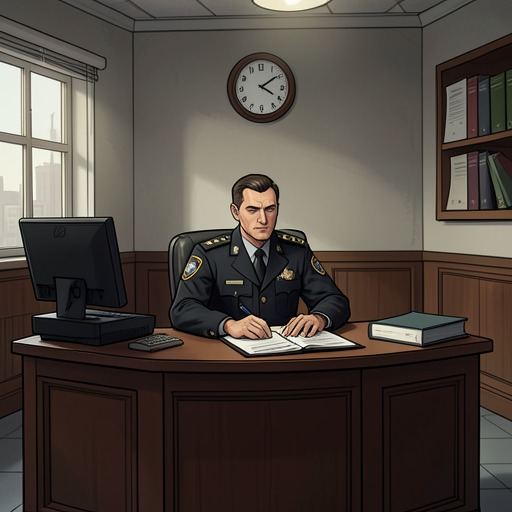
Falconi sits alone in the back of the car and says nothing during the journey. Janvier is also silent, while Maigret smokes his pipe. At headquarters Falconi is taken upstairs and brought into Maigret’s office. Later, Maigret points him out to Janvier and instructs him to take Falconi into his office, write down his statement, obtain his signature, and take him to the cells. Maigret says he will telephone the magistrate, Coméliau. The arrest thus leads directly into documentation and detention, rather than ending with the deduction alone.
The episode’s method is as important as its outcome. The investigation moves from uncertain readings of clothing and scene circumstances, through the medical evidence, to a contradiction between rum and a claimed martini and an assessment of Louise’s likely conduct. Each clue has limits: the wool suggests a struggle but does not name the attacker; the alcohol narrows the possibilities but does not independently identify Falconi. Maigret’s conclusion gains force from their convergence with Falconi’s account. His attention to Louise as an individual, rather than as a generic bar customer, is what exposes the account’s weak points and makes the arrest possible.