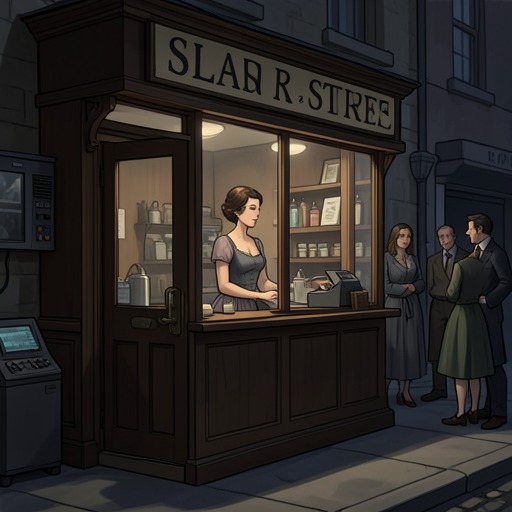
Elisabeth Coumar
Maigret and the Dead GirlElisabeth Coumar, known professionally as Irène, is a clothing provider whose exchange with Maigret gives the investigation a precise account of Louise Laboine’s blue evening dress. She describes a practical arrangement built around reusable garments, deposits, and exchange: when Louise returned unable to leave money, Coumar let her leave the clothes she was wearing instead. Her real name and brief reference to repeated imprisonment widen the portrait, but the evidence leaves both her wider circumstances and the nature of those convictions unresolved.
Identity and Work
Coumar introduces her two names when Maigret asks about Mademoiselle Irène. She answers, “Is it my real name you want to know? If so, its Coumar, Elisabeth Coumar. In my line of business, Irène sounds better.” The distinction is straightforward and purposeful: Coumar is her real name; Irène is the name she finds more suitable for work. The exchange establishes a professional identity without explaining whether the name is meant to attract customers, conceal her identity, or serve some other purpose. Anything beyond her own stated preference would go beyond the evidence.
Her account suggests work organized around supplying and reusing clothes. She identifies the blue dress Maigret shows her as a size twelve and explains that it has been worn for a night by many girls in the district. The detail gives the garment a history beyond Louise’s individual use: it belongs to a circulating stock, rather than being a new or uniquely hers piece. Coumar speaks of this repeated use matter-of-factly, as one of the ordinary conditions of her business.
The surviving details do not establish the formal nature or scale of that business. They do show that Coumar could find clothing for a customer, took deposits under ordinary circumstances, and was able to make practical substitutions when a customer could not pay in the usual way. Her work appears through these specific transactions, rather than through a fuller description of a shop or its operation.
Her Encounters with Louise Laboine
Coumar’s knowledge of Louise is limited but useful. When Maigret asks whether she knew her, Coumar says she had seen her once. Her answer marks the boundary between a customer relationship and personal acquaintance: she can recount the clothing transactions, but does not claim a close connection with Louise. The investigation depends here on the accuracy of a brief commercial memory, not on intimate knowledge of the woman whose belongings Maigret is tracing.
The first transaction is summarized plainly: Louise took the blue dress away. Coumar later confirms that Louise returned for it again, but the available exchange does not supply a fuller account of the earlier visit. The contrast between those visits matters because the second one required a different arrangement. Coumar recalls that Louise came shortly after nine in the evening and asked whether the dress was still available. Louise explained that she could not leave a deposit this time, and offered the clothes she was wearing in its place. Coumar accepted them.
The substitution makes Louise’s financial difficulty concrete without requiring Coumar to interpret it. Louise did not simply ask for an exception; she put her own clothes forward as security. Coumar’s account establishes that she agreed to the exchange and that Louise changed there. When Louise also needed shoes and a coat, Coumar found her a velvet cloak cape that would do. These details show Coumar responding to the immediate practical needs of the transaction, while the clothes Louise surrendered and the outfit she obtained became part of the chain of evidence Maigret was following.
The Interview and Its Limits
Maigret elicits Coumar’s account piece by piece, returning to the previous evening and interrupting her when he wants to establish whether she actually knew Louise. Coumar’s testimony is consequently specific about times, garments, and payment arrangements, but narrow in what it can prove. She had seen Louise before and remembers the repeated use of the dress; she does not present herself as a confidante or explain Louise’s circumstances beyond what Louise told her about the deposit.
A separate question adds a stark fact about Coumar herself. After leaving the premises, Maigret asks Lognon whether she has been in prison, and Lognon replies that she has been there three or four times. Maigret then asks whether it was for receiving stolen goods. The supplied passage does not include an answer to that question, so it does not establish the offense or the circumstances of any conviction. The distinction is important: repeated imprisonment is reported, while the suggested charge remains a question, not a confirmed explanation.
Narrative Role
Coumar’s contribution is small in scale but concrete in consequence. She identifies the blue dress as a size-twelve garment used by many women, reconstructs Louise’s return shortly after nine, and describes the exchange of Louise’s clothes for the dress, shoes, and cape. Each detail makes the garment part of an ordinary economic arrangement before it becomes a clue in Maigret’s inquiry. Coumar is not shown solving the mystery or explaining Louise’s life; her value to the investigation lies in a precise recollection of what passed between them.
The two sides of her appearance remain in tension without being resolved. In the interview, she is a practical witness who remembers a customer’s clothing and the terms of an exchange. In Maigret’s later question, she is also someone reported to have served prison time several times. The evidence does not connect that history to the dress transaction, nor does it establish that her work involves stolen goods. Coumar therefore remains defined by a few sharply bounded facts: a chosen working name, a business involving reusable clothes, a willingness to accept clothes instead of a deposit, and a criminal history whose particulars are left open.