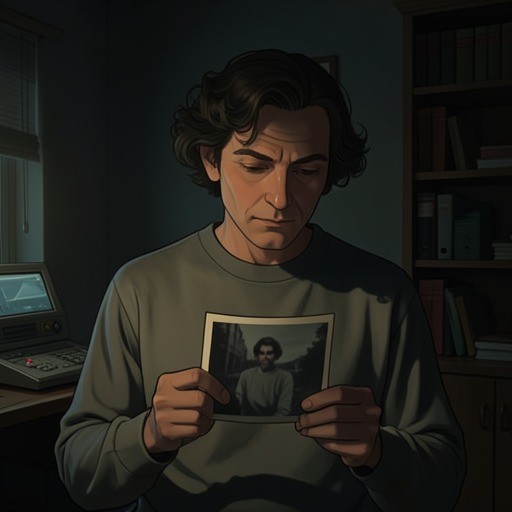
Germaine Laboine
Maigret and the Dead GirlGermaine Laboine is Louise Laboine’s mother, a solitary former performer whose past surfaces through several names and a belated police inquiry. Nearly sixty, she is encountered at a roulette table, where an investigator has to tell her directly that her daughter is dead before she will leave. The contrast between her elaborate appearance, her narrow gambling routine, and the long silence surrounding Louise makes her less a conventional witness than a figure whose life has to be pieced together from fragments of self-presentation and recollection.
Identity and Public Names
The name on her identity card is Germaine Laboine, but she calls herself Liliane, while the croupiers know her as Lili. Earlier, as a performer, she toured under the stage name Lili France. These names belong to distinct settings: legal identification, the casino, and her former working life. The evidence does not explain why she uses different names, but it establishes that no single name exhausts how she has been known.
Her outward appearance is described in terms of age and conspicuous adornment: she is nearly sixty, heavily made up, and wearing a great deal of fake jewelry. Her dress and hat are said to be at least ten years old. The details place an old performance identity beside signs of limited means; the jewelry is imitation, and the clothes are worn over time. They do not, by themselves, disclose what she feels about her appearance or her past.
Work, Gambling, and Daily Circumstances
Laboine tells the investigator that she used to be an artist and had toured for years in the Near East and Asia Minor as Lili France. The account of touring is set against a broader description of the agencies in Paris that recruited such performers: they needed to learn only a few dance steps or songs before being sent to places including Turkey, Egypt, or Beirut, where they worked as bar girls in cabarets. This context gives her former occupation a practical, commercial setting rather than presenting it as a secure or prestigious career. The account establishes the kind of work she did, without filling in the particular performances or conditions of her own tours.
In the present, the roulette table holds her attention so completely that the investigator struggles to question her while she watches the ball and tightens her fingers whenever it stops. The investigator describes a familiar group of casino regulars who work with small capital, repeatedly stake and recover modest sums, and rely on limited winnings for daily expenses, including bus fare. According to that account, management knows these players and may pay them off when the rooms are crowded and the tables are full. Laboine is presented within this routine, though the explanation of the system is the investigator’s, not a detailed account from her.
She lives alone in a furnished room on Rue Greuze, near Boulevard Victor Hugo. When asked whether she had been married, she responds evasively that the answer depends on what counts as being married. The exchange establishes her reluctance to give a simple label to that part of her life; it does not, in the available account, settle her marital history. At the casino she insists that she has done nothing wrong and says she will answer questions that evening. Her promise sets a limit on the questioning rather than opening her history all at once.
Louise and the Interrupted Family Connection
Laboine says that Louise left four years earlier, on her sixteenth birthday, leaving a letter that said she was going away for good. Her mother has not heard from her since. The birthday and the letter make the departure a defined break, not merely a gradual loss of contact; the four years without news leave the break unresolved from Laboine’s perspective. The evidence gives no account here of what prompted Louise to leave or how Laboine responded at the time.
When the investigator finds her, Laboine is still at the roulette table and has not been reached through reports in the papers, or at least Maigret asks whether she has seen them. The investigator says that getting her away required the blunt announcement that her daughter was dead. This is the moment at which the private absence becomes an urgent matter of investigation. Her immediate insistence that she has done nothing wrong shows how she frames the encounter; it does not establish that she knows what happened to Louise or that she has any part in it.
Meeting Julius Van Cram
In an account later given to Maigret, Laboine recalls meeting Julius Van Cram in Istanbul when she was thirty-eight. She describes him as a Dutchman who looked like a real gentleman and says he was staying at the Pera Palace. The details are specific but limited: they locate a meeting in place and time and preserve her impression of the man, while leaving the subsequent course of their relationship unstated in this passage. Her recollection adds another period and setting to a life otherwise encountered through the casino, her rented room, and the estrangement from Louise.
Taken together, the evidence presents Laboine through changes of name, former touring work, a solitary present, and a daughter whose departure has become four years of silence. The police inquiry brings these separate fragments into view, but does not make them a complete biography. Her own account moves between the practical—where she lives, how she earns or spends her days—and selective memories, especially the encounter with Van Cram. The distinction matters: what can be established about her circumstances is more substantial than what can be concluded about her motives or private feelings.