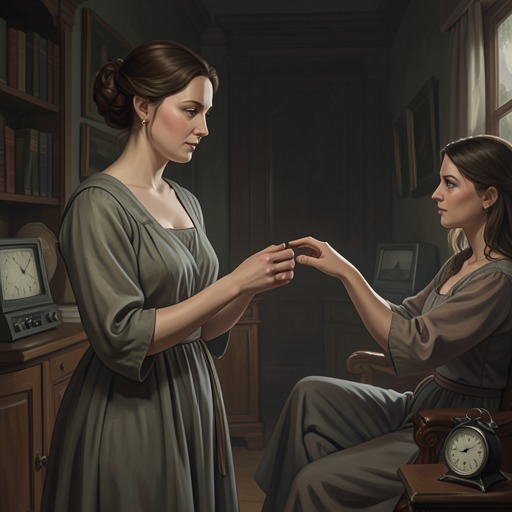
Germaine Laboine and Julius Van Cram
Maigret and the Dead GirlGermaine Laboine and Julius Van Cram’s relationship begins with a meeting in Istanbul and develops into a presumed marriage, a shared return to France, and the birth of their child. Its decisive complication is that the marriage, on which Germaine’s understanding of their bond and her later identity rested, was ultimately judged invalid. Van Cram’s departure did not end all contact, but the letters and money that followed never restored their shared life or resolved the uncertainty around him.
Meeting and unexpected family
Germaine met Van Cram in Istanbul when she was thirty-eight. He was described as Dutch and as staying at the Pera Palace; Germaine regarded him as a gentleman. The account of their history presents the meeting through details she later supplied, while leaving Van Cram’s own perspective and the circumstances that brought him to Istanbul unstated.
After a few months, Germaine discovered that she was pregnant, something she had not experienced before. She told Van Cram, expecting that he might advise her to end the pregnancy. Instead, he showed no apparent alarm and, a few weeks later, asked her to marry him. The sequence sharply changed the relationship’s stakes: what Germaine had taken to be a disclosure requiring a difficult response became, through his proposal, the beginning of a family arrangement.
A marriage believed to be real
The couple married in Istanbul, though the process as Germaine understood it offered little independent confirmation. Van Cram took her to an office whose location she could not identify; she signed papers and took an oath. Because he told her they were married, she believed him. The account does not establish what the papers were or what Van Cram knew about their legal force, so the marriage’s apparent certainty rests on her trust rather than on a document later accepted by French authorities.
A few days after the ceremony, Van Cram suggested that Germaine return to France to live. They travelled by Italian boat to Marseilles. They had not obtained a new passport for her, and they stayed in Marseilles for a couple of weeks before moving to Nice. There, in a comfortable apartment somewhere off the Promenade des Anglais, their child was born. These successive moves turn the supposed marriage into a practical domestic life, even as the lack of new papers leaves its legal basis unresolved.
Departure and intermittent contact
Two months after the child’s birth, Van Cram went out to buy cigarettes and did not return. Germaine never saw him again. The ordinary purpose of his errand contrasts with the permanence of the separation: the account gives no farewell, explanation, or confirmed reason for his departure. His absence ends their shared household without ending the relationship’s consequences for Germaine and their child.
Van Cram wrote several times from a succession of places—London, Copenhagen, Hamburg, and New York—and sent money with his letters. The sums varied, sometimes substantial and sometimes very small. He asked for news of Germaine and particularly of the child, and she replied. This correspondence preserved a limited channel between them, but it offered no return to their life in Nice and no account of why he had left. The pattern is one of contact at a distance: he remained informed about the family he had left, while Germaine was left to manage the consequences of his absence.
Legal uncertainty and the relationship’s significance
Years later, Germaine needed to renew her identity card and decided to obtain it in the name of Van Cram. Officials asked for her marriage certificate. The only paper she could produce was written in Turkish; it was examined and sent to the Turkish Consulate. She was then told that it was worthless and that she had never been married. The discovery retrospectively unsettled the status of the relationship: the ceremony and domestic life had been real to Germaine, but the proof she possessed could not secure the legal identity she sought.
The report also records suspicion that Germaine was not entirely truthful when she said she did not know where Van Cram’s money came from. That suspicion remains unresolved; no source for the money is established. It sits beside, rather than explains, the confirmed details of the relationship: the letters, their changing sums, Van Cram’s questions about the child, and Germaine’s replies. The account therefore preserves an asymmetry of knowledge without turning it into a proven accusation.
As a relationship, theirs is shaped by a swift promise of marriage, a short period of shared family life, and a separation that becomes permanent in practice but not absolute in correspondence. Van Cram’s letters sustain a thread of responsibility or attachment, although the evidence does not determine what feeling motivated them. For Germaine, the consequences are concrete: she raised the child after Van Cram disappeared and later tried to use his name to renew her identity documents, only to learn that the marriage she had believed in was not recognized. The bond persists in traces—papers, letters, money, and a child’s unanswered history—rather than in a resumed partnership.