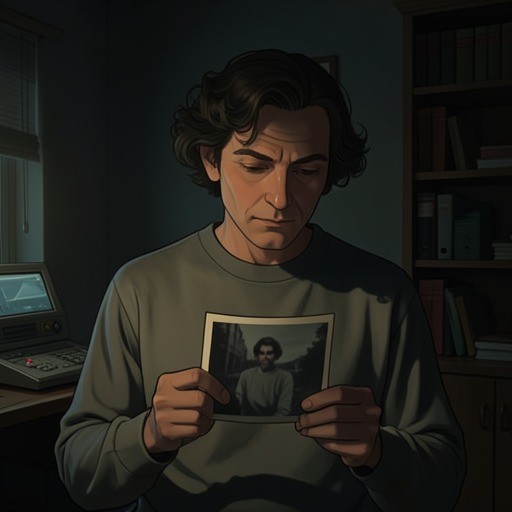
Louise Laboine
Maigret and the Dead GirlLouise Laboine is reconstructed less through her own account than through the places she stayed, the people she sought, and the final moments Maigret tries to imagine. Her path runs from a childhood in Nice with her mother to precarious lodging and an attempt to find Jeanine at Le Roméo; its decisive end is a street attack that begins as a grab for her handbag and becomes murder. The investigation makes her vulnerability legible, but only after the life she struggled to establish has been cut short.
Identity and Background
Louise grew up in Nice with her mother, Germaine Laboine, in circumstances the narrative presents as markedly different from those of their neighbors. Looking back toward Louise’s childhood, the narration suggests that she probably knew nothing of her father. Even when very young, she may have wondered why her mother was unlike other mothers and why the two of them lived differently from the people around them. These are retrospective inferences rather than memories Louise is shown recounting; her inner life has to be approached through what others can piece together.
The account describes Germaine as half-crazy, a judgment that conveys the instability surrounding Louise’s early life without giving a full history of their household. What is clear is the effect the narrative attributes to that upbringing: Louise entered a world she found bewildering and spent years trying, without success, to discover where she belonged. Her background is therefore not presented as a neat explanation for every later choice, but as the starting point of a long struggle to understand rules that seemed obvious to other people.
A Life Reconstructed from Fragments
As the inquiry progresses, the separate pieces of Louise’s route begin to form a sequence. The reconstructed account follows her from leaving her mother in Nice to the evening she found Jeanine at Le Roméo. That outline gives her movements a direction, but not the security of a homecoming: it shows her trying to reach a person, not arriving at a settled place in life.
Another fragment comes from a manageress of a small hotel on Rue d’Aboukir. After taking several days to come forward, and explaining that she had been too busy to read the newspapers, the woman reported that Louise had stayed at her hotel for four months and left two months earlier. Louise had occupied a top-floor room, a kind of garret, in what the witness described as the lowest sort of establishment; most of its clients were Algerians. The detail locates Louise in an improvised and low-status lodging, while the delay in the manageress’s report shows how easily evidence about her could remain unnoticed.
The reconstruction was not complete when Maigret reviewed it. The route from Nice to Le Roméo had become possible to trace, but about two hours of the night of Louise’s death were still unexplained. That gap matters: the inquiry could recover a broad itinerary while remaining unable, at that point, to account for a short but crucial interval. Her story emerges through successive corrections and partial witnesses rather than through a continuous testimony of her own.
Seeking Connection, Meeting Isolation
Louise’s effort to find Jeanine belongs to a larger pattern the narration identifies: she had held desperately to the first person she met, and that person eventually left her. Alone again, she braced herself to face what she experienced as a hostile world, still trying to learn how to manage within it. The language stresses not a single misunderstanding but repeated failure to find a secure place among other people.
The evening-dress image gives that isolation a concrete appearance. While sitting in a crowded bar on Rue de l’Etoile, Maigret tried to picture Louise entering in her shabby evening dress and a velvet cape that did not fit. The contrast is stark: the bar is full, yet his imagined figure is defined by ill-fitting clothes and by her precarious position among strangers. This is Maigret’s act of reconstruction, not a scene the narrative presents as his direct observation of her arrival. Its force comes from his attempt to imagine the person behind the case rather than treating her movements as entries in a file.
The Attack and Its Consequence
The account of Louise’s death reveals how an attempted theft became lethal. A car passed her first; then Bianchi got out as she came level with it. The street was deserted. He seized her handbag without realizing that its chain was twisted around her wrist. The chain kept the bag connected to Louise as she fell to her knees, turning the attempted snatch into a physical struggle.
When she opened her mouth to scream, Bianchi struck her in the face. Louise held on to him, apparently trying to call for help; he then took a blackjack from his pocket and clubbed her. The sequence gives the thin chain a grim importance. It is an ordinary fastening, but in the attack it prevents the bag from being easily taken and leaves Louise entangled with the man who is assaulting her. Her attempt to resist and summon help is followed by escalating violence, not rescue.
Maigret’s Recognition and the Story’s Meaning
Maigret’s understanding of Louise affects how he tests the account offered by Albert. He judges the story almost too perfect and says he would have believed it if he had not known the girl. Before reaching that conclusion, he has been sitting silently in Pickwick’s Bar on Rue de l’Etoile, trying to picture her among the customers in the clothes she possessed. His response turns familiarity with Louise into an investigative resource: a polished explanation can be questioned against the human circumstances of the person it purports to explain.
The closing reflection enlarges the individual case without pretending Louise ever solved the conditions of her life. For years she had sought a place in the world and failed; after losing the person she had clung to, she faced it alone and tried in vain to learn its rules. The narration’s final emphasis is thus on the distance between a traceable itinerary and a comprehensible life. Investigators can establish where she stayed, whom she went to find, and how the attack unfolded; Maigret’s effort to imagine her makes visible the loneliness and confusion those facts alone cannot contain.