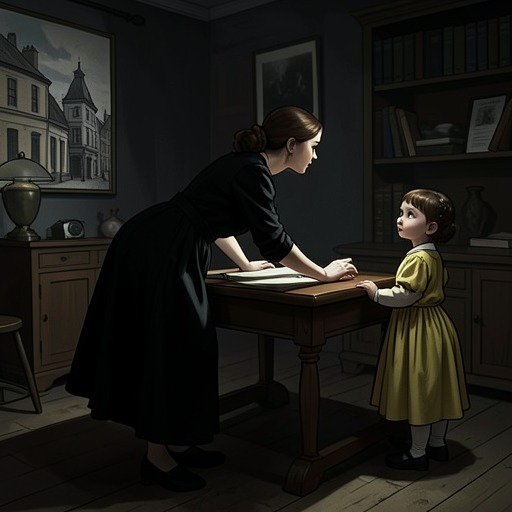
Louise Laboine and Germaine Laboine
Maigret and the Dead GirlLouise Laboine and Germaine Laboine are mother and daughter whose relationship is defined less by shared life than by an early departure that neither repaired nor fully explained. Louise left home for good on her sixteenth birthday; afterward, Germaine had little reliable knowledge of her daughter’s life in Paris and showed no visible grief when questioned about her. Their estrangement emerges through brief, practical recollections, making what is missing from their connection as important as what can be established.
Childhood and the limits of the record
The account of Louise’s childhood arrives as an image formed during the investigation: a little girl sent to buy fish at a shop where Germaine owed money and where the child received a cool reception. The detail gives their earlier life a concrete setting, but it does not establish how either mother or daughter understood the encounter. It shows Louise moving through an adult financial difficulty, dispatched on an errand into a shop whose response made her mother’s debt visible to her.
That glimpse is strikingly small beside the finality of what followed. The narrative does not supply a sustained account of their home life, the reasons for Louise’s departure, or the nature of their affection before the break. Instead, childhood is recalled through an errand and an unwelcome reception, while the later separation is recorded through letters and the answers Germaine gives an investigator. The relationship is therefore reconstructed from fragments rather than presented as a continuous domestic history.
Departure on her sixteenth birthday
Germaine reports that Louise left four years before, leaving a letter that said she was going for good. Louise was just sixteen, and the departure took place on her birthday. These details make the separation unusually definite: it was not described as a temporary absence or a gradual drift away, but as a departure announced in writing and attached to a specific day in Louise’s life.
Germaine did not report Louise’s disappearance to the police. The officer recounting the interview suggests that she was rather glad to be rid of her daughter, but this remains his interpretation, not a motive Germaine explicitly acknowledges. The distinction matters. The evidence supports a failure to seek official help and the investigator’s impression of relief; it does not disclose everything Germaine felt, or whether her apparent acceptance concealed other responses.
The letter gave Germaine notice that Louise intended to leave permanently, but it did not preserve an ongoing channel between them. When asked whether she had ever learned what became of her daughter, the account is that she had not. In this way, Louise’s written declaration marks both a decision and the beginning of an extended absence: Germaine knew that Louise had gone, yet the available testimony presents no continuing exchange between them.
Warnings without reunion
A few months after Louise left, Germaine received a letter from Mademoiselle Poré, who lived on Rue de Chemin Vert. Poré advised her to keep an eye on her daughter and not to leave her alone in Paris. The warning establishes that someone outside the immediate family had information or concern about Louise’s situation and took the trouble to alert Germaine. It does not establish what danger Poré feared, what arrangements she had with Louise, or whether Germaine acted on the advice.
Germaine could not initially provide the number of Poré’s house, though she promised to give it to the investigator that evening. The missing address is a modest but telling measure of how attenuated the connection had become: a potentially useful contact existed, but Germaine could not immediately supply its simplest identifying detail. Her promise also means the relationship was not wholly beyond investigative reach; the mother could still contribute a lead, even though she could not give the whereabouts of her own daughter.
The questioning further clarifies that Germaine knew Louise had left home and gone to Paris, but did not know her daughter’s address. Julius Van Cram had asked whether Germaine knew Louise had gone; the response indicates that this fact was known, while any precise location remained unknown. Awareness of the broad outline of Louise’s life did not amount to active contact or knowledge of where to find her.
A restrained response and its significance
When Germaine spoke about Louise’s fate, the investigator observed no visible sign of grief. He described her attention as belonging to another world, especially when she was fixed on the roulette ball and tightened her fingers as it stopped. That description places her response to her daughter beside the intensity of her gambling, but it is the observer’s characterization of her, not an independent explanation of her feelings. The narrative offers behavior and impression rather than a psychological account.
Germaine’s reported words are brief: “I hope she didn’t suffer too much.” They acknowledge the possibility of Louise’s suffering without identifying its cause or expressing a wish for renewed contact. The sentence can sound compassionate, but its restraint leaves the depth and history of that compassion unresolved. It neither cancels the evidence of separation nor proves that Germaine felt nothing for her daughter.
For the investigation, the relationship matters because Germaine can supply fragments of Louise’s past—a childhood errand, the birthday departure, Poré’s warning, and the fact that Louise went to Paris—but cannot point directly to her. The pattern is one of knowledge without closeness: enough memory to reconstruct the outline of a life, not enough connection to locate the person living it. Louise’s departure is therefore both a personal break and a narrative absence, made legible through the mother’s sparse recollections and the gaps they leave.