Louise Laboine and Julius Van Cram
Maigret and the Dead GirlLouise Laboine and Julius Van Cram are linked by an unusual combination of early abandonment and intermittent contact: he disappeared when she was an infant, yet continued to send money and ask after her through her mother. The relationship reaches the reader indirectly, through objects and recollections rather than a meeting between father and daughter. Its apparent continuity is also unsettled by the later discovery that the marriage on which the family’s history rested had no recognized legal standing.
A Father Known Through Others
The account of Julius Van Cram’s relationship with Louise comes chiefly from her mother, who describes their life together and the years after his departure. Louise was only two months old when Van Cram left, so she could have had no conscious recollection of a shared life with him. As far as her mother knew, he never returned to France. The father-daughter relationship is therefore not represented through conversation, shared experience, or a reunion; it is assembled from what the mother remembers and what Van Cram later sent.
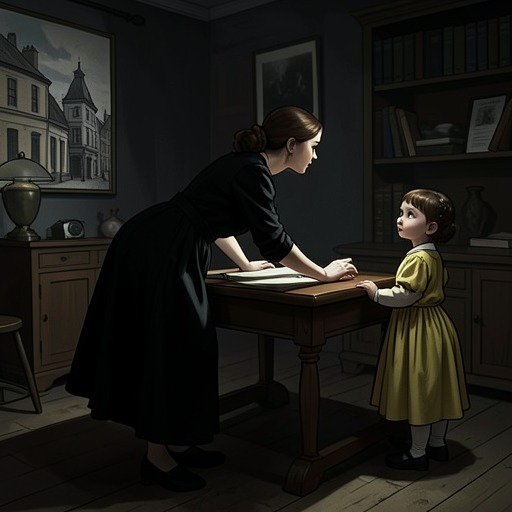
Before his disappearance, the couple stayed in a comfortable apartment near the Promenade des Anglais in Nice. Two months after arriving there, Van Cram went out to buy cigarettes and did not come back. The ordinary purpose of the errand sharpens the abruptness of the break: the mother’s account supplies no farewell or explanation, only an absence that became permanent from her point of view. Louise’s infancy makes that departure especially consequential for the relationship. Van Cram left before she could know him, and the story offers no later encounter to restore what his disappearance removed.
The Photograph and the Uncertain Connection
A shabby notebook found among the contents of Louise’s bag held money and a photograph of a man. The photograph was at least fifteen years old, faded, and dog-eared; it showed a man of about forty, described as handsome and distinguished-looking. His very light-colored, probably linen suit and the palm tree behind him prompted the observer to associate the setting with Nice. Asked whether Louise resembled him, the observer saw no likeness and noted that the possibility he was her father had occurred to them too.
The photograph gives the father question a material presence, but it does not by itself settle it. The man is not identified by name in the account of the photograph, and the lack of resemblance is an observation rather than proof either way. Its worn condition shows that it had been kept, while its place in a notebook containing money makes it part of the small group of personal possessions recovered with Louise. The narrative thus places an image of a possible father beside the later account of Van Cram without turning the photograph into conclusive identification. The relationship is made legible through traces, but those traces leave room for uncertainty.
Contact Across Distance
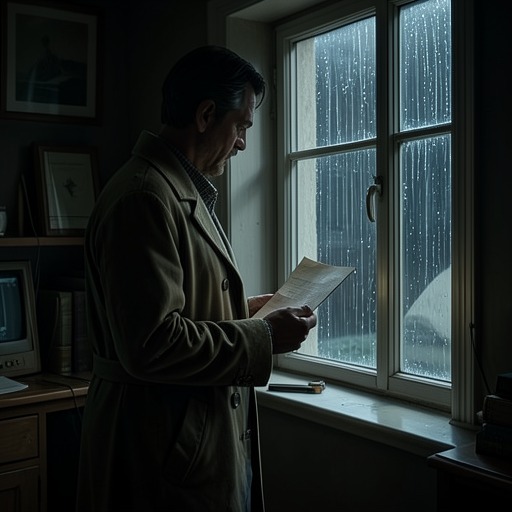
After leaving, Van Cram wrote to Louise’s mother several times from London, Copenhagen, Hamburg, and New York, and sent money with each letter. The sums varied: sometimes they were substantial, at other times almost nothing. His letters asked for news of the mother and, especially, of the child. She replied by poste restante. This correspondence establishes that the separation was not simply followed by complete silence. Van Cram maintained a channel of communication and showed interest in Louise’s circumstances, but all the contact described here passed through her mother; the evidence does not describe letters addressed directly to Louise.
The money makes that distance concrete. It could support the household, but its irregular amount meant that the assistance was not a stable provision. The last money order had arrived a year before the account was given. It was a large one, yet Louise’s mother lost the entire sum in a single evening of gambling. That loss connects Van Cram’s intermittent support to the precarious family life that followed his departure: money reached them, but its arrival did not guarantee security. The mother also acknowledged that she had not been entirely truthful about knowing where the money came from, leaving the source of Van Cram’s funds unresolved.
By the time the police asked whether Van Cram knew that Louise had left home for Paris, her mother said that he did know. He had asked where Louise was, but the mother did not know the young woman’s address. The information confirms that he had been told of her departure while underscoring the limits of his access to her: concern or inquiry did not become direct contact. Louise’s move to Paris therefore sits at the far end of a chain in which news traveled through her mother, while father and daughter remained apart.
Marriage, Paternity, and the Limits of the Record
The account of Van Cram’s disappearance is accompanied by a revelation about the marriage itself. When Louise’s mother renewed her identity card a few years earlier, she decided to obtain one in the name of Van Cram. Officials asked for a marriage certificate. The only paper she could produce was written in Turkish; it was examined and sent to the Turkish Consulate, where it was judged worthless. She was told that she had never been married at all.
That finding changes the status of the couple’s history without answering every question about Louise’s parentage. It undermines the official basis for the mother’s claim to have been Van Cram’s wife, but the account does not establish that he was not Louise’s biological father. Nor does it explain why the document was invalid or what Van Cram understood about the marriage. The evidence keeps these questions distinct: a remembered family relationship, a presumed father who left when his child was two months old, and a marriage that officials refused to recognize are not interchangeable facts.
The resulting portrait is one of connection maintained at a remove. Van Cram’s letters and remittances meant that he continued to receive news of Louise and to ask about her, yet the child grew up without seeing him, and no direct exchange between them is recorded. The photograph offers a possible face; the mother’s testimony supplies the chronology; the rejected Turkish paper unsettles the legal story. Together, these fragments define a paternal relationship that persists in evidence and material support but remains absent as lived companionship.