Louise Laboine’s isolation
Maigret and the Dead GirlLouise Laboine’s isolation is not simply a matter of being physically alone: it grows from insecure work, dependence on temporary shelter, and a reserve that other people struggle to interpret. In Paris she has a friend who gives her a place to hide, yet even that refuge is precarious. The novel shows the loneliness both through the practical arrangements of her life and through small observations—a habitual smile, a bench, a single sandwich—that make her presence visible while leaving her largely unknown.
Arrival and precarious beginnings
Louise arrives in Paris at the same time as Jeanine Armenieu. The two meet on a third-class train, where they cannot sleep and spend the night telling each other their life stories. Their connection begins in a shared condition of uncertainty: Louise has enough money for only two or three weeks, and the women initially appear close enough that someone who knows them might take them for sisters, cousins, or childhood friends. In fact, they have known each other only since the journey, two or three months earlier.
Louise finds work putting stamps on envelopes in an office. According to the account Mademoiselle Poré later hears from Jeanine and Louise, her employer makes advances and Louise slaps him. Mademoiselle Poré explicitly cautions that this may not be what happened; it is Louise’s reported version, not independently confirmed fact. When Louise runs out of money, she is turned out of the cheap hotel where she has been staying. Her next shelter depends on Jeanine, who offers to let her stay for a few nights while she looks for another job. The sequence leaves little margin between employment and homelessness, and makes friendship a practical necessity as well as a personal bond.
A friendship that cannot provide an ordinary home
Jeanine does not tell her aunt, Mademoiselle Poré, that Louise is staying in the flat. Instead, she lets Louise in while her aunt is out, and Louise hides under Jeanine’s bed until Mademoiselle Poré has fallen asleep. During weeks when Mademoiselle Poré works the second shift, Louise must remain there until half-past two in the morning, because her aunt does not begin work until three. The arrangement offers shelter only by requiring concealment; Louise is indoors, but cannot openly take her place in the household.
Their closeness also has limits. Mademoiselle Poré says she knows Louise mostly through Jeanine because Louise does not stop to chat. At first she assumes they are childhood companions or relatives; learning that they met only on the train changes her understanding of the friendship. She describes their feelings as mixed rather than simply affectionate or hostile, and says that the pattern she has seen among young women sharing rooms—first companionship, then growing dislike—develops especially quickly between these two. The evidence does not make the friendship unreal: Jeanine does offer Louise shelter. It does show that the relationship does not become a stable home for her.
The contrast between Louise and Jeanine
Mademoiselle Poré initially reads Louise’s reserve as pride, then becomes inclined to understand it as shyness. Her explanation is that young women arriving in Paris can respond to feeling lost either by bluffing and boasting or by withdrawing into themselves. Jeanine belongs to the first group: she is unafraid, goes out nearly every evening, learns how to dress, and soon stays out until two or three in the morning. Louise, by contrast, usually remains upstairs. She sometimes takes a walk, but never far, as if afraid, and the two go to the movies together only occasionally.
The contrast is not just between two temperaments. It records how differently the women manage the same unfamiliar city. Jeanine builds a life of outings and new acquaintances; Louise’s movements stay narrow, from upstairs to short walks and, at other times, to places within her immediate district. Mademoiselle Poré even says Louise seems like a little girl beside her friend, although they are about the same age. That comparison measures Louise’s apparent inexperience from an observer’s perspective; it does not explain away the economic and social pressures that keep her life so restricted.
Work, withdrawal, and being misunderstood
Work repeatedly fails to give Louise a durable foothold. Mademoiselle Poré says that Louise never adapts herself to a job and does not keep one for more than a few weeks. She has little education and poor spelling, which makes office work difficult. In shops, according to the account, a boss or department head may try to take her to bed. Rather than handle such advances tactfully, Louise responds by confronting the man, slapping him, or leaving and slamming the door. Once, after thefts in a shop, she is suspected, though Mademoiselle Poré considers her innocent.
These episodes show how Louise’s directness can intensify her vulnerability: a job that might have offered routine or independence ends in conflict, and suspicion can attach to her even when she has done nothing wrong. They also complicate the impression that she is merely aloof. People around her see the consequences of her reactions more readily than they know her circumstances; Mademoiselle Poré admits that she has heard only one side of Louise’s story. Her isolation is thus social as well as material: others observe her behavior, but their knowledge of her remains partial.
Solitary routines and departure
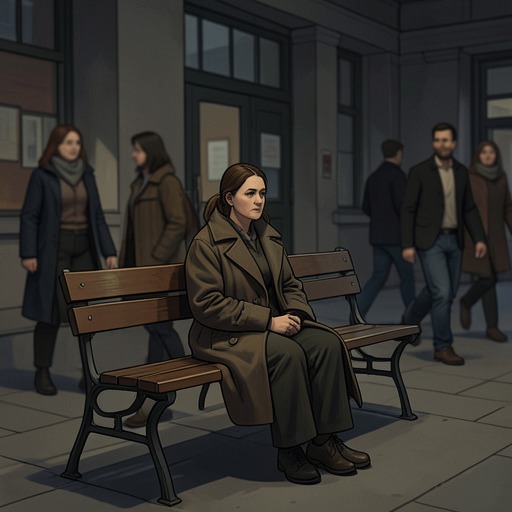
Another woman who sees Louise on the stairs says that Louise never speaks to her, though she always smiles. The witness thinks she looks unhappy and compares her appearance to that of a film actress. She has seen Louise several times on a bench in the Trinité garden, where she herself goes most afternoons with children. Louise is alone there. The witness recalls no one accompanying her and no sign that she reads; on one occasion, she eats a sandwich. The details are modest, but together they establish a routine of being present without joining in: Louise walks down Rue de Clichy, remains within the district, and sits in the garden doing nothing in particular.
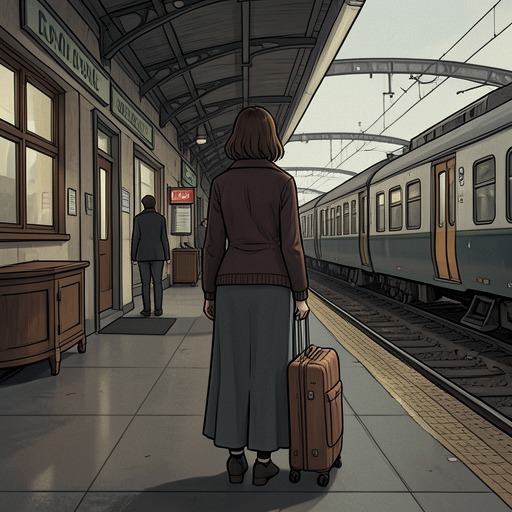
When Louise later tells Mademoiselle Poré that she has to leave, she does not cry. Her lips tremble, and Mademoiselle Poré can see that she feels completely lost. All she has with her is a little blue suitcase, and when asked where she is going, she says she does not know. Mademoiselle Poré offers to let her stay a few more days until another tenant is found; Louise thanks her but would rather not accept. That refusal does not erase the help she has received, but it leaves her departure unresolved: she has neither a destination nor substantial luggage, only the need to leave.
The account of Louise’s isolation is built from other people’s incomplete observations and recollections. The woman on the stairs can describe her smile and her visits to the garden, while Mademoiselle Poré can piece together her work, her concealment, and her uncertain friendship with Jeanine. Neither knows her fully. When the witness wonders whether Louise knew she was going to die, the ordinary details of that solitary routine acquire a grave retrospective weight: the woman who seemed to be doing nothing had been moving through a life in which few people could tell where she would go next.