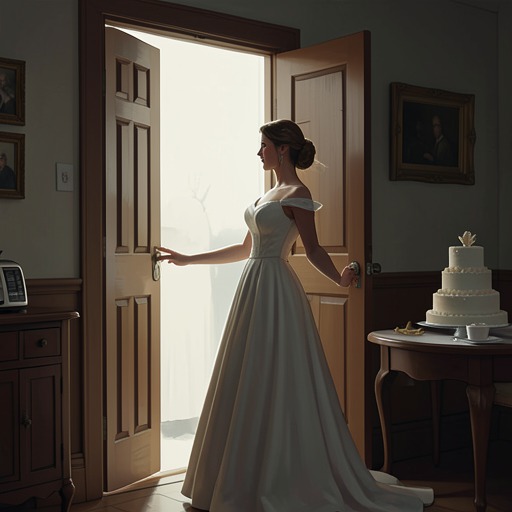
Louise goes to the wedding reception to find Jeanine and ask for help
Maigret and the Dead GirlLouise goes to the wedding reception to find Jeanine and ask for help, turning a crowded celebration into the setting for a quiet appeal shaped by poverty and uncertainty. She finds the bride amid the guests and speaks with her, but the account of that meeting initially leaves its practical outcome unresolved. Later testimony clarifies that Louise was seeking money after losing both her remaining funds and her lodging, and that Jeanine gave her several thousand francs. The episode links Louise’s visible attempt to reach an old friend with the precarious circumstances that made the appeal urgent.
The Reception and Louise’s Approach
When the head waiter first noticed Louise, she was standing just inside the reception-room door. He approached and spoke to her in a low voice; she shook her head. The account suggests that he may have been asking whose party she had come to join, but the exchange itself was not established as certain. Louise then slipped through the crowd without joining a group.
The room was busy: many guests were standing, while couples danced between the tables as well as on the dance floor. That congestion mattered to the course of the encounter. Jeanine was dancing, so Louise could not reach her immediately. It took time for her to make her way to the bride, and their conversation began only after she had crossed a room full of guests absorbed in the wedding.
A Difficult Conversation in Public
Once Louise reached Jeanine, the two women talked for several minutes. Their conversation did not unfold privately or without interruption. Marco Santoni, the groom, grew impatient and twice interrupted them. The interruptions mark a contrast between the wedding’s public celebration and Louise’s personal need: she had sought out the bride, but their exchange had to compete with the movement and demands of the reception.
A barman’s account described Jeanine’s manner as reserved, even cold. She shook her head several times while speaking with Louise. Those gestures offer evidence of distance or disagreement, but they do not establish exactly what the women said or whether Jeanine refused the request Louise had brought. The barman eventually lost sight of Louise in her blue dress. He could not say whether Jeanine gave her anything during their conversation, and the evidence from the reception alone therefore did not settle whether Louise had received help there.
The Need Behind the Visit
Later questioning of Jeanine supplied the circumstances that the reception witness could not see. Jeanine said that Louise came to look for her because she wanted to borrow money. Louise told her she had no money left and that her landlady had thrown her out. She also suggested that she saw no alternative to killing herself, though Jeanine recalled that Louise did not express this plainly. The appeal was therefore more than a request for ordinary assistance: it came from someone who described herself as penniless and without a place to stay, while communicating the seriousness of her situation indirectly.
Jeanine said she gave Louise three or four thousand-franc notes and had not counted them. That later account establishes that money did pass from Jeanine to Louise, while leaving a distinction important to the reconstruction: the barman could not confirm a transfer during the conversation he witnessed at the reception. In Maigret’s questioning, Jeanine also confirmed that Louise came to see her at the Roméo on their wedding night. The evidence thus connects Louise’s attempt to reach Jeanine at the wedding with a further encounter that night, without making the barman’s uncertainty disappear.
Significance and Limits of the Account
The episode is reconstructed from different kinds of testimony. The barman supplies the room’s visible details—Louise at the door, the crowded dancing, the conversation, Jeanine’s gestures, and Marco’s interruptions—but cannot report the women’s private words or confirm a gift. Jeanine’s later account supplies Louise’s stated need and the amount of money she gave. Read together, these accounts show both what the encounter revealed and what remained inaccessible to observers in the room.
The wedding reception also sharpens the contrast between Louise’s isolation and the social world she has entered. She arrives alone, is questioned at the door, and must find her way through a crowd before she can speak to the bride. Even then, the conversation is interrupted, and its meaning is difficult for an onlooker to read. The later disclosure of Louise’s homelessness and financial desperation gives the visit its decisive significance: beneath the brief exchange at a celebration lay an urgent effort to obtain help from someone with whom Louise’s relationship had become guarded.