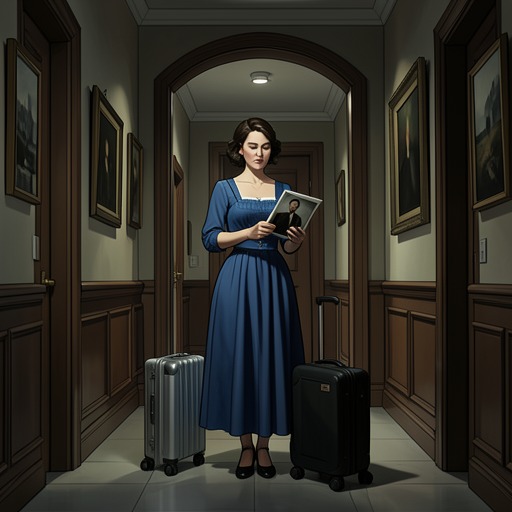
Madame Santoni
Maigret and the Dead GirlMadame Santoni, formerly known as Jeanine Armenieu, occupies a revealing place at the edge of the inquiry: her marriage gives her a public identity in Parisian society, while her earlier connection to Louise Laboine surfaces through a former shared flat and a letter meant for Louise. The evidence presents her indirectly, through a newspaper clipping and the recollections of people around her. That distance is significant: she is legible through changing social ties, but the account does not supply her own explanation of them.
Identity and Background
At the wedding announcement, the bride is named as Mademoiselle Jeanine Armenieu, a Parisian with no occupation, marrying Marco Santoni. The clipping devotes its more substantial portrait to the groom: he is forty-five, well-groomed and slightly stout, a representative in France for an Italian vermouth brand, and a familiar presence in nightclubs, bars, and leading restaurants. The wedding party is said to have attracted many guests because Santoni was popular in fashionable circles. Against that public profile, the bride is identified with striking economy: name, city, and absence of an occupation.
Mademoiselle Poré confirms that Madame Santoni is her niece, the daughter of her half-brother. She criticizes the way her half-brother brought Jeanine up, but gives no further account of her niece’s childhood. The distinction matters because Poré had been discussing another woman, a friend, whose photograph she had seen. She hesitated to approach the police because she could not be certain she would recognize that friend after three and a half years; she explicitly separates that uncertainty from what she knows about Jeanine. The family connection establishes a background, but does not turn Jeanine into the subject of the photograph or explain her later choices.
Marriage and Social Position
The investigator’s account places Madame Santoni outside the social pattern associated with her husband. Santoni had had numerous mistresses, mostly models or dancers, but Jeanine was not a model and did not belong to his circle. He had met her about four or five months before the inquiry, and, according to the account, had not told anyone where he had found her. The available facts thus set her apart from the company Santoni usually kept without explaining what drew them together or what she thought of his world.
Her wedding makes that difference visible in public. The ceremony’s announcement presents her as Santoni’s bride and records her as having no occupation; the investigation’s account, by contrast, emphasizes that she came from outside his accustomed milieu. These two descriptions do not contradict one another, but neither resolves the other. The marriage gives Jeanine a new public designation, Madame Santoni, while the questions around her earlier life remain open. The account supplies no direct statement from her about the courtship, the wedding, or the change in social position.
Louise Laboine and the Former Flat
In the inquiry into the former lodging, the rent and lease place Madame Santoni in a concrete position: she paid the rent, and the flat’s lease stood in her name. The people questioned say that the women left about six months earlier, with Jeanine departing first. The order is specific even though the evidence gives no reason for her departure. It establishes that she was not merely a name attached to Louise’s past; she had held the practical responsibility of the tenancy before the two women left.
That chronology sits alongside the report that Santoni met Jeanine roughly four or five months before the inquiry. It places the end of the flat arrangement and the beginning of the reported acquaintance within a relatively close span, but the account does not state that one caused the other or describe what happened between them. The contrast is nonetheless clear: the lease identifies Jeanine as the person responsible for a shared home, while the wedding clipping identifies her through her marriage to a wealthy, socially established man. Neither document explains how she moved from one setting to the other.
The Letter and Her Place in the Inquiry
A later telephone exchange connects Madame Santoni once more to Louise. The person speaking with her says that the concierge at Rue de Ponthieu had given her a letter for Louise. Madame Santoni responds with regret that she had offered to take it. The scene suggests that she was speaking by telephone with her husband, but it does not disclose the letter’s contents or establish what became of it. What it does show is that, after leaving the flat, she remained a point through which a message intended for Louise could pass.
Together, the clipping, family identification, tenancy details, and telephone exchange construct Madame Santoni from separate traces. In one, she is the bride in a large wedding party; in another, a niece whose upbringing her aunt disapproves of; in another, the named tenant who left the flat before Louise; and finally, the recipient of a letter meant for her former companion. These details connect her to several parts of the investigation without making her the source of its central answers. Her narrative role lies in that partial visibility: each new fact clarifies a relationship or circumstance, while her own perspective and the reasons behind her changes remain unreported.