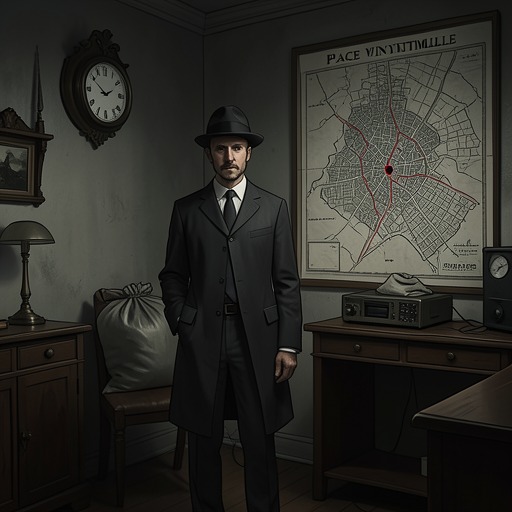
Marco Santoni
Maigret and the Dead GirlMarco Santoni is a forty-five-year-old representative in France for an Italian vermouth brand who moves in fashionable Paris nightlife. His marriage to Jeanine Armenieu connects that world to the investigation into Louise Laboine’s murder: the wedding makes Santoni a subject of the inquiry, and the letter entrusted to his wife gives Maigret a reason to reach him. The evidence establishes his social profile and his response to police, but does not establish that he is involved in the murder.
Identity and Social Position
Santoni is described as good-looking, slightly stout, and very well groomed. His work as a brand representative places him in France on behalf of an Italian vermouth company, while his leisure habits situate him among nightclubs, bars, and the best restaurants. He is presented as a familiar figure in the smart world, with a wide circle of guests attending his wedding.
The account also reports that Santoni had had many mistresses, most of them models or dancers. That history sketches a pattern of relationships within the social milieu he frequents; it does not, by itself, explain his marriage or establish anything about his conduct toward Jeanine. The contrast matters: Jeanine did not belong to his usual circle, and Santoni had not told people where he had met her.
Marriage and Public Profile
Santoni married Mademoiselle Jeanine Armenieu, identified as having no occupation and living in Paris. Their wedding reception took place at Roméo, which had been rented for the wedding party and was closed to ordinary clients that night. A newspaper clipping recording the marriage gives the event a public, verifiable dimension within the inquiry. The reception was well attended, consistent with the report that Santoni was popular among fashionable people.
Santoni had met Jeanine about four or five months before the investigation, as far as the investigator could discover. The circumstances of their meeting remain unexplained: she was outside his customary social circle, and he had not disclosed to others where he found her. This gap is a limit in the available account, not proof of deception. The evidence leaves their courtship’s beginnings obscure even as it records the wedding in detail.
After the wedding supper at Roméo, Santoni and Jeanine left for Florence, where they planned to stay for a few days. His flat was on Rue de Bern. These practical details place the couple away from Paris at a moment when the investigation was gathering information about the wedding and its guests; Santoni himself had not yet been interviewed in person. The investigator obtained information about the couple’s departure from Santoni’s valet, Joseph Ruchon.
Contact with Maigret
Maigret eventually reached Santoni by telephone after asking for Madame Santoni. Once the message had been delivered, Santoni—not his wife—came to the telephone. His voice was described as aggressive, and he immediately challenged the reason for what he understood as the pursuit of his wife. His response frames the first direct exchange as a dispute over why the police were involving Jeanine, rather than as a voluntary account of the wedding or his own movements.
Maigret told him that the police were not concerned with Jeanine as a suspect. The reason for contacting her was that a former friend of hers, Louise Laboine, had been murdered, and that a letter had been entrusted to Jeanine. Maigret explained that the letter might enable the investigation. Santoni replied that he had already been told about the murder the previous night, then continued to question the police interest in his wife. The exchange establishes his awareness of the case and the letter’s connection to Jeanine; it does not reveal what he knows about the letter’s contents.
Narrative Role and Limits
Santoni’s role is chiefly connective. His marriage supplies a route to Jeanine, whose possession of the letter matters to Maigret, while the wedding’s venue, guest list, and departure for Florence give the investigation concrete leads. The account’s sequence moves from a public record of the marriage to details gathered from people around the couple, then to the tense telephone contact. In that progression, Santoni shifts from a profile assembled at a distance to a voice challenging the inquiry.
The description of his polished appearance and fashionable habits also places him in contrast with the unresolved circumstances surrounding Louise, without making that contrast evidence of guilt. His unexplained meeting with Jeanine remains an unanswered biographical detail; his defensive reaction remains a reaction to police contact. The supplied account ends while Maigret is explaining the significance of the letter, so it does not establish Santoni’s later response, what happened to the letter, or any further part he may have played in the investigation.