Wedding of Jeanine Armenieu and Marco Santoni
Maigret and the Dead GirlThe wedding reception of Jeanine Armenieu and Marco Santoni is a private celebration at Le Roméo that becomes significant because Louise Laboine enters it and reaches the bride. Reconstructed afterward from witnesses and an investigator’s inquiries, the episode places Louise’s shabby blue evening dress amid a crowded, fashionable party: conspicuous enough to be remembered, but not enough to tell anyone what she wanted or whether she received help.
Occasion and Setting
On Monday night, shortly before midnight, Léon Zirkt waited opposite Le Roméo, a new night club on Rue Caumartin. The venue was not receiving ordinary clients that evening. It had been rented for a wedding party, celebrating the marriage of Marco Santoni, an Italian vermouth brand’s representative in France, to Jeanine Armenieu, listed as having no occupation and being of Paris. The party drew numerous guests; Santoni was described as popular in fashionable circles.
That private booking matters to the scene’s contrast. Outside, Zirkt and several other taxi drivers waited in drizzling weather, available to people leaving the club. Inside, guests danced and circulated among the tables. The reception had its own threshold and social arrangements, but it was not sealed off from the street: a neon sign lit the entrance, and the hired drivers could watch who emerged. The scene’s account connects those two spaces through observation rather than through any description of the ceremony itself. Its focus is the party as a place Louise enters, crosses, and leaves.
Louise at the Entrance
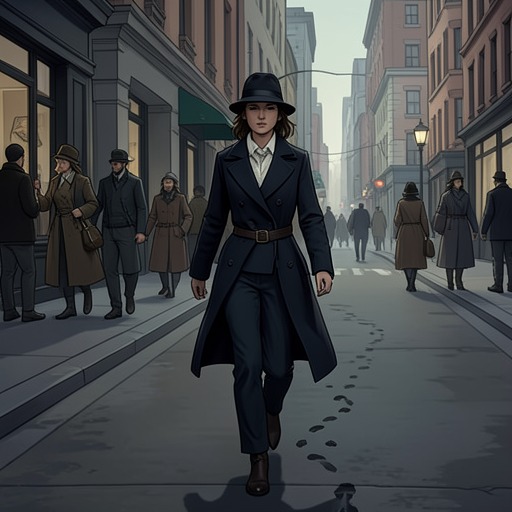
At about a quarter past twelve, a girl came out of Le Roméo wearing a blue evening dress and a dark velvet cape. Zirkt called his customary offer of a taxi; she continued walking and shook her head. He was certain she was the woman being sought. The entrance’s neon light had made her visible, and his experience working at night helped him notice that her dress was rather shabby. Gaston Rouget, the club’s doorkeeper, also recognized her photograph.
The difference between the formal occasion and the condition of her dress is a concrete detail, not an explanation of her presence. The evidence establishes that she attended the reception and later left on foot; it does not establish why she came, how she was admitted, or where she intended to go when she refused the taxi. Her appearance and refusal nevertheless gave the investigators useful points of recognition. A fleeting encounter at the club entrance could be compared with a photograph, and two witnesses—the driver and the doorkeeper—could connect the pictured woman to the wedding night.
Inside the Reception
The account of what happened indoors came from the barman. He first noticed the girl standing just inside the door. The head waiter approached and spoke to her quietly; she shook her head. The account suggests that he may have been asking whose party she had come to join, but this is presented as a probability, not a confirmed exchange. She then slipped through the crowd. Many guests were standing, while couples danced both between the tables and on the floor.
Her route through the room was neither described as an announced arrival nor as an encounter with the whole gathering. She moved among the guests until she could reach the bride. Because Jeanine was dancing, it took some time for Louise to get to her. Once they met, the two women talked for several minutes. These details establish a purposeful contact with the bride, but the witnesses do not supply the conversation’s words or a definite account of what Louise asked for.
Santoni interrupted them twice, growing impatient. His interruptions mark a repeated obstacle to the conversation, but the account does not say what he said, whether Jeanine tried to resume speaking, or how the exchange ended. Asked afterward whether the bride gave Louise anything, the barman could not say. The uncertainty is material: witnesses can place Louise in the room and confirm that she spoke with Jeanine, but they cannot confirm a transfer or resolve what passed between them.
Reconstruction and Significance
The reception reaches the reader as a chain of reported observations. Zirkt supplies the time, weather, clothing, refusal of a taxi, and view from outside; Rouget independently recognizes the photograph; the barman supplies the sequence inside the club. The investigator who pursued these details had visited Le Roméo and brought Maigret a newspaper clipping identifying the couple and the occasion. He also presented photographs, including one the witness recognized as showing the woman in evening dress. The account therefore distinguishes the wedding’s public particulars from the more uncertain reconstruction of Louise’s movements.
This evidentiary structure makes the party important without turning it into a fully explained episode. Louise’s presence is supported by recognition from more than one witness, and her conversation with the bride is supported by the barman’s account. Yet the central matter—the purpose and result of that conversation—remains open in the available testimony. The setting sharpens that gap: a crowded celebration, a bride repeatedly occupied by dancing, and a groom interrupting twice are all visible circumstances, while the substance of the meeting is not. The wedding thus becomes a hinge in the investigation, joining a traceable public occasion to a private exchange whose outcome the witnesses could not establish.