Beauty as a weapon and armor
Man on FireBeauty as a weapon and armor is the novel’s account of how Rika Balletto’s exceptional appearance functions at once as social power and protection, shaping her choices while limiting her perspective. Beauty opens doors and wards off indignity, but the security it provides can also keep its possessor from seeing beyond the world organized around her appearance.
Beauty as leverage and shelter
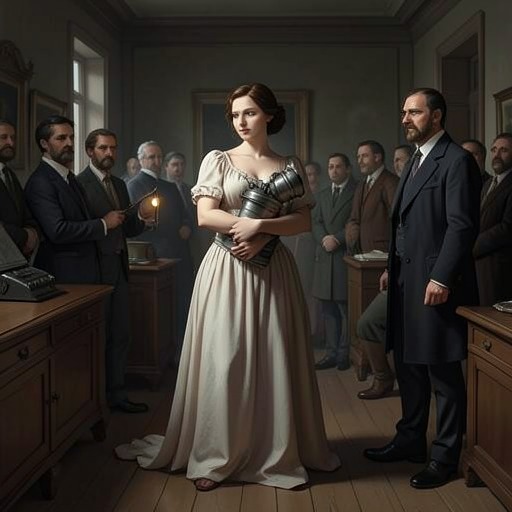
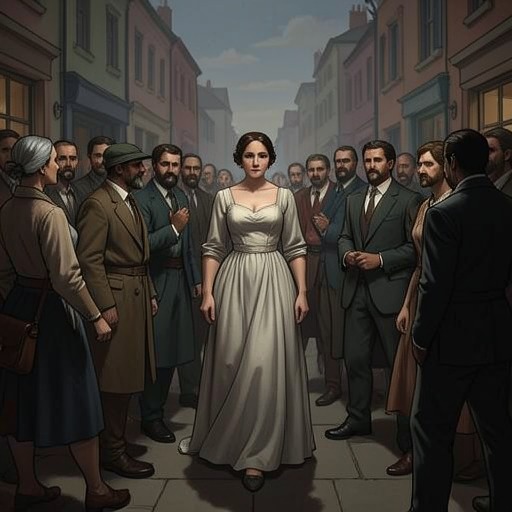
The idea is introduced as more than a description of Rika Balletto’s looks. Her beauty has controlled her mind because, from an early age, it has allowed her to follow paths unavailable to most women. The novel describes it as both a weapon, with which to move through life, and an armored vehicle that protects her from discomfort and indignity. The paired images capture the concept’s double action: beauty can help someone exert influence, but it also screens her from experiences that might otherwise deepen her understanding.
That protection has a cost. The narrator suggests that Rika Balletto has a good mind, yet imagines that in a less beautiful body it might have developed beyond the narrow circle illuminated by her appearance. The vehicle metaphor makes the limitation active rather than merely external: as beauty carries her forward, its movement pushes shadows out of view. Advantage thus becomes a boundary. The problem is not that Rika Balletto lacks intelligence, but that the world’s response to her beauty can make other forms of attention, experience, and development harder to reach.
Attention, selfhood, and social status
The account broadens from Rika Balletto to women whose beauty makes them objects of constant attention: eyes watch them and ears listen. Under such scrutiny, the narrator argues, self-centeredness can become a condition of survival and adaptation. Even the possibility of independence is framed as precarious. If a woman’s character survives until her beauty fades, it may emerge on its own; more often, the loss of beauty is accompanied by grievance at nature for withdrawing what it had once bestowed. This is the novel’s generalization, not a simple celebration of beauty’s rewards: the same attention that confers privilege can make identity reliant on continued admiration.
Rika Balletto’s argument over her daughter’s protection reveals how beauty’s social currency intersects with class. She insists that Pinta Balletto’s well-being is not an extravagance, comparing it with material luxuries and pointing out that other prominent families have hired bodyguards for their children. Creasy understands that her concern is not only about physical safety. Rika Balletto also fears that others will think her family unable or unwilling to keep pace with its social rivals. The scene shows status operating as a form of protection in its own right: the bodyguard is presented as care, but also as a visible sign that the family can meet the expectations of its circle.
Desire and the gaze
Creasy’s assessment of Rika Balletto brings the concept into the realm of attraction. He notices her unadorned appearance: little makeup, naturally hanging hair, long unpainted nails, and no perfume. He reads these details as an extension of her personality, rather than as decoration added to it. Her beauty is therefore not treated solely as a public image; in his perception, it seems continuous with her way of being.
Yet Creasy’s attention is also calculating. He registers his physical attraction as a factor in their situation and watches Rika Balletto’s response to him, interpreting her initial hostility as giving way to curiosity. He believes she is drawn to his past and to its violence, and that she likes to dominate and test the limits of domination, first mentally and perhaps physically. His conclusion is caution. The passage makes attraction a contest of observation and anticipated influence: he studies her as she studies him, and beauty is one element in a relationship neither assumes to be neutral. It also makes clear that this reading belongs to Creasy; the novel does not simply equate his interpretation of her desires with an objective account of them.
The limits of bodily power
The concept’s force lies in its refusal to make physical advantage an uncomplicated form of freedom. Rika Balletto’s beauty protects and empowers her, but the protection can restrict her view; social attention can confer status while tightening the bond between selfhood and appearance. Elsewhere, Creasy’s story emphasizes a very different vulnerability of the body. He reaches a point at which he cannot find a reason to continue living, later recognizes that his reactions have grown dull, and ultimately lies gravely wounded, with blood and torn flesh visible to those who come to help him. These scenes do not describe beauty, but they prevent bodily power from seeming permanent or absolute. His love for Nadia Schembri and the physical intimacy they share likewise belong to a different register from Rika Balletto’s public social advantage: intimacy is depicted through mutual discovery, gentleness, and trust, not through beauty as armor. Together, these contrasts frame beauty as a consequential but limited resource—one that can shape how others respond, without guaranteeing inner freedom, lasting strength, or protection from loss.