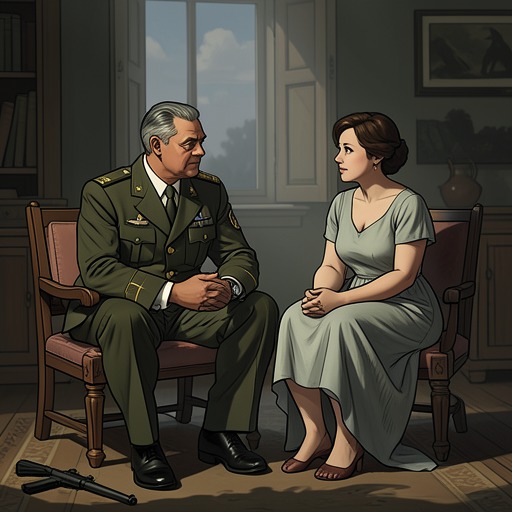
Belonging and acceptance by the community
Man on FireBelonging and acceptance by the community on Gozo are shaped by an egalitarian social code, a guarded approach to outsiders, and acts of recognition that become meaningful because they are earned. For Creasy, the island’s welcome is more than hospitality: over the course of his stay, its people make him part of their routines and obligations, giving him a sense of friendship and belonging he has never known before. Yet that happiness remains in tension with the purpose that eventually takes him away.
An egalitarian community with its own boundaries
Creasy’s first impression of Gozo is of a place unlike the social worlds he has known. He remembers no class distinction: the poorest fisherman considers himself as good as the richest landowner, while a person who believes himself superior would be better off elsewhere. The island’s noise and cheerfulness do not mean that it immediately opens itself to everyone. Its people may be friendly to strangers, but they do not disclose local information until they understand who is asking and what the person wants.
That distinction appears in the bar at Gleneagles. Creasy asks after Paul Schembri, explaining that the farmer lives near Nadur, but the bartender initially replies that Schembri is a common name and that Gozo has many farmers. Creasy is not offended; he understands the reticence as a defense of the island’s privacy rather than a personal rejection. He knows the bartender must know the man, but waits, drinks his beer, and lets the encounter proceed on local terms. The small island protects its own knowledge even from tourists, and familiarity, not mere arrival, is what opens the way in.
Recognition begins with familiarity
When Creasy explains that Guido Arrellio sent him to stay with Paul Schembri, the bartender recognizes which farmer he means. He studies Creasy, then smiles, introduces himself as Tony, and recalls that Creasy was present when Guido married Julia. He identifies his brother Sam and the other men at the bar, including the local drinker known as Shreik and Michele and Victor, who work on the ferry when they are not drinking there. Creasy remembers Michele and Victor supervising the loading of cars and trucks and collecting fares. The names and recollections turn a brief exchange into recognition: he is no longer simply an unknown visitor.
Tony calls Joey Schembri to collect him, and Creasy settles into the company around the bar. A pint placed before him and the familiar practice of buying rounds matter because they include him in an ordinary social ritual rather than making him the subject of an interview. He recalls the Gozitans’ capacity for drinking: once the rounds begin, a day and a half can pass. In this setting he feels relaxed and able to relate to the people around him. He expects neither intrusive questions nor the effort to assign him a social category or manufacture intimacy. The island’s welcome, as he experiences it, asks for conduct rather than a polished account of identity: be as one wishes, do not tread on others, do not be mean when it is one’s turn to buy, and above all do not be proud. A person might be accepted despite serious transgressions, he reflects, but arrogance would breach the community’s central taboo.
A nickname as proof of inclusion
The community’s acceptance becomes unmistakable when Creasy learns that the Gozitans have given him a nickname. After a near mishap, Shreik jokes that it is a pity Creasy was not properly drowned, since the islanders could then have held a real party in commiseration. On the drive back, Creasy asks what the repeated Uomo means. Joey explains that everyone on Gozo has a nickname; Uomo means “man” in Italian and is complimentary. Creasy privately thinks that, after the morning’s effort, “jackass” might have been more apt. But the joke and the name carry a larger significance: outsiders do not merit nicknames. The nickname marks the passage from being tolerated as a visitor to being recognized as someone within the community.
That acceptance does not depend on ceremony. Creasy can sit among the regulars, listen to their conversation, and be present without having to perform a new identity or account for his past. The customary rules are plain and reciprocal: do not presume superiority, do not impose on others, and take one’s turn in the social exchange. The simplicity he finds there is itself a relief. In a place where people are not trying to slot him into a category or force a spurious friendship, recognition is expressed through familiarity, shared time, and the expectation that he will observe the same standards as everyone else.
Nadia and the public shape of belonging
Creasy’s growing relationship with Nadia Schembri becomes part of this communal recognition. Their attachment takes shape through repeated, quiet routines: they meet at the cove in the evenings, swim and talk, and grow close without stating a formal commitment. Nadia discovers Creasy’s dry, often cynical humor; he sees in her deep intelligence and an erotic mystery, as well as the possibility of a full life that would not constrict him. Their unforced intimacy is private in feeling, but Nadia also wants the community to see them together. When they go to Gleneagles, she sits beside him with an arm around his waist, openly presenting herself as his woman.
The regulars do not comment on the pairing. To Shreik, Benny, Tony, Sam, and the others, the relationship between the Schembri girl and Uomo simply seems right. Their silence is not indifference; it is the community’s quiet recognition of a bond that has become part of its visible social order. Creasy is not only accepted by the island’s men as a drinking companion and worker: he is also recognized alongside Nadia, in the place where the community gathers. The relationship’s public ease contrasts with Creasy’s earlier isolation, while the lack of interrogation preserves the privacy he values.
Friendship, obligation, and departure
By the time Creasy prepares to leave, the difference between being a stranger and belonging has become palpable. George Zammit tells him that he has made friends there, especially on Gozo, and asks him not to forget them whatever happens on his trip. At Gleneagles, Creasy enters a room filled with fishermen, farmers, and the people who have become familiar to him. He has never made friends before; now he is absorbed into the noise and affection of the gathering. Victor passes him a drink, Nadia brings him a cable confirming that the general in Paris has honored his request, and conversation flows around him. The scene gathers the small recognitions of his stay into a collective farewell.
Belonging is also expressed as a promise of practical help. Benny takes Creasy onto the balcony and solemnly tells him that if he ever needs assistance, he must call Benny first or Benny will be angry. He directs Creasy to send a cable to Gleneagles, where Tony will find him at any time. The offer gives their friendship a future beyond Creasy’s immediate presence on the island. It is not merely a warm goodbye but a specific assurance that he can call on someone there.
Creasy, in turn, tries to settle what he owes Paul Schembri. He points out that he has lived in Paul’s house for more than two months and eaten a great deal of food, so the stay should be paid for. Paul proposes fifteen pounds a week, the same amount a farm laborer earns locally, and says that this makes them even. He also insists that he could not have found a worker that summer who would have done as much as Creasy. The exchange balances hospitality with work and payment: Paul refuses to treat Creasy as a burden, while Creasy wants to acknowledge the material cost of being received. Their negotiation makes belonging reciprocal rather than sentimental.
Creasy leaves with Nadia after saying his farewells, not because he has failed to find happiness on Gozo but because he understands that remaining would mean turning away from his purpose. His will for revenge has not weakened; he imagines it as a closed drawer that will soon be opened and dominate his thoughts. The farewell therefore holds two truths together. The island has given him friendship, a nickname, intimacy, and a community willing to help him; none of these can erase the purpose he believes he cannot abandon. Acceptance changes what leaving costs, even as it does not change his decision.