Carabinieri
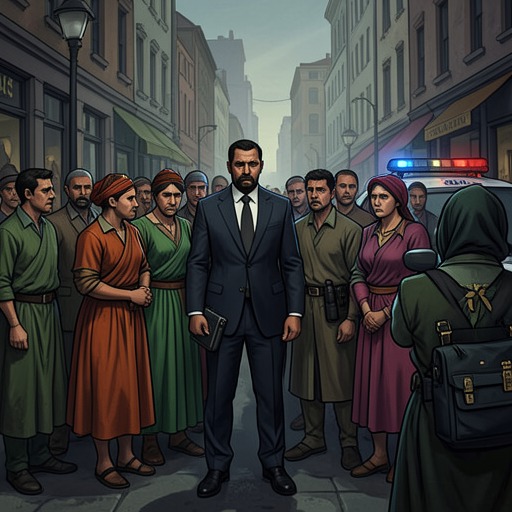
Man on FireThe Carabinieri are the Italian law-enforcement force through which the novel examines the difficult work of confronting organized crime. Their most prominent representative is Colonel Mario Satta, whose investigations depend on patient collection of evidence, surveillance, and informants rather than on a single decisive raid. Through Satta and his assistant, Massimo Bellu, the force appears both as an institution with national reach and as a human organization vulnerable to compromised information and difficult judgments.
Institutional Role and Criminal Context
The novel places the Carabinieri in a country where organized crime has rebuilt its influence alongside the postwar return of ordinary commerce. After the Americans liberated Italy, criminals were released along with people imprisoned under the Fascists; justice and crime, the narration observes, returned together. By the early 1950s, criminal bosses had restored networks that profited from prostitution and legitimate businesses, while presenting protection from other criminals as a service. Later, leading bosses sought agreements over territory and power, treating coordination among criminal groups as a means of imposing their own order.
Against this background, law enforcement faces more than isolated offenses. The criminal networks connect activities across regions and cities, and their influence can reach into official life. The novel does not depict the Carabinieri as automatically able to overcome that system. Instead, it shows the force working through evidence and procedure while the criminal organizations retain resources, influence, and opportunities to interfere.
The kidnap-for-ransom trade illustrates the wider setting in which police work takes place. Italian insurers are not permitted to issue ransom policies, on the stated grounds that insurance could encourage kidnapping, while foreign coverage is available under conditions of offshore payment and secrecy. In the scheme involving Pinta, a supposed security arrangement becomes part of an insurance fraud: the bodyguard is hired for appearance and reduced premiums rather than effective protection. These circumstances do not make the Carabinieri parties to the scheme; they show the financial and criminal mechanisms surrounding the offenses the force must investigate.
Satta’s Investigative Work
At thirty-eight, Satta holds the rank of colonel in the Carabinieri. His standing may owe something to his mother’s connections, the narration allows, but even his enemies are more likely to credit his ability. His choice of policing also sets him apart from the more conventional paths his family considered suitable. The novel links his work to a skeptical interest in the conduct of a corrupt society, rather than to a simple faith that the law is already functioning well.
For three years, Satta’s work has largely consisted of assembling and comparing information: matching names and faces, and tracing criminal activity between northern and southern cities. He connects, for example, a prostitution ring in Milan with a wine-adulterating group in Calabria and a drug-smuggling syndicate in Naples. This accumulated knowledge makes him exceptionally well informed about the Italian Mafia, including its internal workings.
During the year before the main investigation, Satta has begun turning that knowledge into active cases. He spearheads an inquiry into a major steel-plant scandal in Reggio di Calabria, which results in Don Mommo going to prison for two years. He then focuses on the two principal Families in Milan, led by the Abrata Family and the Fossella Family, gathering evidence concerning prostitution, coercion, and drugs. His methods include telephone tapping, surveillance, and the use of informants. The purpose is specific: to build a case strong enough to imprison senior figures, potentially including the families’ leaders.
That work takes place amid a shift in public opinion. People are increasingly angered by organized criminals’ arrogance and apparent immunity, while stronger laws have begun to follow political change. Yet sentences remain inadequate, and witnesses are difficult to find and protect. The novel therefore presents policing as a contest in which improved public support and legal powers do not by themselves erase the practical obstacles to prosecution.
The Rabbia Murder and the Case Against Creasy
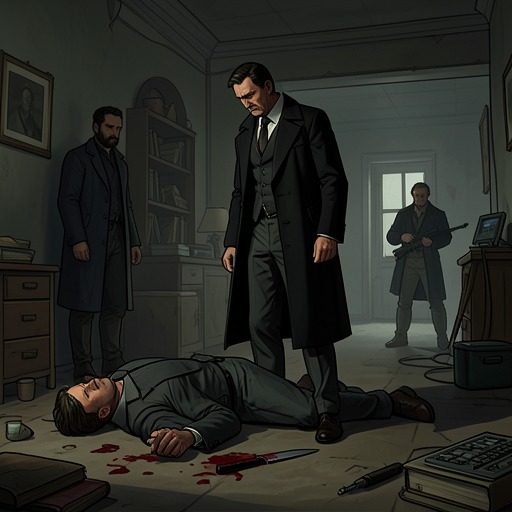
When the body of Giorgio Rabbia is found face up in a drainage ditch beside an access road to the Milan–Turin motorway, Satta and Bellu attend the scene. Satta recognizes the irony of a criminal collector having himself been collected. Bellu reports that the body was discovered an hour earlier and estimates that Rabbia died sometime during the previous night.
Satta treats the killing as a problem requiring reconstruction, not an invitation to jump to conclusions. Rabbia had worked as a collector for fifteen years and, in Satta’s assessment, was loyal even if not clever. The possibility that the murder came from outside the organization raises the central questions of who acted and why. Satta orders Rabbia’s file and every transcript of telephone interceptions from the preceding seventy-two hours, making the investigation’s next step a review of records and communications.
The case eventually places Satta in a conflict between his duty to apprehend killers and his judgment of the circumstances surrounding Creasy. Satta does not describe this as a conventional crisis of conscience: he considers himself capable of setting conscience aside. The sharper difficulty is propriety. He believes laws must exist and that enforcers alone should possess an unspoken latitude to bend them. Creasy’s actions create an opportunity, but also offend that principle, leaving Satta to work toward a compromise rather than simply abandon either his enforcement role or his own standards.
Command, Secrecy, and Institutional Vulnerability
Satta reports the full story and his compromise to his superior, a general, who trusts him and agrees that Satta will control the case. They decide that the press will receive no information, though they expect the story to emerge within days. The arrangement demonstrates the force’s chain of command while granting Satta unusual operational responsibility.
The investigation is divided geographically. Bellu is left to complete work in Milan and then move to Rome to stay near Conti. Satta drives south to Naples, regarding Guido as the key to understanding Creasy’s preparations and character. He orders the Pensione Splendide’s telephone monitored and its mail intercepted. Reports can provide facts, but Satta believes Guido can provide the personal understanding that records cannot.
The novel also shows that official information is not secure simply because it belongs to the police. On the same day Satta sets out for Naples, an officer in the Milan Carabinieri records department files a copy of a confidential memo after reading it carefully. That evening, the officer has dinner with a friend and substantially improves his financial position. The sequence strongly suggests a compromised channel, though the narrative does not specify exactly what was exchanged. It places institutional vulnerability beside Satta’s painstaking attempts to control information and protect the investigation.
Emergency Response and Narrative Significance
At the final confrontation, Satta acts directly to preserve life. He presses his fingers into Creasy’s wounded arm to slow the bleeding, while Bellu asks what he can do. Satta directs him to call for help, insists that those coming be fully equipped, and demands a helicopter immediately. As Bellu makes the call, Satta continues applying pressure. He sees Don Cantarella’s dead body nearby and notices the gold crucifix amid the blood, but keeps his attention on the wounded man.
This closing action gives the Carabinieri a concrete role beyond surveillance, files, and jurisdiction: their officers are also the people summoned to manage the physical aftermath of violence. Satta’s hands are tired, yet he maintains pressure while sirens approach. The scene brings the institution’s authority down to an urgent, bodily task, completing a portrait of law enforcement that is neither effortless nor detached. The Carabinieri can investigate, coordinate, and respond, but their effectiveness depends on individual judgment, trusted colleagues, and the fragile integrity of the information passing through their ranks.