Catholic Church
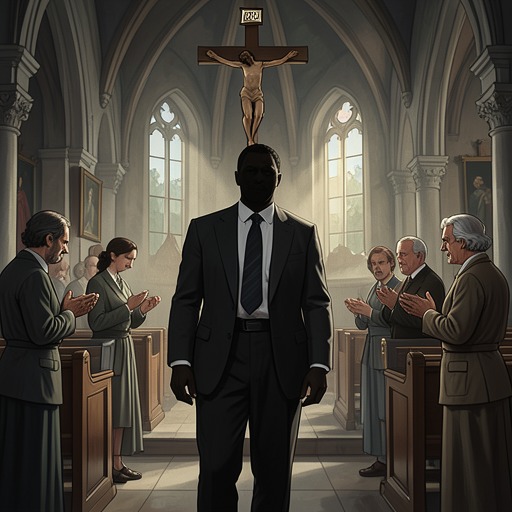
Man on FireThe Catholic Church in the novel is at once a visible institution, a community of service, and a set of intimate practices through which characters confront suffering, guilt, and uncertainty. Its wealth and procedures provoke Creasy’s distrust, yet the selflessness of missionaries and the faith of Pinta and Nadia Schembri complicate his judgment: the Church’s institutional contradictions do not exhaust what belief means to the people who live by it.
Hierarchy, Wealth, and Doubt
Creasy’s view of the Church is shaped by both personal loss and what he has witnessed in war. Raised Catholic, he cannot reconcile a providential God with the deaths of innocents or with the suffering he has seen. His skepticism sharpens when he recalls the Pope’s visit to the Philippines. The country’s beautiful churches stood amid widespread poverty, while bishops who had gathered in Manila to meet the Pope later traveled first class and drank champagne on a plane to Hong Kong. To Creasy, the contrast between religious display and deprivation had no logic.
That judgment is not the whole of his experience. He has also encountered missionaries in the Congo and Vietnam who spent their lives working without material reward. The narrative places those lives beside the champagne-drinking bishops, making the Church appear neither uniformly corrupt nor easily defended: institutional privilege and costly service coexist, and Creasy cannot make them resolve into a single answer.
Missionary Duty in the Congo
One memory gives that tension a human scale. Creasy and Guido drive to a mission hospital outside Leopoldville as the simbas approach. They tell four Belgian nuns that the danger is imminent, that their unit cannot protect them, and that they must leave. The nuns refuse because they believe their duty is to remain with their patients. Even when Creasy describes the violence they may face, they do not change their decision.
A young nun, whom Creasy recognizes as especially vulnerable, meets his warning with the words, “Go with God,” and a serene smile. The encounter leaves him reluctant to drive away, but his unit has to retreat. When he and Guido return a week later, they find the hospital’s destruction so appalling that years of witnessing brutality have not prepared them for it. They dig a grave and bury what remains. Later, Creasy kills many of the simbas; the narrative connects that killing to the atrocity without presenting it as a clear act of divine justice. He wonders whether it is God’s will or revenge, and whether faith is a test—but cannot accept an explanation that makes the suffering intelligible. The nun’s courage remains evidence of devotion, not an answer to his questions.
Faith as a Personal Practice
Pinta gives Creasy a small gold crucifix on a finely wrought chain, bought with money she saved herself. The gift carries particular weight because she knows that religion is, for him, a subject of contradiction. He has described the loss of his impoverished Catholic parents and the wartime suffering that made belief in a just, attentive God difficult. Pinta does not argue away those experiences. Instead, she offers a concise distinction between certainty and faith: “If you know for sure, you don't need faith.” Her own position is direct: she will believe unless someone proves beyond doubt that belief is false. When Creasy asks how she would recognize such proof, she answers that it would be announced on television.
The crucifix becomes a recurring presence rather than a resolution of Creasy’s doubts. When he begins exercising again after his decline, Laura Schembri tells him, “I go to early Mass at five o'clock,” explaining that someone in the family has to pray for its sinners. Creasy lightly asks her to pray for him too. She nods, then looks at the crucifix around his neck. The scene brings the object, his admission of wrongdoing, and Laura’s everyday religious practice together without claiming that he has become a believer.
Sacraments, Marriage, and Community
The Church’s authority also enters the lives of the Schembri family through marriage and confession. After returning to Malta, Nadia Schembri tells Paul Schembri and Laura what has happened and applies for an annulment. The Cowboy, who married her, forwards the papers to the Holy See and explains the drawn-out process: witnesses must be found, depositions taken, and anonymous judges must decide the case, potentially over years. The teaching that marriage is sacred stands beside Nadia’s immediate distress. She wants a normal family life, but fears that gossip in a small community will make remarriage difficult even if the annulment is granted. Her attachment to her family home and land offers steadiness while that institutional decision remains unresolved.
Confession is another point where formal religious practice meets ordinary life. Salvu, whose wife died five years earlier, goes to church in Nadur every Sunday and deliberately confesses outrageous sins to provoke The Cowboy. Laura says the priest keeps the confessional secret; Salvu, rather than the priest, tells others about the performances, claiming they help The Cowboy understand what he is missing. The episode sets the sacrament’s strict confidentiality against Salvu’s irreverent use of it, while preserving the priest’s obligation to silence.
Later, Nadia’s religious routine changes. She begins attending early Mass every morning but does not enter the confessional. The Cowboy finds this an enigma: she prays daily, yet does not confess. When someone suggests that she must confess, the answer is blunt: “You cannot confess for another.” The line marks a limit on religious authority as well as a rule of individual responsibility. Earlier, before Creasy’s revenge campaign, Nadia had promised to go to church with her mother and pray for him to kill the people responsible for Pinta’s death, postponing confession until he was dead or had returned. Her later pattern preserves the distinction between prayer and confession: devotion can accompany anger and loyalty, but it cannot substitute for another person’s act of confession. Across these scenes, the Church is not merely a hierarchy or a set of doctrines; it is encountered in a saved-for gift, a dangerous act of service, a long legal process, and the repeated practices through which people seek help, keep faith, or remain answerable for themselves.