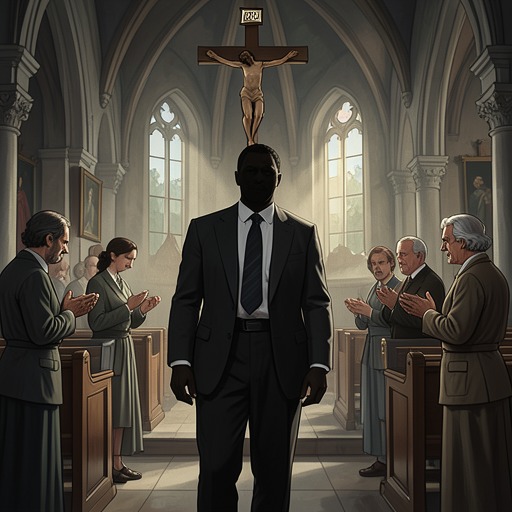
Catholic confessional secrecy
Man on FireCatholic confessional secrecy is the rule that a priest must not disclose what is said in confession. In the novel, its clearest explanation comes not through formal doctrine but through everyday conversation: Laura assures Creasy that The Cowboy would never reveal Salvu’s confessions, even though Salvu himself talks about them. The rule thus appears as a firm boundary maintained by the confessor amid the irreverence and teasing of Gozo’s local life.
The Rule in Practice
Laura describes The Cowboy as keeping the confessional secret. Creasy questions how that works when Salvu, a widower with a small farm near Ramla, goes every Sunday to the church in Nadur and confesses what Laura calls the worst imaginable things, deliberately hoping to get a rise out of the priest. Her answer draws a clear distinction: The Cowboy will not disclose what Salvu says, while Salvu remains free to boast about his own conduct.
That distinction makes secrecy an obligation of the priest rather than a silence imposed on the penitent. Salvu turns confession into a private joke at The Cowboy’s expense, claiming that his stories help the priest understand what he is missing. The joke depends on the priest’s restraint: Salvu may tease him, but the confessional remains protected because The Cowboy does not answer by exposing or repeating what he has heard.
Creasy’s Questions About Faith
Creasy’s interest in the rule belongs to a broader uncertainty about religion. Pinta gives him a small gold crucifix on a fine chain, recalling their earlier conversation about faith. Raised Catholic, Creasy associates religion with his parents’ suffering: his mother died of pneumonia without money for adequate care, and his father later died after alcohol eased his passing. His experiences of war have not reconciled him to a God who permits the deaths of innocents.
Pinta offers a different account of belief. She tells him that certainty would leave no need for faith, and explains that she saved her own money to buy the crucifix. The object therefore joins personal belief to an act of care between them, rather than settling Creasy’s doubts. Later, after beginning his recovery, he asks Laura to pray for him; she looks seriously at the crucifix around his neck. These moments place religious practice, doubt, and the object itself alongside the institutional rule of confession without suggesting that they resolve his questions.
Confession, Prayer, and Personal Responsibility
Laura’s own religious practice is regular and practical. She rises for five-o’clock Mass and says that someone in the family has to pray for its sinners. Her remark prompts Creasy to ask her to pray for him too, lightly acknowledging his past sins. Mass, prayer, and confession occupy related but distinct places in these scenes: Laura attends Mass and prays for others, while Salvu makes his own confession and The Cowboy keeps it confidential.
The distinction becomes sharper in a later scene involving Nadia Schembri. She comes to early Mass every morning, although she had not done so before, and prays each day without entering the confessional. The Cowboy regards her as an enigma, but when the possibility arises that another person must confess, he answers that one cannot confess for someone else. The exchange marks a limit on what confession can do: the secrecy of the rite protects what an individual confesses, but it does not make one person’s act of confession transferable to another.
Narrative Significance
The rule is shown through conduct rather than a formal exposition. Creasy’s question gives Laura the opportunity to state the principle plainly, while Salvu’s repeated provocation demonstrates that The Cowboy follows it even when the penitent turns the practice into a joke. The later contrast between Nadia’s prayer and her absence from the confessional extends the subject from confidentiality to the personal nature of religious responsibility.
Across these episodes, the novel keeps institutional practice close to ordinary life: Sunday confession, early Mass, a priest’s silence, and a gold crucifix worn by a doubtful man. Catholic confessional secrecy is not presented as proof that Creasy has found certainty. Instead, it is a concrete boundary of trust within a story where faith remains unsettled, and where religious meaning is encountered through particular people and acts.