Creasy and Pinta's Growing Trust and Friendship
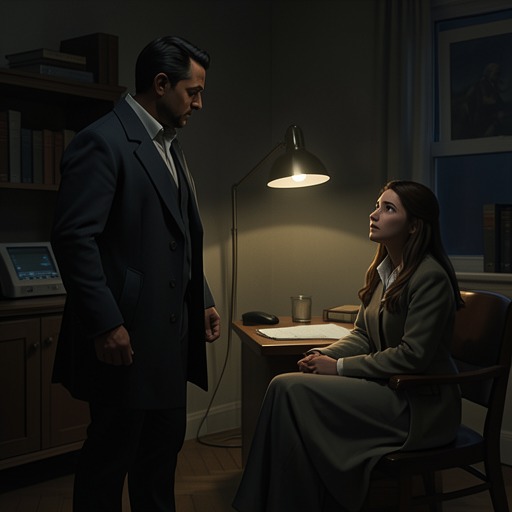
Man on FireCreasy and Pinta's Growing Trust and Friendship begins as a one-sided effort: Pinta, an observant and persistent eleven-year-old, wants to know the taciturn man who has entered her household, while Creasy treats her approach as an unwelcome demand. Their relationship becomes reciprocal almost imperceptibly. Pinta's curiosity draws him back toward ordinary human attachment, and his attentive care gives her the trusted adult and guide she has been seeking. When she is later killed, the bond she helped create becomes inseparable from Creasy's grief and his decision to leave in pursuit of those responsible.
First Contact and Resistance
At their first meeting, Pinta is dressed in a white T-shirt and jeans. She formally offers Creasy her small hand and smiles tentatively; he is a stranger whose chest reaches far above her head. She wants to know him, but his reserve makes even simple contact difficult. In a car, she notices the disfiguring scars on his hands and reaches out to touch one. Creasy jerks away and sharply tells her not to touch him while he is driving. Her interest has encountered not just silence but an explicit boundary.
Pinta responds with tears and anger. Creasy stops the car and explains that he does not get on with children or like questions; if she cannot accept that, she should ask her father to find someone else. She moves to the back seat and insists on addressing him formally as Mr. Creasy. The exchange establishes the early pattern of their relationship: his instinct is to close himself off, while she feels the hurt but does not abandon her wish to befriend him.
At meals, Pinta appears to accept the distance. She talks instead with Bruno and Maria, treating them warmly, and leaves Creasy alone as though he were a necessary but uninteresting fixture. This is a deliberate pose, not indifference. Having been told not to bother him, she chooses an indirect strategy: she will watch for a weakness in his defenses rather than risk another direct rebuff. Her patience is active. She believes there is more to the man than the remote figure he presents, and waits for an opening.
Care Opens the Relationship
The opening comes by accident. While her parents are away in London, Pinta hears that a nightingale has nested in a bush behind the house and hurries up the steep slope to see the two chicks. She steps on a stone, turns her ankle, and falls hard against an outcrop. Creasy hears her cry, examines the swelling ankle and the abrasion below her ribs, and checks carefully for damage. He decides to take her into Como for an X-ray, sends Maria back to the house to wait in case Pinta's parents call, and asks Bruno to stay with her. Then he lifts Pinta and carries her down to the car, careful not to press her injured side.
His gentleness is practical rather than consciously intimate: he has often dealt with wounded people, and his first response is to calm and reassure them. But for Pinta, the care matters. Her efforts to win his friendship are no longer only a game of curiosity; she has begun to feel a definite, if fragile, link with him and wants to strengthen it. Creasy, too, feels that connection. It unsettles him: he cannot easily imagine himself as a friend to an eleven-year-old, yet he finds that he cannot banish her from his mind and does not want to.
The change becomes visible after a Sunday lunch with Elio and Felicia. Creasy brings Pinta into the company of his friends, and she looks to him for cues before gradually relaxing. She plays with the children, helps Felicia in the kitchen, and joins in teasing the men. The day gives Pinta a sense of acceptance, and it changes the terms between her and Creasy: he has not introduced her as a child to be managed, but as a friend among friends. Afterward, she is more at ease with him, and her questions begin to draw out answers rather than provoke retreat.
Conversation, Memory, and Trust
Pinta becomes a listener as well as a questioner. She asks about Guido after hearing Creasy talk about their long friendship, and notices that his expression softens when he speaks of him. In turn, Creasy finds it unexpectedly easy to talk to her. Her limited experience and open mind help make the conversation a kind of release: he can speak about pain and the brutalizing effects of war without the discussion becoming another ordeal. Pinta pays attention and responds, building a dialogue across their different generations and backgrounds.
One conversation returns to the scars she had first tried to touch. This time she asks what happened without provoking him to jerk away. Creasy tells her, and the memory takes him back to the end of the Battle of Dien Bien Phu in 1954: surrender, humiliation, and a three-week forced march to a prisoner-of-war camp, where little food and frequent deaths marked the journey. When exhausted men fell and could not rise, guards shot them. Creasy survived and carried a wounded young officer on his back. Later, during interrogation, a Vietnamese captain repeatedly stubbed cigarettes out on Creasy's strapped-down hands while questioning him. Pinta's willingness to ask, and Creasy's willingness to answer, turn the scars from a reason for withdrawal into a point of trust.
She learns more about his earlier life than anyone except Guido: his poor parents and childhood on a small Tennessee holding, his early enlistment in the Marines, his fighting in Korea, and the disgrace that followed when he struck an officer whose decisions had cost good men their lives. She also learns why he joined the Legion and how war shaped him. The intimacy is not based on Pinta knowing everything, but on Creasy allowing her to know what he has kept from others. Her curiosity gives him a setting in which painful memories can be spoken rather than shut away.
Shared Purpose and Lasting Consequences
Their friendship also takes the form of shared work. After Pinta injures her ankle, Creasy helps her prepare for the sports meeting. He makes starting blocks and sets them into the front lawn; when she can train, he coaches her starts in a blue-and-white tracksuit. He explains reaction time and teaches her to respond automatically to the starting sound rather than anticipate it. Clapping his hands to simulate a gun, he drills her until she springs from the blocks like a startled deer. He sets the expectation of an hour's practice each day and tells her she will win.
The training gives Creasy a reason to consider his own physical decline. Watching Pinta's energy and fitness makes him think about returning to a gym after the three-month period in which his employment will be confirmed. More deeply, he recognizes that she has filled a vacuum in his life. Her future gives him something to attend to and a part to play: he can watch her develop and contribute to her growing mind. Against the death and destruction that had made his previous existence seem futile, helping her is an ordinary, continuing responsibility. The friendship does not erase his past, but it gives him a direction that is not organized around violence.
That direction is shattered when Guido tells Creasy that Pinta is dead and that she was abused. Later, Creasy tells Nadia the story of his arrival in Naples, his initial effort to shut Pinta out, and the gradual closeness that followed. He recalls the day in the mountains when Pinta gave him the crucifix as the happiest and most natural day of his life. As he describes her awareness, curiosity, and joy in living, Nadia understands the girl through his words and grieves for her as though she were her own child. Creasy's account makes clear how much of his renewed capacity for feeling came through Pinta: her trust drew him into care, and his memories of her remain vivid enough to be shared as a living presence. Her death therefore ends neither the significance nor the force of their relationship. It turns the friendship that restored his sense of purpose into the emotional ground of his grief and the actions he undertakes afterward.