Creasy and Rika expose the kidnapping fraud
Man on FireCreasy and Rika expose the kidnapping fraud in a dinner-table confrontation that changes the meaning of Pinta Balletto’s abduction: the crime was not simply an attack on a child, but an insurance scheme in which her father, Ettore Balletto, was implicated. Creasy brings the concealed arrangement into the open, tells Rika who profited, and then yields to her the decision of what should happen to Ettore. The scene turns a campaign of revenge into a moment of choice, without resolving what Rika will do next.
The insurance logic behind the scheme
The fraud grows out of the economics of kidnapping insurance. Vico Mansutti explains to Ettore that Italian insurers are barred from writing policies of this kind because insurance might encourage kidnapping, while foreign insurers can offer the coverage. Lloyd’s of London is presented as a leading provider. Its policies require premiums to be paid outside Italy and the insured person never to disclose that he is insured. The secrecy condition, ostensibly part of a legitimate financial arrangement, becomes essential to a plot in which the victim’s family is secretly involved.
The policy’s price also gives the arrangement a practical rationale. A full-time bodyguard could lower an insurance premium by improving the stated security provision: in Vico’s example, a one-billion-lire policy might cost fifty million lire at five percent, or thirty million at three percent if a bodyguard were hired. Since that bodyguard would also cost thirty million lire a year, Vico describes a cheaper alternative: a nominal premium bodyguard costing about seven million lire, whose presence could qualify the insured for a lower rate without providing meaningful protection. This distinction between protection on paper and protection in fact anticipates the breach that follows.
Ettore’s actual policy, Creasy later tells Rika, was for two billion lire. The alleged agreement was that Fossella would return half of the ransom to Ettore. Vico had acted as intermediary and received a commission for his connection to organized crime. What had been presented as protection against a financial catastrophe was thus, in Creasy’s account, a mechanism for distributing the proceeds of a kidnapping among its beneficiaries.
From promised protection to catastrophe
Rika’s fear for Pinta is established well before the revelation. She insists to Ettore that their daughter’s safety is at stake and invokes a child taken outside his school in broad daylight as evidence that kidnapping is a real danger. Ettore argues that the family is not wealthy enough to attract kidnappers, while privately aware that his financial difficulties are becoming known in the city’s financial circles. Their disagreement gives the later fraud its bitter force: Rika’s demand for genuine protection meets a plan that treats security as a financial calculation.
Creasy approaches the job as a tactical problem. Although he has not previously worked as a bodyguard, he thinks in military terms, viewing Pinta as an asset who might be seized at home, at school, or on the road. He inspects the school’s high, spike-topped walls and heavy gates, and identifies the route as a likely point of danger, where changing the daily journey could frustrate an ambush. The threat does arrive during an ordinary return to the car: a black car mounts the curb, four men appear, and Creasy recognizes the kidnapping attempt. He shoots one man but hesitates to fire at the others while Pinta is between them; one attacker catches her and carries her back toward the car.
The kidnapping ends in Pinta’s death despite the ransom being paid two days earlier. She was meant to be released that night, but failed to appear. The next morning police found her in the trunk of a stolen car. During a major sweep for a Red Brigade gang, the kidnappers apparently became nervous and went to ground for several hours. Pinta’s hands and mouth had been taped; she vomited, probably because of petrol fumes, and the autopsy established that she choked to death. The account explains the immediate circumstances of her death while sharpening the difference between ransom as a transaction and the irreversible loss it could not prevent.
Creasy’s account at the dinner table
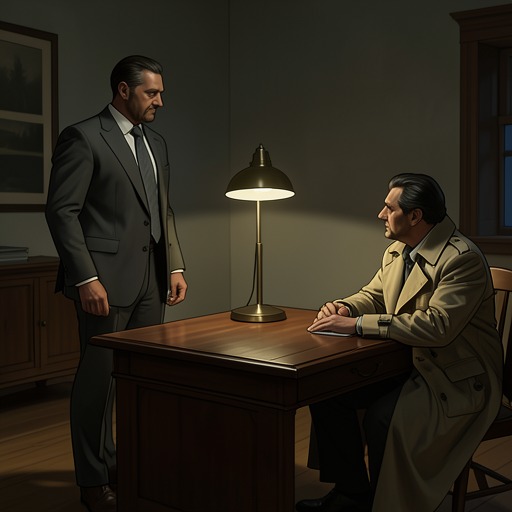
When Creasy returns to the house by the lake, Ettore and Rika are sitting opposite each other at dinner. Rika has grown thinner but retains her beauty; the narration contrasts her loss with Ettore’s apparent preservation of what matters to him. Their expectation that a servant is bringing dessert is interrupted by Creasy filling the doorway. He advances, turns a chair around, and sits with his arms across its back. He tells Ettore that he intends to speak to Rika and warns him that any interruption or movement will get him killed; then he places a loaded pistol on the table.
The threat fixes the room’s positions, but Creasy’s central action is disclosure. His manner softens as he tells Rika what he learned from Fossella: the kidnapping was arranged as an insurance job, Ettore took out the Lloyd’s policy, Fossella was to return half the ransom, and Vico served as the go-between for a commission. Rika watches Creasy throughout the explanation and looks at her husband only when it is over. Her hatred becomes visible in the silence between them; Ettore slumps, opens and closes his mouth, and lets his eyes slide away. The scene makes the revelation legible through those reactions as well as through the particulars of the scheme.
Revenge, recognition, and the unresolved choice
Rika asks whether Creasy killed the people who carried out the kidnapping. He confirms that he intends to kill everyone who profited, including the boss in Rome and the powerful figure in Palermo. The scope of his revenge is therefore broader than the men at the scene of the abduction: it reaches the people who arranged, brokered, or benefited from it. When Rika asks whether he meant all of them, Creasy picks up the pistol and says he came to kill Ettore.
Instead, he puts the pistol away, stands, and says he might leave Ettore to Rika. She emphatically asks him to do so. This is not a recorded act of revenge by Rika, but a transfer of agency: the man Creasy entered intending to kill is left in the room with the person whose fear and trust he betrayed. As Creasy moves toward the door, Rika stops him with a question about Mansutti. The exchange ends by opening the next line of accountability rather than showing its outcome. In that unresolved turn, the scene distinguishes exposure from justice: the fraud has been named, its beneficiaries identified, and Ettore’s immediate fate placed in Rika’s hands, but the consequences she will exact remain unknown.