Creasy's Emotional Numbness in Wartime
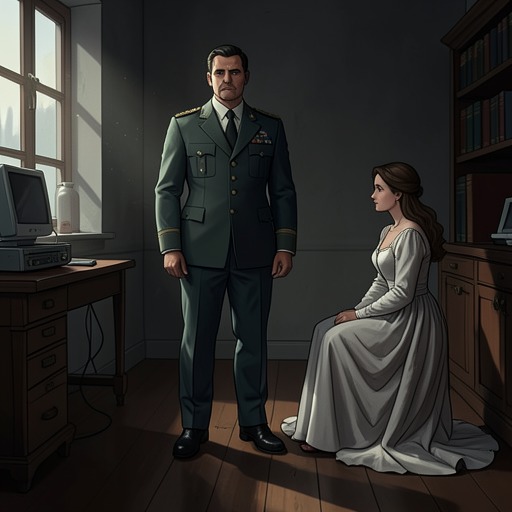
Man on FireCreasy's Emotional Numbness in Wartime describes both the protective shell Creasy built against suffering and the gradual disturbance of that defense through his relationship with Pinta. War had taught him to perceive children’s misery without allowing it to reach him emotionally; Pinta's curiosity and trust make that old division harder to maintain, and give him a reason to imagine a future beyond violence.
The Wartime Defense
Creasy's distance from children is not presented as indifference born in a vacuum. In the wars he has fought, children have seemed to him among the most exposed victims: confused, separated from their parents, and hungry. He remembers children in the Congo with swollen bellies and uncomprehending eyes, and children in Vietnam, where they could look like dolls yet be caught among bombs, mines, and gunfire. He has heard that South Vietnam contains more than a million orphans and feels, at times, as if he has seen them all.
The scale and repetition of that suffering make compassion feel dangerous to him. Creasy believes that a person exposed to such misery must either shut it out or lose his mind; he chose to close himself off early. He still saw the children, but, as he understands it, the message carried by their eyes was diverted before it could fully reach his mind. The distinction matters: his numbness does not erase his awareness of their plight. Instead, it interrupts the passage from seeing to feeling, a survival mechanism that allows him to keep functioning in the midst of war.
The narration identifies this numbing of compassion as the most acute of war's brutalizing effects. Creasy's accumulated experience has made pity something he can contain by distance, rather than something he can respond to through sustained attachment. That defense has served him in settings where children's hunger, injury, and bereavement recur without respite. His new work, however, places him close to a child who is neither hungry nor homeless, and whose ordinary presence cannot be managed as just another image of wartime suffering.
Pinta Enters His Guarded World
At first, Creasy expects Pinta herself to be the difficulty. He has little experience with children; before her, they have existed in his life chiefly as objects of pity. His arrival gives Pinta, an only child who is often bored, someone new to talk to. She treats him as more than a protective presence, and her interest prompts an exchange that he would not ordinarily seek out.
Pinta begins by asking about America. Creasy explains that he has not lived there for years, but her enthusiasm persists, and he tells her he came from the South, from Tennessee. Her questions open a conversation in which he eventually begins answering questions about himself. She asks about Guido, whose friendship with Creasy is already a subject of conversation between the two men. As Pinta learns about their years together, she notices that Creasy's hard features soften when he speaks of his friend. Her attention is observant as well as curious: she begins to understand him through the changes in his expression, not merely through the facts he supplies.
Creasy finds it easy to talk with Pinta. He considers whether her lack of experience or her uncluttered mind makes that possible, but the consequence is clear: speaking with her brings relief. She leads him toward difficult subjects, including the pain and brutalizing effects of war. The conversation does not immediately remove his defenses; rather, it creates an unusual space in which he can acknowledge what those defenses have been holding back.
The Hands and the Act of Witnessing
The change becomes visible when Pinta asks, "Creasy, what happened to your hands?" Earlier, Creasy would have jerked away from such attention. This time he looks down at the mottled scars. The physical marks lead his memory back to the end of the Battle of Dien Bien Phu in 1954: surrender and humiliation, followed by three weeks of forced marching to a prisoner-of-war camp. The men had little food, and death was frequent. Guards shot those who fell and could not get up. Creasy survived the march and carried a young wounded officer on his back.
Survival was followed by interrogation. Across a wooden table sat a small, immaculate Vietnamese captain, while Creasy, huge and gaunt, refused to answer the questions with anything but a shake of his head. The captain chain-smoked Gauloise cigarettes and stubbed them out on the backs of Creasy's hands, which had been strapped down. The old injury is therefore not an abstract emblem of suffering: the scars connect Pinta's present-day question to a specific sequence of coercion, endurance, and pain.
Creasy tells her, "A man once asked me questions. He smoked a lot. There was no ashtray." His understated account does not reproduce the interrogation in full, but Pinta understands what he means. She falls silent, and tears fill her eyes. For Creasy, this is a reversal of the old diversion: another person has looked at the evidence of pain, understood it, and remained emotionally present. He does not recoil from her response. He tells her, "Bad things happen in the world. I told you that, once." Pinta, smiling through her tears, answers, "Good things happen, too." The exchange places suffering and consolation in the same conversation without pretending that the latter cancels the former.
A Different Measure of the Future
Creasy's altered course becomes most explicit in his response to Pinta's life ahead. He recognizes that she has filled a vacuum. He wants to watch her develop and to play a part in the growth of her mind. Against the wars that had offered him death, destruction, and mutilation, this prospect does not seem futile: it gives his attention a future-facing object. The change is not a claim that his memories have disappeared, but that his capacity to care has acquired a direction beyond surviving them.
The development also reframes his sense of time. Pinta has a life in front of her, and Creasy imagines remaining present as that life unfolds. The thought that he might contribute to her growth contrasts with the wartime scenes in which children appeared as hungry, displaced, or caught in violence. Here a child is not only a witness to suffering but a person whose future can be supported. That difference makes closeness possible where pity alone had kept him at a distance.
The narrative traces this emotional reawakening through concrete acts of attention: Pinta's questions, her noticing the softening of Creasy's face when he speaks of Guido, her touch on his scarred hands, and her tears after she understands his answer. Creasy's wartime numbness began as a means of enduring repeated exposure to suffering; it loosens not through a general rejection of his past, but through a particular relationship in which he speaks and is heard. Pinta's reply leaves both realities intact—bad things happen, and good things happen too—and gives Creasy a reason to stay attentive to what can still grow.