Creasy's Weariness of Life and Loss of Purpose
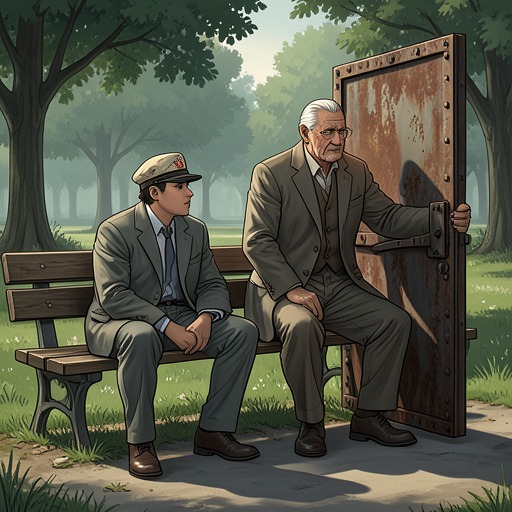
Man on FireCreasy's Weariness of Life and Loss of Purpose is the crisis that leaves Creasy unable to imagine a meaningful future after a lifetime of war. In Rhodesia, he sees the conflicts that have defined him as repetitions without an attainable end; his retreat into heavy drinking and physical neglect gives that conviction a bodily form. Guido's quiet understanding keeps the crisis from becoming mere isolation, while Creasy's later bond with Pinta offers a sharply different kind of purpose: attention to a living person whose future is still open.
The Crisis Named to Guido
After arriving in Naples, Creasy tells Guido that he can no longer find a reason to go on living and cannot summon even slight enthusiasm for a new morning. His difficulty is not described as a single disappointment. It is the exhaustion of a man who has spent years identifying himself with soldiering and has come to feel that this identity has consumed the possibilities of a life beyond it.
The night after his arrival, he tries to explain himself in his characteristic reticent, disjointed manner. His sentences are separated by silences and long pauses as he thinks out each next phrase. Guido does not interrupt or press him; he sits nursing a drink and lets his friend work through the account. Creasy finally gives the feeling its bluntest expression: "I just get the feeling that I've lived enough or too much-a lot happened-I'm a soldier, nothing else ever-never wanted anything else-known anything else-but I'm sick of it. Have been for the last five years or so." The admission embarrasses him, making the disclosure itself a strain, but Guido reaches out and touches his shoulder in understanding.
Guido can recognize the condition because he has endured a comparable emptiness after Julia's death. It took him two years to adjust to life without her, and Creasy had come to stay for a couple of weeks, helping him through the immediate aftermath. Now Guido imagines what his own existence would have been if he had never known Julia and understands how Creasy might experience a future emptied of its former commitments. His response is not an argument that Creasy should feel differently; it is the recognition of grief and disorientation by someone who has lived through them.
War as Repetition and Futility
Creasy's loss of purpose takes its sharpest form in his account of Rhodesia. He had gone there, trained young white recruits, and led them in the bush, but could not identify with the world he had entered. He does not reduce the conflict to a simple division between right and wrong: he sympathizes with the white settlers and regards them as people overtaken by historical change. They see themselves as pioneers, comparable to early American settlers, yet the old language of settlement cannot make the changed circumstances disappear.
The difference is not abstract. The white settlers cannot wipe out the black population as American Indians or Australian Aboriginal peoples had been wiped out; most of the whites, Creasy believes, would not have wanted such an outcome, and those who did encountered opponents armed with land mines, grenades, rocket launchers, and Kalashnikovs. The point that haunts him is not a prediction of victory for either side but the futility of battles conducted under slogans of patriotism, final stands, and never giving up, with death at the end of the promised last stand.
Rhodesia makes Creasy see his own past as a connected sequence: from the Battle of Dien Bien Phu to Algeria, then Katanga, back to Vietnam, and onward through what he experiences as endless circles of futility. The other men cannot see the pattern, but he feels he has spent a lifetime learning to recognize it. Looking ahead, he expects the same sequence to resume somewhere else. Futility becomes both his epitaph for the past and the defining adjective of tomorrow: the war is not simply one more posting, but the occasion on which his accumulated experience seems to foreclose any different future.
Withdrawal and the Search for a Home
Once Creasy loses interest, his inward collapse becomes visible in his conduct. He drinks heavily and lets his body grow slack and lethargic. The Legion takes him off operations and makes him an adviser instead. He understands that the decision to retain him reflects charity toward a man whose earlier service they remember, and pride prompts him to leave rather than accept that diminished place. His departure is therefore not a clean recovery; it is an attempt to escape the role of a tolerated veteran after he has ceased to believe in the work.
Creasy first goes to Brussels, where a woman he had known has moved on. He then takes a train to Marseilles and, on impulse, catches a ferry to Corsica, where the Legion's main contingent is based. An instinct draws him back toward the institution he left years earlier. The 1st R.E.P. had mutinied, but the Legion itself has forgiven him; for a man who thinks of himself as an orphan, its willingness to receive him suggests the possibility of returning to an orphanage. That image offers belonging, not yet a renewed conviction that life has meaning.
In Calvi, Creasy sits in the square with a drink while deciding whether to go up to the barracks. The Legion's marching hymn, Le Boudin, reaches him before the recruits do. They round the corner in new uniforms, marching at the distinctive pace of eighty-five steps a minute and displaying their drill; their young, scrubbed faces make him feel a thousand years old. The scene places the institution's disciplined continuity beside his own sense of having aged out of purpose. He finishes his drink and walks to the station rather than going up to the barracks. The following day, in Bastia, he waits by the docks with another drink for the ferry to Livorno, planning to see Guido and wondering whether they might get together again and whether it might not be futile.
A Different Direction Through Pinta
Later, Pinta's training gives Creasy a concrete reason to reconsider what his days can contain. After teaching her to react automatically to the starting sound and practicing the start with a clap, he thinks about her vitality and her disciplined, fit body. He decides that when his three-month period in the job is confirmed, he will find a gym in Como or Milan and exercise a couple of evenings each week. The decision is modest, but it marks a turn away from letting his own body decline: Pinta's training prompts him to imagine taking responsibility for his physical condition again.
Creasy recognizes that Pinta has filled a vacuum and changed his course. He can watch her develop and play a part in the growth of her mind; this work looks forward to a life rather than circling back toward death and destruction. Its contrast with the wars that have defined him is explicit: helping Pinta does not involve deaths, destruction, or mutilation, and therefore does not seem futile to him. When Johnny Cash's music ends, he changes the tape to Linda Ronstadt singing Blue Bayou; downstairs, Pinta smiles as she hears it. The moment does not erase the years of weariness or promise that they are permanently resolved. It does show the first clear alternative to Creasy's old horizon: care, practice, and the unfolding future of another person.