Creasy's death
Man on FireCreasy’s death is confirmed at a funeral on a hill above Naples, after a prolonged fight to survive the Battle of Palermo. The ceremony closes the public story of his survival as well as the private story of his life: reporters watch a small group gather around the grave, and Guido lowers the coffin before a French general salutes. The account gives no precise moment of death. Instead, it marks the loss through the failed efforts to save him and the measured actions of those who bury him.
The Battle for Life
The funeral draws substantial press attention because reporters have followed Creasy’s condition since the Battle of Palermo became a headline a month earlier. Their interest shifts from the fighting to a different contest: whether he will live. The narrative presents these as connected struggles, but not interchangeable ones. The earlier battle has ended; the battle for his life ebbs and flows afterward, keeping the outcome uncertain.
At first, while Creasy is in intensive care in Palermo, reporters are told he has little or no chance. He nevertheless clings to life and surprises the doctors. The account emphasizes his persistence without suggesting that determination alone can overcome the damage he has suffered. His survival is a possibility, not a certainty, and the medical effort continues over time.
After two weeks, a special Carabinieri aircraft transfers him to Naples. Satta arranges the move because Cardarelli Hospital is better equipped than the hospital in Palermo and offers greater security. The transfer thus combines medical need with protection: Creasy is moved to a facility judged both more capable of treating him and more secure. It is a consequential intervention, but it does not reverse the injuries’ eventual outcome.
Satta’s brother leads the team of doctors working to save Creasy. The doctors fight hard and long, and at first they have hope. This detail gives the rescue effort a personal connection to Satta, whose earlier intervention had brought Creasy to Naples, while also locating the attempt within the work of a medical team. The narrative acknowledges their effort and initial optimism before making clear that the damage proves too great, even for a man described as strong and determined to live. The funeral therefore follows a real, sustained attempt at recovery rather than an immediate surrender of hope.
The Funeral and Its Witnesses
The burial takes place in cold weather, deep into winter, on a hill above Naples. The funeral is well attended, and reporters are present alongside the mourners. The account distinguishes the small group assembled at the open grave from the larger public attention surrounding it: the journalists have followed the medical struggle, but the ceremony itself centers on those who knew Creasy or are connected to the aftermath.
Guido stands between his mother and Elio. His mother is old, stooped, dressed in black, and continually moves her fingers over her rosary. Felicia stands beside Pietro, her eyes red. Across the grave are Satta and Massimo Bellu, with Rika Balletto between them. She has also been weeping; now she fixes her eyes on the coffin as it hangs above the grave on straps. These positions make the gathering legible as a network of family, friendship, and shared involvement in events that have led to the burial, without requiring the scene to explain each person’s history again.
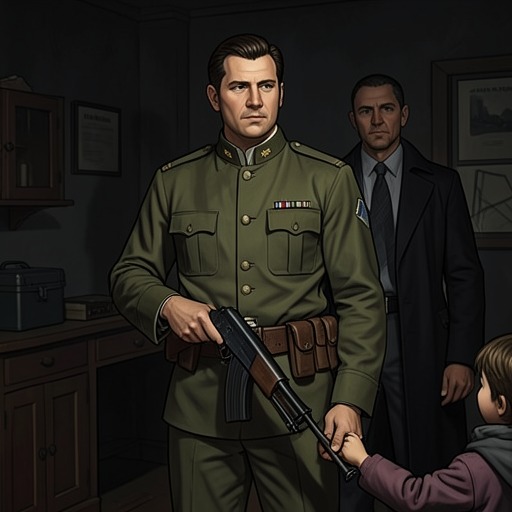
An erect, elderly man stands beside Satta in the full-dress uniform of a French general, his chest covered with medals and ribbons. The account does not identify him further. His presence adds a formal, military dimension to the funeral, but the narrative gives him no speech or explanatory role. His final gesture is a salute, a brief act of recognition among the ceremony’s closing movements.
The Closing Gestures
When the priest finishes and steps back, Guido nods to the attendants. The coffin slowly descends. The priest makes the sign of the cross, and Guido bends to pick up a lump of earth and tosses it into the grave. The scene moves through a sequence of restrained actions—the priest’s conclusion, Guido’s signal, the lowering of the coffin, and the earth cast into the grave—rather than describing Creasy’s death directly. The burial makes the loss present through what the living do in response to it.
The general comes to attention and salutes; then the group breaks up. That last movement ends the ceremony without a further speech or a stated resolution for those present. Reporters had watched the uncertain course of Creasy’s medical struggle, and they now witness its final public consequence: his burial. The contrast between the doctors’ prolonged effort and the grave’s finality gives the ending its force. The account recognizes the hope that accompanied treatment while confirming that neither medical skill nor Creasy’s determination could prevent his death.
Narrative Significance
The event’s presentation postpones confirmation until the funeral. Rather than narrating the moment Creasy dies, it recounts the changing prospects for his survival and then places the reader at the grave. This structure makes the ending a passage from uncertainty to certainty: first the poor prognosis, then the surprising persistence, the transfer and renewed hope, and finally the admission that the damage was too great.
The reporters’ continued presence links the Battle of Palermo to the funeral without making the burial another battle scene. Public attention follows Creasy from the fighting through the struggle to stay alive and into the final ceremony. At the same time, the specific gestures of Guido, the priest, and the general keep the ending focused on a small group gathered around the grave. Creasy’s death is thus presented both as a public aftermath of the Palermo events and as a personal loss marked by the people who stand beside his coffin.