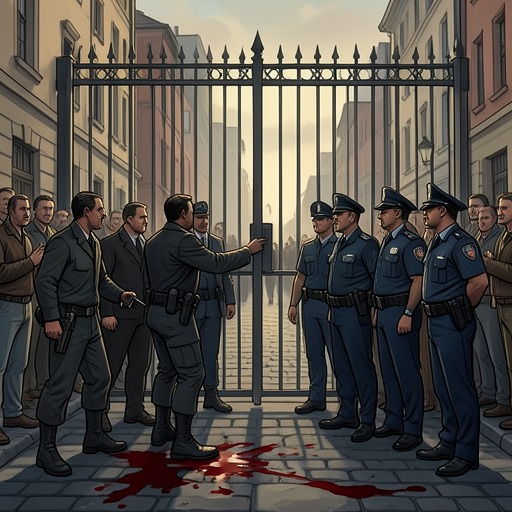
Creasy's revenge campaign
Man on FireCreasy’s revenge campaign is the armed vendetta he undertakes after Pinta dies in captivity: not a conventional effort to secure justice, but a deliberate attempt to kill those responsible, reaching upward through the criminal network behind her kidnapping. Its decisive turn comes when private grief becomes an explicit, far-reaching objective, with Guido Arrellio drawn in as his indispensable ally.
Origins and Declared Aim
Pinta’s death gives Creasy’s campaign its cause and its uncompromising logic. The ransom had been paid two days before she was due to be released, but the kidnappers, alarmed by a police sweep against a Red Brigade gang, went to ground for several hours. Her hands and mouth were taped; after vomiting, probably from petrol fumes, she choked to death in the trunk of a stolen car. What should have ended in her return instead leaves Creasy facing a death that was not intended but cannot be undone.
When Creasy explains his plan to Guido on the terrace, he does not present it as a legal or moral remedy. He says it is revenge: someone precious to him has been killed, and he will kill in turn. Guido asks whether Creasy means an eye for an eye. Creasy answers that he wants more than an eye, naming the scale of his intended retaliation in a stark declaration: "More than that. More than an eye. Every bloody piece of them." The exchange makes the campaign personal, but not narrowly limited to the immediate kidnappers.
Guido initially imagines a focused operation against the men who carried out the abduction: Creasy could pick them off and escape, since they were probably not senior figures. Creasy corrects that assumption. He intends to pursue anyone who had a hand in the crime or profited from it, all the way to the top of what he calls the nest. The change in scope is fundamental: the campaign is directed not only against the men at the scene, but against the chain of responsibility behind them.
Methods, Targets, and the First Interrogation
Creasy frames his campaign as a response to the weakness of ordinary enforcement. Guido describes a Mafia able to draw on informers and contacts within police forces, with networks extending from cities into smaller communities; past attempts to suppress it had not prevented its return. Creasy’s answer is not to gather evidence for a prosecution. He identifies three advantages he believes the police lack: he can use terror, extract information by moving from one target to the next, and act with the direct purpose of killing. He regards his lack of family, career, and other obligations as a source of motivation that distinguishes him from policemen and judges. The plan is therefore designed to operate outside the institutions he considers compromised and limited.
That strategy becomes concrete in Creasy’s choice of initial targets. Before setting out, he tells Guido that Giorgio Rabbia and Sandri come first, but that he needs to question only one of them. He judges Rabbia, described to him as a slow-witted enforcer, more likely to break than Sandri, and plans to watch him for several days before taking him. The sequence is deliberate: identify a vulnerable participant, seize him, and turn his account into information about the larger operation. Creasy’s campaign is conceived as a chain in which each captured person can point toward another level of responsibility.
Creasy abducts Rabbia at his car, bringing a concealed gun to the back of his neck as Rabbia reaches for the ignition. He identifies him by name and warns him not to speak. Later, in the room where he questions him, Creasy places steel spikes and a knife before him and threatens to drive a spike through his untaped left hand and cut off his fingers if he refuses to answer truthfully. The threat is not incidental intimidation: it makes explicit the coercive method Creasy had announced to Guido, using fear as an instrument to produce intelligence rather than as an end in itself.
The interrogation begins with the Balletto kidnapping and continues for more than an hour. Rabbia admits that he drove the car and identifies Sandri as the man who shot Creasy, the bodyguard; he names Dorigo and Cremasco as the other men involved. He says the group had been ordered to collect Pinta at a specified time and place and hold her in a house in Niguada, while claiming not to know about the ransom money. The testimony gives Creasy the division of labor within the abduction and confirms that the plan had been carelessly organized: Fossella had said the bodyguard would not be a serious obstacle, and Dorigo had been told to fire shots merely to scare him away. Rabbia’s account thus moves the campaign beyond retaliation against the men who physically seized Pinta, supplying a route toward those who arranged the crime.
Escalation, Investigation, and the Hidden Motive
The first killing makes Creasy’s campaign visible beyond its immediate participants. On Saturday morning, Guido reads a brief newspaper report that Giorgio Rabbia has been shot dead; the item is only a few lines, but Guido understands its meaning and tells his companion to pack for Gozo. The quiet notice marks the beginning of a sequence whose significance is clearer to those who know the kidnapping than to the city at large.
The violence soon draws scrutiny from Mario Satta and Massimo Bellu. After Sandri’s death, Satta suspects the Union Corse and worries that its preference for knives and shotguns will turn the conflict into a wider war, catching innocent people in the crossfire. He also wonders what Sandri’s associate Rabbia may have revealed before dying. The investigation brings the officers back to Pinta’s kidnapping: Rabbia and Sandri had worked together, while Fossella organized the operation. Satta initially doubts that the bodyguard could be responsible for the unfolding violence, but inquiries establish that he had been a mercenary, had recovered from his wounds with conspicuous determination, and had left Italy for Malta. The police trail reaches Guido, whose connection to Creasy gives Satta another route into the campaign.
Creasy’s pursuit of responsibility ultimately exposes a motive more calculated than the kidnappers’ account suggested. He tells Rika that Fossella described the abduction as an insurance scheme: Ettore had taken out a two-billion-lire policy with Lloyd’s of London, and Fossella was to return half the ransom to him. Vico Mansutti had acted as intermediary, using his organized-crime connections for a commission. Rika’s attention remains fixed on Creasy as he explains the arrangement; when she turns toward Ettore, her hatred makes the betrayal unmistakable. The revelation changes the meaning of the crime: Pinta was not merely caught in a kidnapping that went wrong, but made the intended object of a scheme in which her father had participated.
The campaign’s reach is also reflected in the attack on Floriano Conti. At 2:30, Conti leaves a basement garage in an armored Cadillac, accompanied by a second car carrying four bodyguards. From across the avenue, an attacker fires two projectiles: the first pierces the Cadillac’s radiator and destroys its engine, setting the occupants inside ablaze; the second strikes below the front axle and hurls the five-ton vehicle backward into the following Lancia. Only one bodyguard escapes immediate death. The assault carries the vendetta into the upper ranks of the criminal order and turns an individual pursuit into a shock to the wider organization.
That shock persists beyond the immediate killings. A month after the event reported in the press as the Battle of Palermo, reporters still follow the struggle to keep Creasy alive. His actions have not produced a clean return to justice or an uncomplicated victory: they have exposed the kidnapping’s financial conspiracy, provoked a widening contest among criminal forces, and left their author gravely wounded. The campaign’s consequence is therefore double-edged: it brings hidden responsibility into view while multiplying the violence through which that responsibility is answered.
Persistence and Aftermath
Even after Nadia enters his life, Creasy does not relinquish the vendetta. When Guido asks whether he remains determined, Creasy answers that nothing has changed and that the desire for his targets is an ache. Guido wonders whether Nadia has taken away some of the hatred; Creasy’s continued resolve shows that the relationship has not displaced the campaign. He proceeds on the same course, treating the pursuit as an obligation that intimacy cannot undo.
The campaign’s consequences extend into a public struggle over Creasy’s survival. A month after the Palermo assault was headlined as the Battle of Palermo, reporters were still following his condition. He had been given little chance in intensive care in Palermo, but survived; after two weeks, Mario Satta arranged for a special Carabinieri aircraft to take him to the better-equipped and more secure Cardarelli Hospital in Naples. Satta’s brother led the medical team treating him. The story that began as private revenge had become a widely watched battle for life, while the campaign’s final human cost remained unresolved.