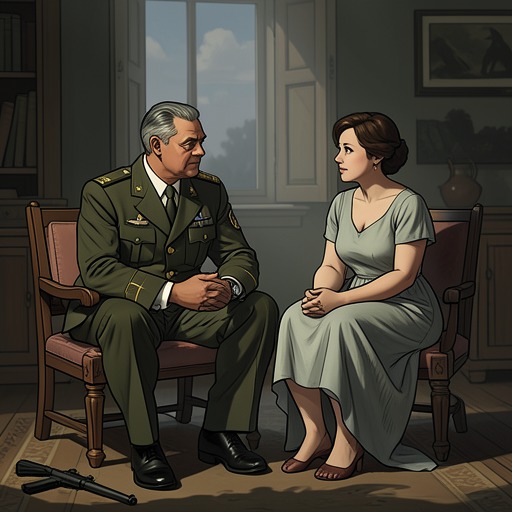
Creasy–Nadia relationship
Man on FireCreasy and Nadia Schembri’s relationship is a brief, deliberate intimacy formed in the shadow of his departure. Nadia offers love without demanding a promise of permanence; Creasy, initially resisting the word, gradually accepts both her presence and his own feelings. Their closeness gives him a life on Gozo to leave behind, and her understanding of his grief for Pinta and resolve to pursue revenge helps clear his mind for the mission ahead.
An Unequal Future, Honestly Named
Nadia makes her feelings plain after the two swim out into the channel near Comino. She asks Creasy not to interrupt, then names the obstacles she already understands: he feels something but does not want involvement, he is at least twenty years older, and he will leave in about a month, probably never to return. Her declaration is not a request that he deny these facts. She tells him that while he remains on Gozo, she will be his woman.
Creasy answers by confirming her assessment rather than offering reassurance. He says there is no future in the relationship and distrusts the ease with which people use the word love. His stillness and slow shake of the head give way to a practical refusal: the age difference and departure are real, and he does not intend to come back. Nadia’s willingness to enter the relationship anyway establishes its terms early. She knows it may be temporary and chooses closeness without pretending that the danger of separation has disappeared.
A Shared Life on Gozo
After their first night together, Nadia moves her clothes into Creasy’s rooms. He accepts this change, initially holding to the measure of time he has already given her: a month. But within a few days, he recognizes that he loves her. Seeing her asleep in the morning brings the realization with a physical force that surprises him. What he had treated as a short arrangement has become an attachment he cannot keep at a distance simply by refusing to name it.
Their intimacy takes shape through routine rather than repeated declarations. Nadia brings coffee at dawn while Creasy does his exercises; they sit together quietly before he runs, now as far as five miles. At the cove she waits with cold beer and towels while he swims to Comino and back. They return to the house, where Nadia has taken over making his breakfast, and he spends the day working in the fields with Paul Schembri and Joey Schembri. In the evenings, they meet again at the cove to swim and talk. Their conversations are not momentous, but their ease and continued presence make the attachment durable within the limited life Creasy has on the island.
Nadia does not make that closeness into a demand. She is neither clinging nor maudlin, and she balances passion with practicality. When they go out after dinner, she sits beside him at Gleneagles with an arm around his waist. Her public manner establishes that she is with him and is not ashamed of it; the local community accepts the pairing without comment. Joey, Nadia’s brother, does raise the subject while he and Creasy load sacks of onions. He speaks seriously and says that he knows what is going on and does not want Creasy to misunderstand, a sign that the relationship is recognized within the family as well as in public.
Love and the Imminent Departure
As Creasy regains his fitness, his thoughts turn toward the work ahead. On a drive toward Cirkewwa, he calculates that he needs two more weeks of preparation. His body is nearly ready, and his mind is already planning the operation; yet leaving Nadia and his life on Gozo feels final. He admits to himself that he loves her, the recognition arriving as a shock rather than as an easy conclusion. Nadia had declared her love first, but her conduct has allowed the relationship to grow without pressing him to repeat the declaration.
Their last evening together before his departure combines ordinary pleasure with the knowledge of what follows. They eat fish on a terrace, agree that Salvu’s is better, and drink two bottles of Soave. Creasy is aware that the next morning his attention will return to plans for death and destruction. Nadia’s independent, composed manner comforts him: she does not make him carry her sadness as an additional burden before he leaves. They go on to Barbarella’s, where Creasy says goodbye to Censu, then return to the farm and walk down to the cove for a final swim. They embrace in the water and make love on the flat rock.
Afterward, Creasy tells Nadia what he is going to do and why. He describes the state in which he arrived in Naples, how Guido Arrellio and Elio arranged his employment, and how he first deliberately shut Pinta out before their bond grew. For once, he can describe his feelings clearly. Nadia listens closely and cries, but distinguishes her grief from fear of losing him: she is crying for Pinta, whom Creasy’s account has made vivid to her, and for the death he recounts. Her response comforts him because she understands that loving her does not remove the reason he must go.
Support Without a Promise of Safety
Creasy tells Nadia that he loves her, although he had not intended to say it. She does not treat the confession as a guarantee. Instead, she asks what chance he has of surviving. He answers that it is very slim. When she asks whether he will return if he lives, he says yes, but tells her not to wait: there is still a chance, though he puts the odds at about one percent, and he does not regard the mission as suicide while any chance remains.
Nadia’s answer binds her love to his purpose without disguising the cost. She urges him to kill those responsible, says she hates them as much as he does, and tells him not to think about her but about what they did. She promises to go with her mother to church each morning and pray for the killings, while withholding confession until Creasy is dead or has returned. Her words and emotion affect him deeply. He cannot identify every element of their effect, but their force settles his mind and leaves him focused on the mission.
The relationship therefore offers no secure reunion or resolution before Creasy leaves. Its significance lies in the contrast between his initial effort to deny a future and his eventual willingness to acknowledge love, speak openly about Pinta, and accept Nadia’s solidarity. She does not ask him to choose between her and his obligation; he does not promise that he will survive. In the brief time they share, ordinary care and unguarded conversation create a genuine attachment, and Nadia’s final encouragement turns that attachment into support for the dangerous course he has chosen.