Creasy–Pinta relationship
Man on FireThe Creasy–Pinta relationship is a parent-like attachment that changes the direction of Creasy’s life. Before Pinta, he had contemplated suicide and accepted work largely to keep himself from acting on that despair. Through her, he begins to feel affection, reduce his drinking, and experience a form of peace. Their bond is tested when she is abducted in front of him: Creasy fights to stop the kidnappers, is shot, and hears Pinta call his name as he falls.
From Despair to Attachment
Creasy later explains to Guido that, five months earlier, he had seen nothing ahead of him and had taken the job to keep himself from killing himself. His account makes clear that his attachment to Pinta was not an intention he brought to the relationship. Children had previously seemed to him like a nuisance; then, as he puts it, Pinta gradually entered his life, day by day. The relationship’s significance lies partly in that unplanned change: his recovery begins not with a declared purpose but with the repeated presence of a child who comes to matter to him.
Creasy describes seeing the world through Pinta’s eyes, as though it had newly appeared for her. The contrast is between his sense that his own life was already over and her fresh encounter with everything around her. Her perspective does not erase his past or resolve his despair by argument. Instead, it gives him a way of attending to life again, through the small, recurring fact of being with her. His account presents attachment as something that grows through ordinary days rather than arriving as a single dramatic revelation.
Everyday Signs of Affection
A country outing shows the bond in quiet, observable gestures. Pinta offers a piece of ham in friendship to a herder, then runs off to play with the dog while Creasy pours the man a beaker of wine. The adults talk casually as cows graze and Pinta and the dog chase one another among the herd. When the herder remarks that Creasy has a fine girl, the look that crosses Creasy’s face puzzles him. The moment suggests that the relationship has become visible to an outsider, even if Creasy cannot readily explain what it means to him.
On the drive back toward Como at sunset, exercise and fresh air leave Pinta drowsy. She folds her legs up, lowers herself in the seat, and rests her head on Creasy’s lap. He drives slowly, glancing down at her sleeping face; his scarred features and brooding eyes relax into rare contentment. The scene gives physical form to a trust that needs no explanation: Pinta settles beside him without alarm, and Creasy’s attention rests on her. For a man who had described himself as having nothing ahead, the drive offers a brief but concrete experience of peace.
Creasy identifies further changes when he tries to explain the bond to Guido. He has cut back sharply on drinking because he no longer needs it in the same way. He recalls bringing the car to the front in the mornings and Pinta running down the steps to meet him. In his description, she has no malice, greed, or hate, and seems to carry the sun on her shoulder. These details connect affection not only to exceptional moments but to a routine: the car, the steps, the morning greeting. Pinta’s importance is built into the ordinary shape of his days.
Love Without Possession
Creasy struggles to find language for what Pinta’s love means to him. He tells Guido that she loved him, then clarifies that he does not mean physical love; he regards it as something better than that. The distinction defines the relationship as intimate and profound without making it romantic. Creasy is moved by being loved by Pinta, and his insistence on the difference shows how carefully he understands the bond even when he finds it difficult to describe.
His effort to explain is itself significant. He pauses to search for words because he needs Guido to understand what has happened to him. The man who had treated children as a nuisance now measures his changed life through one child’s affection and through the new capacity to see the world with her. Pinta has not simply become someone Creasy protects; her presence has helped restore his ability to care.
Abduction and the Bond Under Threat
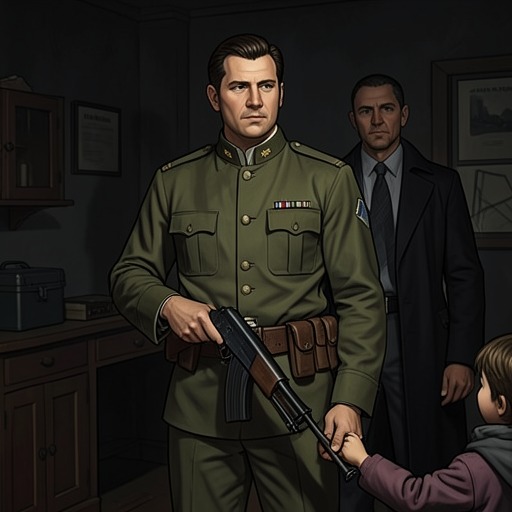
The relationship is placed under immediate threat when Pinta comes out of the apartment and walks toward Creasy’s car. A black car rounds the corner, mounts the curb, and brings four men into view. Creasy recognizes the danger and reaches for his gun; Pinta stops in surprise. He shouts for her to run, but the car blocks her path to him. She ducks under a reaching arm and circles behind it, trying to get back to her bodyguard, while two armed men pursue her.
Creasy hesitates to shoot at the men while Pinta is between them. One catches her, lifts her, and turns toward the car; the other fires at Creasy, who shoots him twice in the chest. The gunman holding Pinta struggles to force her into the back seat as she kicks and screams. Creasy closes in and fires high, aiming away from the car; his shot strikes the kidnapper below the nose and kills him. The violence makes his protective role literal, but it cannot prevent the abduction: shots from the front seat hit Creasy, and the car accelerates away with Pinta inside.
Recognition and Consequence
As Creasy lies stunned and in pain, he remembers hearing Pinta scream his name. He understands it not as a call for help but as a cry of anguish because she has seen him fall. That distinction binds their experiences at the moment they are separated: Pinta’s cry registers her recognition of his injury, while Creasy, barely able to move, clings to the hope that he will not die. Their relationship is conveyed through this brief exchange of perception rather than through a final conversation.
The scenes establish both what Pinta has changed and what is now at stake. Her affection has interrupted Creasy’s suicidal isolation, altered his drinking, and given his days a source of expectation and contentment. The abduction then turns that recovered capacity for attachment into vulnerability: Creasy’s care makes him act, hesitate when Pinta is in the line of fire, and suffer the separation as more than a professional failure. In the evidence of their bond, protection and love are inseparable, but protection cannot guarantee safety.