Creasy's Alcoholism and Physical Decline
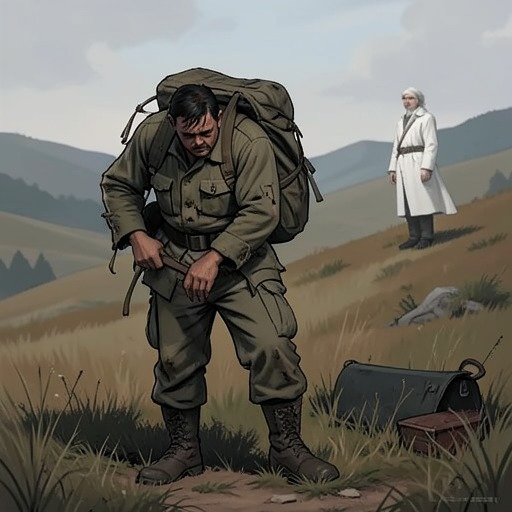
Man on FireCreasy's Alcoholism and Physical Decline is the bodily expression of his loss of purpose: the former soldier who once maintained himself with a weapon's precision becomes slack, lethargic, and dangerously slow. His decline is not simply a change in appearance. It makes him doubt his fitness for work, compromises his ability to protect another person, and becomes the condition he must confront before he can act again.
Background and the Return to Guido
The change is unmistakable when Creasy arrives at Pensione Splendide after years away. At dawn, Guido Arrellio sees the outline of a man in a terrace chair and waits for the light to reveal him. Five years have passed since their last meeting; someone had told Guido a year earlier that Creasy was drinking and deteriorating. Now an empty bottle beside the slumped, apparently somnolent man gives that report a visible form. Creasy is awake, but his heavy-lidded gaze and slack posture are a stark contrast with the man Guido remembers.
Their last meeting had come shortly after Julia's death. Creasy had stayed with Guido for two weeks, quiet as ever, but his presence had helped restore a sense of connection when Guido needed it. At that time, Guido had thought him almost unchanged, seemingly fixed at a young forty. Now, calculating that Creasy was nearing fifty, Guido sees him as older than his years. His concern is sharpened by the knowledge that Creasy had always cared for his body and appearance. The decline signals that something fundamental has gone wrong.
The marks on Creasy's body do not, by themselves, explain the change. While Creasy sleeps in Guido's rooms, Guido recognizes the old scars: pale weals curving around the stomach, puncture marks under the left ribs, burn marks on the hands, a badly stitched wound above the knee, and scars on the face. Guido knows their histories. The body has been abused by past experience, but this is familiar damage, not a new injury. What alarms him is that the present neglect is self-inflicted in a way the old wounds were not.
War, Futility, and Alcohol
Creasy's decline follows a crisis of belief rather than one newly inflicted wound. Looking back over campaigns from the Battle of Dien Bien Phu through the Algerian War and the Katanga Secession War to the Vietnam War and Rhodesian War, he sees the same cycle repeated: battles fought for causes framed as patriotic final stands, ending in more deaths without a lasting resolution. In Rhodesia, this accumulated sense of futility becomes impossible for him to ignore. He anticipates the same sequence wherever he goes and can no longer persuade himself that another morning or another assignment will matter.
He starts drinking heavily and lets his body become slack and lethargic. The change has occupational consequences: he is removed from operations and made an adviser. His former service earns him some forbearance, but he recognizes that this lenience is charity. Pride, rather than renewed purpose, moves him to leave. He goes first to Brussels, where a woman he had known has moved on, then travels to Marseilles and takes a ferry to Corsica. The Legion has forgiven its former mutiny, and he wonders whether he can return to the institution that once served as a home for the orphan. In Calvi, however, the sight of young recruits marching to the Legion hymn makes him feel a thousand years old. He leaves for Bastia and takes the ferry toward Livorno, deciding to see Guido; perhaps their friendship might offer something other than futility.
When Creasy reaches Guido, his own explanation is halting and fragmented. He tells his friend that he has been a soldier and nothing else, that he has had enough of what has happened, and that he has felt sick of it for about five years. Guido listens without forcing the pauses into a conversation. The empty bottle, the diminished body, and the difficulty of speaking all register different aspects of the same condition: Creasy cannot summon enthusiasm for life, and the discipline that once structured his existence has lost its object.
A Job Built Around the Decline
Guido looks for a way to give Creasy an immediate role, with help from his brother Elio, an auditor whose client is a security agency supplying bodyguards to industrialists. There is strong demand for trained guards, but ordinary professional work is not a plausible fit: Creasy is physically unfit and virtually an alcoholic, and Guido knows that he would regard taking such a job under false pretenses as unacceptable. Elio's information about so-called premium bodyguards changes the proposal. These men are inexpensive appointments that qualify a client for a lower insurance rate, even though they would do little to stop a kidnapping. Creasy, who has substantial savings, does not need the job for its pay; Guido sees a possible reason to get him moving again.
The arrangement is part of a larger insurance system that Vico Mansutti explains to Ettore Balletto. Italian insurers cannot write kidnap policies, on the stated concern that coverage could encourage abductions, while insurers abroad can; Lloyd's of London is described as a leading provider. Policies require payment of premiums outside Italy and secrecy from the insured's household. Security measures can lower rates, and Vico gives the example of a one-billion-lire policy whose premium might fall from fifty million lire to thirty million if the industrialist hires a full-time bodyguard. A conventional guard costs about thirty million lire a year, while a premium bodyguard costs about seven million. The cheap appointment therefore makes financial sense as a device for reducing the premium, not as reliable protection.
That distinction gives Creasy's condition particular importance. He is placed in a role whose appearance of protection is more valuable to the arrangement than his actual ability to intervene. Rika's anger makes the deception personal when she learns that Creasy was hired for a pittance merely to appease her; she calls him a drunk and condemns the choice of protector. Later, Creasy tells her what he has learned from Fossella: Ettore had taken out a two-billion-lire Lloyd's policy, with half the ransom to be returned to him, while Vico acted as intermediary for a commission. The low-cost guard is thus connected to an insurance fraud built around a kidnapping, not simply to a failed attempt to hire adequate security. Creasy's weakness is exploited by the scheme, even as it becomes one of the circumstances that eventually draws him back into action.
Recognition and Physical Reconditioning
For a time, the undemanding job and comfortable routine let Creasy suspend decisions rather than recover a purpose. His drinking eases slightly. Some mornings, Scotch remains in the bottle, and what had been desperate drinking has become an overdone habit. But he knows that alcohol still dulls him and saps his strength; to stop his physical decline, he will have to cut back sharply. The improvement is provisional, not a cure.
The decisive recognition comes after an armed attack involving Rika. In bed afterward, Creasy assesses his response without excusing it: he was far slower than his own standard, and if Rika had been the target, she would now be dead. He judges the attackers to be amateurs, yet that judgment only sharpens the comparison with his former self. Once, he believes, he could have dealt with the gunman and the two men on foot before they had gone five paces. His reactions are dull. The possibility of someone else's death makes the physical cost of his drinking immediate rather than abstract.
Creasy has always treated his body as a weapon, maintaining it as carefully as his other weapons, nursing it after injury, exercising its parts, and keeping it responsive to his brain. A weapon can be cleaned and its moving parts lubricated; his neglected body cannot be restored so easily. He understands that the work will be slow and painful, requiring a rebuild rather than a quick adjustment. Though he is barely overweight, Guido can see the slackness and loss of muscle tone beneath an appearance that might otherwise seem acceptable. Creasy thinks of a fine machine left to rust.
He sets a concrete program: ten minutes of circuit training in his room each morning, gradually increasing the pace, followed by gym sessions with weights and bars. The process will take months, but he believes he has caught the decline in time. This decision marks a change in the way he inhabits his body. It is no longer an instrument he can assume will answer him; it must be patiently restored before he can trust it in the field.
Recovery, Intimacy, and Continuing Vulnerability
On Gozo, preparation gives Creasy a purpose and a demanding structure. As he approaches departure, he feels impatient to begin the work for which he has trained, his mind already running through strategy while his body catches up. At the same time, leaving means separating from Nadia and the life they have made together. He recognizes that he loves her, and that recognition arrives with physical force. Their intimacy is neither presented as a cure for his past nor as a substitute for his preparation; it is a form of closeness he had not expected to find alongside the work of rebuilding himself.
Their shared routine makes room for both effort and attachment. At night they make love without pretense, and Nadia finds security in the familiar weight of his arm around her. They do not speak of his impending departure, but its silence does not remove the conflict: he is preparing to leave precisely as their relationship becomes real to him. The body once treated only as a soldier's tool is also the means through which he gives and receives comfort. His recovery therefore includes more than restored fitness, even though the narrative keeps the two forms of vulnerability distinct.
By the time he is considering departure, Creasy feels close to full fitness and ready to act. The later sight of him after the Battle of Palermo, eyes open and fixed on Satta while Guido supports him, returns the story to the body's exposure to violence: blood and torn flesh, clenched teeth, and a hand Guido urgently tries to position. That injury is not the same as the earlier, self-neglecting decline, and recovery does not make Creasy invulnerable. The movement from the empty bottle at Guido's terrace to the disciplined training program and then to this battlefield vulnerability defines the state's narrative significance: rebuilding gives Creasy the capacity to choose and act again, but it cannot protect him from the costs of the life he has resumed.