Cross Pinta Gave Creasy
Man on FireThe Cross Pinta Gave Creasy is a small gold crucifix that turns an intimate birthday gift into a recurring sign of Pinta’s care and a marker of Creasy’s unresolved relationship with faith. He wears it after she asks him to keep it, and remembers her joking instruction to raise it against the devil. After Pinta is abducted and killed, the crucifix becomes part of how he recalls her; later, its presence around his neck leads Laura Schembri to ask whether he is Catholic. The object’s significance rests not on any demonstrated power to protect him, but on the contrast between Pinta’s warm, practical belief and Creasy’s uncertainty, grief, and readiness to meet violence with violence.
Gift and Meaning
Pinta tells Creasy that she bought the crucifix herself with money she had saved. Her explanation makes the present a deliberate act of affection: it is not merely something passed on to him, but an object she chose and paid for. When she asks him to keep it, she frames the request lightly, suggesting that it cannot hurt and that he can at least hold on to it until the truth about faith is settled. Her manner joins conviction to playfulness rather than turning the gift into a solemn demand.
That tone reflects Pinta’s straightforward approach to belief. She is willing to believe unless someone proves beyond doubt that faith is false, while allowing for a comic, public test: the announcement would come on television. The crucifix therefore arrives within a conversation about uncertainty, not as proof that Creasy shares her religion. His answer is a smile and a gesture: he lifts the chain and drops it over his neck. He thanks her, squeezes her shoulder, and jokes that he suddenly feels very holy. The exchange makes wearing the cross an acceptance of Pinta’s gift and affection, without establishing a conversion.
A Joke Beside the Threat of Violence
Pinta gives the crucifix a practical role in her teasing: if Creasy ever meets the devil, he should hold it up in front of himself. Creasy smiles wryly at the suggestion, thinking that it would make a change from holding a machine gun. The contrast is compact but revealing. The cross belongs to Pinta’s playful faith; the gun belongs to the violent world in which Creasy has learned to act. Her instruction imagines a different kind of protection, but the scene does not show him abandoning the weapon or treating the crucifix as a substitute for it.
The distinction matters when Guido Arrellio later visits Creasy and notices the crucifix. Creasy sees Guido looking at it and says he will explain later. The pause makes the object conspicuous: it is visible to another person, yet its personal meaning is not immediately available to him. When Creasy does explain, he identifies it as Pinta’s birthday present and recalls her warning about the devil. The memory gives the object a history that Guido could not infer from seeing it alone. It carries a private relationship inside a public, recognizable religious form.
After Pinta’s Death
In recounting what happened to Pinta, Creasy returns to the crucifix and the joke attached to it. The recollection shifts sharply from her playful instruction to his account of her abduction, abuse, and death. He says that he keeps seeing what was done to her, imagining her restrained and subjected to further abuse. The object does not soften that memory or provide him with consolation in the scene; instead, its association with Pinta brings her tenderness into painful proximity with the brutality of her final hours.
That juxtaposition changes the force of her instruction. Before her death, the devil is a figure in a teasing exchange; afterward, Creasy’s language gives the imagined evil a human and immediate form. The crucifix remains the same gift, but its remembered context now includes both Pinta’s care for him and the violence that he cannot stop recalling. His explanation to Guido connects the object directly to the loss, showing that the small keepsake has become one of the concrete details through which he speaks of her.
Wearing the Cross
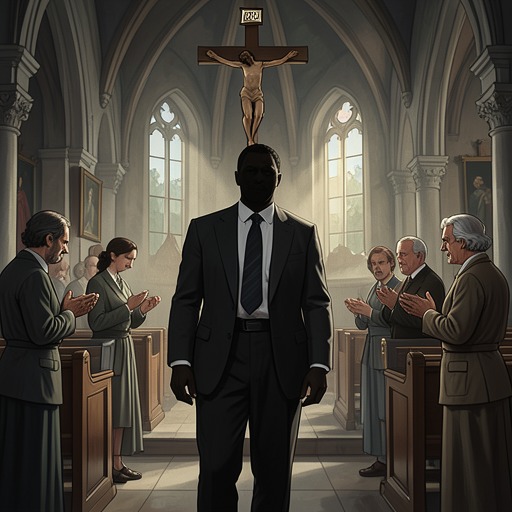
The crucifix remains visible later, hanging from Creasy’s neck when Laura Schembri notices it. She asks whether he is Catholic. Creasy does not claim a clear religious identity; he shrugs and says he is nothing very much. The exchange sets the object’s public appearance against the uncertainty of the wearer. To Laura, a gold crucifix suggests a question about religious belonging; for Creasy, the evidence given ties it instead to Pinta and to a gift he chose to wear.
Across these encounters, the cross moves from Pinta’s saved money and affectionate joke, to an object Guido notices but does not yet understand, to a visible sign that invites Laura’s question. Its meaning accumulates through those moments rather than through any stated doctrine or miraculous intervention. Pinta’s faith is expressed as open, lightly humorous trust; Creasy’s response remains guarded and unsettled. The crucifix holds those differences together, while preserving the memory of a bond that persists even after the person who gave it is gone.