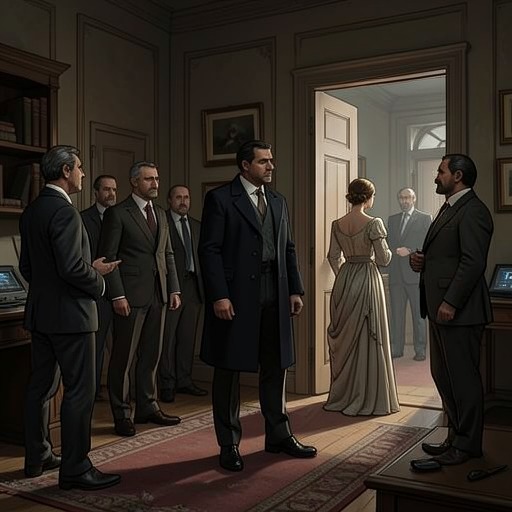
Dino Fossella is abducted, tortured, and killed by a bomb
Man on FireDino Fossella is abducted from his mother’s home, interrogated under the threat of a timed bomb, and killed when the deadline expires. The episode makes his familiar weekly visit the opening in an operation that strips away the protection he assumes his bodyguards and alliances provide. Its final image is not a confrontation but a man bound to a chair, watching an alarm clock after his captor has gone.
Background and False Security
Fossella’s Wednesday dinners with his mother are a settled routine. He travels to Bianco each week because missing dinner would make him feel guilty, while his mother would be angry; in his mind, even Don Cantarella could not match her anger. That domestic obligation takes him away from his usual guarded world at a predictable time and place.
The journey is arranged to appear secure. Fossella’s own car is sandwiched between two others filled with bodyguards, and the convoy drives cautiously into the village. Yet he treats the presence of his family as a boundary his enemies would not cross. As he climbs the stone steps to the house, he dismisses the precautions of the Union Corse as melodrama and assumes that even they would not involve relatives in business disputes. That confidence is not simply misplaced about the threat; it blinds him to how thoroughly the attackers have already prepared the scene.
The criminal conflict around him is also tightening. Fossella resents a message delivered through an intermediary—“We are displeased with you.”—and privately dismisses its sender as a political operator whose alliances reach across Italy. He is nevertheless making arrangements to send money to Marseilles and expects the payment to let him relax. The contrast between this calculation and the abduction that follows gives the episode its reversal: money, connections, and a guarded convoy do not protect him in the one place he assumes is beyond the business at hand.
Abduction at the Family Home
When Fossella enters the house, his mother is already bound to a chair. White tape covers her mouth; her wrists and ankles are tied, and a large armed man holds a shotgun against her left ear. The threat is directed at Fossella through the danger to his mother: even a small sound from her, the captor warns, would make him an orphan. His assumption that family would remain untouched has been turned against him before he can act.
Fossella is ordered to face the wall, put his hands against it, and spread his feet. A blow from behind ends his attempt to work out who the attacker is. When he regains consciousness, his wrists are bound and tape is being tightened around his knees and ankles; his mouth is sealed as well. The attackers carry him out rather than allow him to walk, a physical indignity that sharpens his anger and humiliation. The scene leaves him unable to resist or call to the bodyguards he has left nearby.
A gray van waits in the cobbled street behind the house. Fossella is dumped inside, and the side door is quietly shut. As it rolls down the slope, he thinks of his guards, no more than thirty meters away, and curses his own failure to anticipate the danger. He has not been blindfolded. The faded lettering on the van—Luigi Racca-Vegetable Dealer—means nothing to him, but he understands that being allowed to see it signals a one-way journey. Over the next two hours, discomfort gives way to stiffness and numbness while he can devise no explanation for what is happening.
Interrogation and Threat
The van finally stops in darkness beside tall trees and a small whitewashed cottage. Fossella is carried inside and laid on a stone floor. After another blow leaves him unconscious, he comes to bound to a chair. In front of him stands a rough wooden table marked by a dark stain around a small hole; an open notebook and an old-fashioned alarm clock sit within his view. The clock reads 9:02. His captor has removed the tape from Fossella’s mouth, but Fossella says nothing, having learned from what happened to Giorgio Rabbia.
The interrogation quickly makes clear that the captor is not seeking only a general account of underworld alliances. He wants to know about Floriano Conti and Don Cantarella, and then asks why a man as intelligent as Fossella would have kidnapped a girl whose father had no money. The question connects the present coercion to the kidnapping that brought the girl into danger, rather than treating Fossella’s current position as an unrelated power struggle.
The captor explains that a small, modern bomb has been placed inside Fossella’s body and is set to explode at ten o’clock. At 9:07, Fossella looks at the clock. He is told that he can answer questions fully and honestly before the deadline and be allowed to remove the bomb. Fossella objects that he will be killed anyway; the response is that, unlike the others, he is needed alive. He does not believe this assurance. The clock makes the interview a timed ordeal: the possibility of survival is held out, but the captor controls both the questions and the deadline.
Death and Narrative Significance
The questioning ends at 9:53. The man caps his pen, takes the notebook, watches Fossella for a few moments, and walks out. Fossella hears the van start and fade away. He neither shouts nor struggles; he sits rigid, his eyes fixed on the clock. At 9:58 the alarm rings. Two minutes later the bomb explodes, killing him.
The episode turns a weekly family ritual into a fatal vulnerability and overturns Fossella’s own confidence that his enemies would keep family outside their business. His guards remain close enough for him to remember them during the abduction, yet their proximity does not prevent the operation or bring help before the bomb’s deadline. The measured sequence—from the 9:02 clock reading, through questions that end at 9:53, to the alarm and explosion—makes time itself part of the captor’s control. Fossella’s death is the consequence of an interrogation structured to leave him waiting, bound and alone, after the person who set the terms has already departed.