Ettore Balletto
Man on FireEttore Balletto is Rika Balletto’s husband and Pinta Balletto’s father, a man caught between financial peril and an attachment he understands as a form of addiction. His decisive role in the novel is not merely that of a beleaguered family man: he secretly helps arrange Pinta’s kidnapping as an insurance scheme, making the father who should have protected her part of the machinery that endangers her. When Creasy later exposes the arrangement, Ettore’s domestic and financial compromises become a public moral collapse, ending in suicide.
Identity and Private Life
Ettore’s inner conflict appears during his drive from Milan to Como after a week away. He misses Rika and Pinta, yet expects his return to be stormy because decisions must be made and Rika will dislike them. He recognizes that she is unlikely to change, but does not treat leaving as a real option. In his own formulation, marriage has made him an addict: because he has never been free of it, he cannot judge its effects from outside. He does not consider himself weak, and neither do his friends; nevertheless, he describes his choices as brutally narrow. Acceptance seems possible, separation does not.
That self-understanding gives his relationship with Rika a particular tension. He calls her beautiful, willful, and self-centered, but his complaint does not become a plan to leave. He has learned to expect difficulty across thirteen years of marriage and cannot even settle whether he regrets them. The image of addiction conveys both his recognition of the marriage’s cost and his inability to imagine withdrawal. His dependence is not presented as a simple declaration of affection: it is a condition that leaves him able to see the trap without escaping it.
Financial Crisis and Family Decisions
Ettore tries to bring the household under control by insisting that Pinta return to school and that Rika reduce her extravagances. He raises the matter only after the maid has left the room, pouring himself cognac before asking to discuss their situation rationally. Rika’s response is a smile without warmth and a questioning repetition of his charge. When he presses the point, he makes the danger concrete: unless he reaches an agreement with the banks within a month or so, he could face serious embarrassment. Rika asks what he is doing about it; he answers carefully, anxious that she understand. The scene establishes both the urgency of his finances and the difficulty of speaking plainly within the marriage.
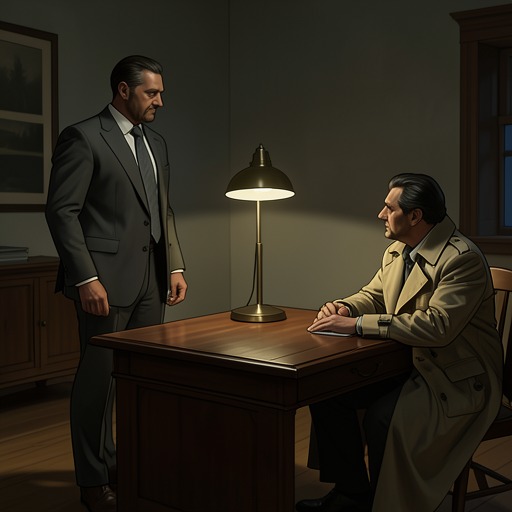
His consultation with Vico Mansutti gives him reassurance, but not independence. The two men lunch in a semiprivate alcove at Granelli’s, eating prosciutto with melon and vitello tonnato and drinking vintage Barolo, a wine Vico likes despite being slightly too heavy for the veal. Vico promises to speak personally with the bank managers and tells Ettore not to be pessimistic. Ettore, however, feels at a disadvantage beside his urbane, impeccably dressed lawyer. Vico’s tailored suit, Swiss cotton shirt, Como silk tie, and Gucci shoes project polished assurance; his cynicism makes that assurance harder for Ettore to trust completely. The exchange places the crisis inside a world of expensive surfaces, professional connections, and debts that cannot be settled by appearances.
Ettore’s meeting with Vico also leads to the search for a bodyguard suited to Rika’s requirements. Rika takes charge of the domestic arrangements: the guard is to have a large room at the top of the house, furnished with a small table, a large easy chair, extra furniture, and casual rugs alongside the existing brass bedstead, chest of drawers, and wardrobe. He will eat in the kitchen with Maria, the housekeeper, and Bruno, the gardener. Rika’s list of duties makes the family’s expectations explicit: the most important task is driving Pinta to school and collecting her, with chauffeuring Rika to shopping and lunch engagements between those trips. Ettore is relieved when Creasy drives the Lancia smoothly, having asked him to take the wheel so he could judge his capability. The role begins as a practical response to the household’s arrangements, before its real significance becomes clear.
The Insurance Scheme and Its Exposure
The later revelation transforms Ettore’s earlier financial anxiety into something more culpable. At dinner in the house by the lake, Creasy tells Rika what he has learned from Fossella: Pinta’s kidnapping was set up as an insurance job. Ettore had taken out a policy with Lloyd’s of London for two billion lire, on the understanding that Fossella would return half the ransom to him. Vico Mansutti had acted as intermediary and received a commission through his connections with organized crime. The scheme connects Ettore’s financial pressures to the abduction itself, while turning the lawyer who had promised to help him negotiate with the banks into a participant in the criminal arrangement.
Rika listens without taking her eyes from Creasy. Only when he finishes does she turn toward her husband, and the hatred crossing the table is described as almost physical. Ettore slumps in his chair; his mouth opens and closes, and his eyes slide away. Rika asks whether Creasy killed the others who carried out the kidnapping. Her question sharply separates the exposed family betrayal from the violence of Creasy’s retaliation, but the evidence of Ettore’s own guilt is already before her. The dinner scene reverses the household roles established earlier: the man who tried to direct spending and family arrangements can no longer control what is said about him, while his wife’s attention fixes on the truth rather than on his explanations.
Confession, Suicide, and Narrative Role
After Vico’s sudden death, Ettore initially refuses to speak until his lawyer arrives. Once he learns that Mansutti is dead, however, he breaks down and turns to Mario Satta as though to a priest, father, and protector. His account pours out in a disjointed, sometimes rambling form, and Satta listens sympathetically, interrupting only to clarify points. Massimo Bellu takes notes rapidly; Rika remains silent and cold, her gaze still on her husband, her expression conveying disgust rather than comfort. The scene does not restore the trust destroyed by the revelation. Instead, it shows Ettore seeking understanding from an authority figure while the person closest to him offers no sign of reconciliation.
Satta’s recollection of this interview includes another surprise: Creasy is continuing his campaign against Conti and Cantarella. Satta had assumed that the killing of Fossella had satisfied the revenge and that Creasy would flee across the border. Ettore’s confession is thus set against a pursuit that is not over, even as the family scandal moves toward its own end. The two trajectories meet through Satta, who hears the confession and later carries news of Ettore’s death to Guido Arrellio.
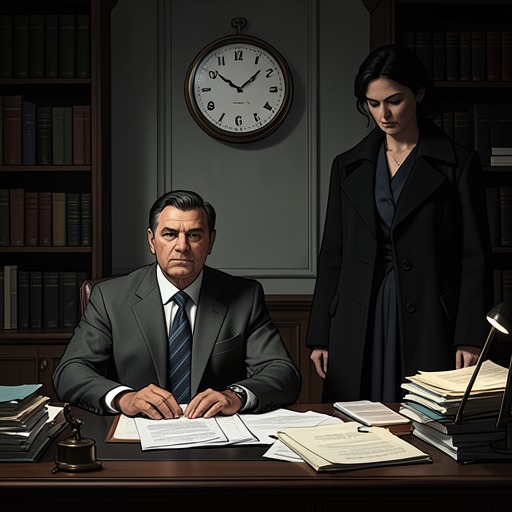
The final report is direct: Ettore has committed suicide. When Guido asks whether Satta is certain, Satta says there is no question; Ettore sat on the ledge of his eighth-floor office for half an hour before deciding. The account establishes the deliberateness and duration of the act, but does not specify a single motive. Read alongside the exposed fraud, Vico’s death, and Rika’s undisguised disgust, the suicide concludes Ettore’s passage from private financial desperation to the loss of his marriage, his business ally, and his place within the family. His arc makes the domestic plot inseparable from the criminal one: the bodyguard hired to protect Pinta becomes the person who reveals that her father helped put her in danger.