Guido Arrellio
Man on FireGuido Arrellio is Creasy’s closest surviving link to a life before despair: a former French Foreign Legion comrade who recognizes how far his friend has fallen, offers him a reason to act, and later stands beside him through a campaign of revenge. As owner of the Pensione Splendide in Naples, Guido becomes both host and operational ally; his loyalty is practical, expressed through shelter, information, planning, and, at the end, a hand placed beside Creasy’s as he lies gravely wounded.
Identity and Background
Guido has a history with Creasy that predates the action in Naples. When Pietro tells him after midnight that a stranger named Creasy has arrived, Guido goes quietly onto the Pensione Splendide’s terrace at dawn to see him. The light takes time to reveal Creasy’s face, and the sight brings an immediate comparison: five years have passed, and Creasy has changed. Guido had heard a year earlier that his old friend was drinking and deteriorating; now the empty bottle makes that report visible.
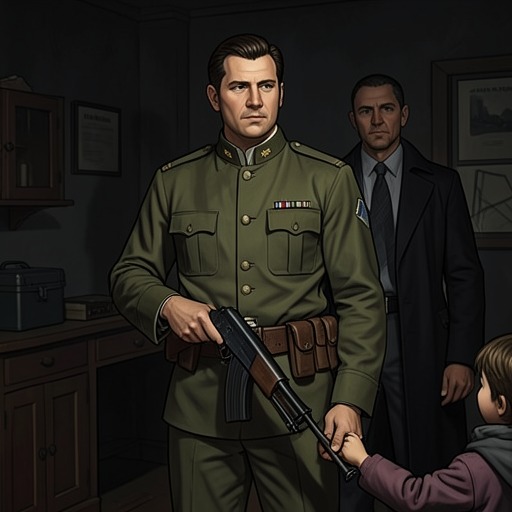
Their shared past began in the French Foreign Legion. Guido tells Pietro that they served together and remained together afterward, until Guido married eight years earlier. The difference in their standing was once considerable: Guido was a new recruit, while Creasy was a decorated veteran of Vietnam and a top sergeant. Guido had been the only Italian in his intake and struggled with French, taciturn and isolated among the recruits. When a Dutch recruit pushed him too far, Guido retaliated savagely; the instructors allowed the fight as a test of whether recruits could withstand pressure. He was left alone afterward and came to be regarded as a possible good Legionnaire.
After training, Guido volunteered for the elite 1st R.E.P., based at Zeralda, as the Algerian War intensified. Assigned to B Company, he first saw combat when the unit was sent to block the escape route of the Algerian National Liberation Front after an ambush near Palestro. Initially disoriented by the noise and movement, he recovered quickly and used his light machine gun effectively. The unit wiped out the opposing force. His bond with Creasy developed over months, through their shared reserve and privacy in an environment where privacy was scarce.
Bringing Creasy Back into Action
By the time Creasy arrives in Naples, Guido understands that his friend is not merely drinking but has lost the capacity to find a reason to live. Guido goes to an olive grove on the lower slopes of Mount Vesuvius to think through a possible intervention. He has just visited his mother; the presence of both her sons has eased her illness, though he expects her symptoms to return within a month. He has also spoken with his brother Elio, who has suggested a temporary solution for Creasy.
That solution is bodyguard work. Guido presents the idea to Creasy in the kitchen, explaining Elio’s suggestion. The opportunity comes through a system shaped by kidnapping risk and insurance. Vico Mansutti explains that Italian insurers cannot write kidnap policies, while overseas coverage, especially through Lloyd’s of London, depends on premiums being paid outside Italy and on the insured keeping the policy secret. Security measures can lower premiums; a full-time guard could reduce the rate on a one-billion-lire policy from five percent to three percent, a saving of twenty million lire. A so-called premium bodyguard, who offers little real protection but qualifies the client for a lower rate, costs about seven million lire annually.
Guido’s introduction to the work therefore places Creasy inside a compromised arrangement. When the family later learns that Creasy was hired for a pittance merely to appease Rika Balletto, Rika calls him a drunk and denounces his ability to protect her daughter. Guido does not answer her anger with an argument: he silences Elio when he starts to protest, gathers Creasy’s belongings, and leaves with him. The scene marks a sharp reversal from an arrangement that treats Creasy as a cheap appearance of security to Guido’s unmistakable choice to stand by his friend.
Friendship and Practical Alliance
Guido’s loyalty becomes especially clear after Creasy’s recovery. When Creasy returns, Guido studies him, rises, and embraces him; the two share a familiar joke about the skill of the people who repaired him. Later, sitting together on the terrace after dinner, Creasy explains what he intends to do. Guido knows him too well to mistake the purpose for a campaign of justice: Creasy means revenge for the person who was precious to him and was killed. Guido does not try to disguise that motive or argue it into a more respectable one.
Instead, he offers help. He still has old connections and says he will check the setup. The friends go into the kitchen, make coffee, and work through Creasy’s carefully mapped strategy. Guido takes notes on transport and accommodation, praises the plan, and cautions that Creasy must understand the opposition once he has gathered better information. Their collaboration draws on the habits of old comrades: Creasy supplies the design, while Guido tests its practical requirements and makes himself useful without pretending that the danger is small.
That assistance extends across distance. Guido tells Creasy that he sent Pietro to Marseilles and that Pietro has done much of the groundwork, including in Rome and Milan. The police later trace Creasy’s connection to Guido, identified as the owner of the Pensione Splendide. Guido’s home and network thus become part of the story’s practical infrastructure, linking the veteran’s movements to people and places beyond Naples.
The Fraud and Its Consequences
Guido is present when the truth about Pinta Balletto’s kidnapping is laid bare to Rika. Creasy explains that the abduction was arranged as an insurance scheme: Ettore Balletto had taken out a two-billion-lire policy with Lloyd’s of London, with Fossella to return half the ransom to Ettore. Vico Mansutti acted as intermediary and took a commission through his organized-crime connections. Rika listens without looking away from Creasy, then turns on her husband with hatred. Ettore slumps in his chair and cannot meet her gaze.
The revelation gives new weight to the earlier use of a low-cost, largely ineffective bodyguard. The insurance system’s incentives, the secret policy, and the supposed protection converge in a plot in which the child’s danger was engineered for financial gain. The evidence does not establish that Guido knew of the conspiracy when he brought Creasy into the job; his actions in the later scenes instead show him supporting Creasy and facing the consequences of the revenge that follows.
The End of the Campaign
As the conflict reaches its closing stage, Guido refuses to pretend his home is a safe refuge. When Mario Satta appears at the Pensione Splendide, Guido insists that it is closed and tells him to go to a hotel. Satta warns that Don Cantarella will identify the people helping Creasy and that his men may come to question Guido. The exchange places Guido between police authority and the Mafia’s threatened retaliation, but he remains involved.
After a call, Guido considers what it would mean for Creasy to surrender personally to Satta. Satta says that Creasy would go to prison, but that the sentence might be about five years, perhaps reduced to three with remission. Guido’s question makes him an intermediary in the possibility of ending the pursuit through legal custody, rather than simply leaving Creasy to be hunted by the Mafia and police.
At the final crisis, Satta and Guido reach Creasy as he lies with open eyes, his teeth clenched against pain and his body torn and bleeding. Guido has a hand under Creasy’s armpit and urgently asks Satta to place his own hand beside Guido’s. The gesture completes Guido’s role: from the dawn visit that first registers his friend’s decline, through years of shared history and the practical labor of revenge, he remains physically present at Creasy’s side.