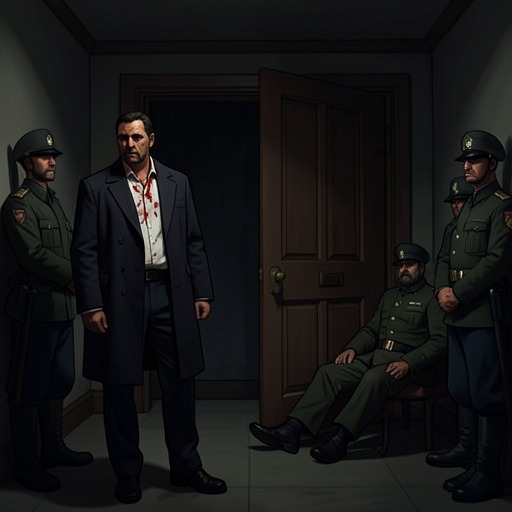
Guido flees Naples and joins the Foreign Legion
Man on FireGuido Arrellio’s flight from Naples begins when the protection keeping him safe is withdrawn: with Conti’s enemies closing in and prison no option, Guido chooses exile and signs on with the Foreign Legion. The decision takes him from a life under the threat of police and organized-crime reprisals to Algeria, though at first he expects to return home after a short absence.
The Threat in Naples
Conti had not forgiven Guido for leading one of the most lethal arms of the opposition. He was not yet ready to defy the new arbitrator openly, so he allowed Guido to reopen his brothel and planned to withdraw his protection later. The police, aided by Conti’s judicial connections, would then do the work of putting Guido away. Guido left a meeting believing he was secure, but that confidence was misplaced.
Guido later told Pietro about the moment he learned the protection had been lifted and the police were coming. He never discovered who had called to warn him, though he recognized that Conti had enemies of his own. The warning made the danger immediate: hiding could only postpone discovery by either the police or Conti’s men, while fighting was a contest he could not win. He did not consider trusting himself to the courts; prison was not an option.
Departure and Farewell
Before leaving, Guido wrote to his mother. He named an honest lawyer in Naples and instructed her to have the family property rented out, with the proceeds supporting her and paying for Elio’s continued education. He ended the letter by telling her he would be away, perhaps for a long time. The arrangements make his escape more than a flight from capture: he tries to provide for the family he is leaving behind even as he has little certainty about his own future.
Guido went to the docks, where friends could hide him for a few days. His mother received the letter the next day and went to church to pray. That same night, Guido was smuggled aboard an old freighter; two nights later he was smuggled ashore in Marseilles. At twenty, with little money and no prospects, he signed on with the Legion the following day. Within a week he had reached the training camp at Sidibel Abbes in Algeria.
Exile and the Expected Return
Recounting the decision later to Pietro, Guido said he had heard the usual stories about the Legion and expected it to be terrible, but felt he had no choice. He had no papers, spoke only Italian, and had very little money. His plan was not to make a permanent home in the Legion: he thought he might desert after a year or two and return to Naples. The account thus presents enlistment as a practical escape from an immediate trap, while Guido still measures his future against the city he has left.
Significance
The departure establishes the pattern of Guido’s early survival: when the institutions around him offer no safe route, he relies on personal connections and makes a decisive break. His letter preserves a tie to his mother and Elio even as smuggling separates him from them. The imagined return also gives the enlistment its provisional quality; at the point of departure, exile is a way to stay alive, not yet a settled destination.