Italy's Organized Child-Kidnapping Ransom Trade
Man on FireItaly's Organized Child-Kidnapping Ransom Trade is presented as more than a series of crimes: it is a high-value business that draws families, insurers, protection services, and organized crime into a common system of risk and profit. The system offers ways to reduce danger or shift financial loss, yet its calculations cannot guarantee a child’s safety. Pinta’s kidnapping reveals the most disturbing reversal: protection and insurance, ostensibly safeguards against the trade, are made part of a scheme that enables it.
Scale and Organization
The threat is established in Milan through the abduction of eight-year-old Pepino Macchetti. In January, after leaving school and getting into what he believes is his father’s blue Mercedes, Pepino realizes that the driver is not the family’s usual driver. The car stops, a heavyset man gets in beside him, and it pulls back into traffic. He is described as Italy’s third kidnapping victim of that year. The sequence makes the crime unnervingly ordinary in its setting: a child’s familiar journey home is turned into an opportunity for an abduction.
Rika’s fear for Pinta is sharpened by that case. She emphasizes that Pepino was taken in broad daylight, outside his school, and argues that Pinta should be moved or otherwise protected. Ettore counters that the Macchettis are exceptionally wealthy, while his own financial difficulties are becoming known in Milan’s financial circles. He believes their relative poverty makes Pinta an unlikely target. Rika disputes the distinction, noting that the families appear to live at least as well as one another. Their disagreement exposes the uncertainty behind private assessments of risk: visible wealth, actual finances, and what kidnappers know about a family do not necessarily coincide.
The Venucci kidnapping further complicates Ettore’s confidence. Eight-year-old Valerio Venucci was taken six months earlier, although his family’s construction business had fallen on bad times. The kidnappers held him for two months while reducing their demand from one billion lire to two hundred million, which the family eventually scraped together. Ettore distinguishes this case from the professional operations he fears, claiming that the abductors were outsiders from Marseilles who knew too little about the family and were caught two weeks after receiving the money. The contrast is important: a family’s financial position does not by itself make a child safe, and a ransom case can vary in planning, duration, and outcome.
Vico Mansutti describes the larger trade as highly organized and usually conducted under the auspices of organized crime. He gives its scale as eighteen billion lire in the previous year and says that the powerful groups control it. His account turns the kidnappings from isolated emergencies into an industry whose size depends on coordination, information, and access to money. The business is discussed in practical terms by the characters, but its human costs remain visible in the children used as leverage and the families forced to bargain under pressure.
Insurance and the Economics of Protection
The trade has generated a market for protection. Vico explains that families who feel threatened may send children abroad, often to Switzerland, or invest in guarded schools, bulletproof cars, and competent bodyguards. Such a bodyguard costs about thirty million lire a year. Specialized agencies supply them, but political violence across Europe—including activity by the Red Brigades—has increased demand and made experienced guards harder to find and more expensive.
Insurance offers another way to manage the financial consequences of a ransom. Italian companies are not permitted to issue these policies, on the reasoning that coverage might encourage kidnapping, but foreign insurers can do so. Vico identifies Lloyd's of London as a leading provider and says it collected more than one hundred million pounds in premiums in the previous year. Two underwriting partnerships specialize in the coverage, and one has a subsidiary that negotiates with kidnappers. The arrangement has strict conditions: premiums must be paid outside Italy, and the insured must never disclose that the policy exists. Secrecy is not incidental to the product; it is part of the conditions under which the insurance operates.
The pricing links insurance to visible security measures. For a hypothetical one-billion-lire policy, Vico calculates that a five-percent premium would cost fifty million lire. Hiring a full-time bodyguard could lower the rate to three percent, or thirty million lire. Since the guard itself costs thirty million, that calculation offers no saving if the family hires a fully capable professional. Vico therefore introduces a cheaper category: a premium bodyguard, who would do little to stop a kidnapping but could qualify the client for the lower insurance rate and cost about seven million lire a year. The distinction between actual protection and the appearance of protection exposes a structural weakness in the arrangement. A measure can satisfy the insurer’s pricing logic without doing much to protect the child.
Protection in Practice
Creasy approaches his new bodyguard assignment through military reasoning. He treats Pinta as an asset a potential enemy might try to capture, and considers the house, school, other regular destinations, and the roads between them as possible sites of attack. Because the route appears the likeliest point of vulnerability, he studies the roads and plans to vary the journey rather than let it become predictable. His method makes the danger concrete: a child’s ordinary movements create repeated opportunities that a kidnapper can watch and exploit.
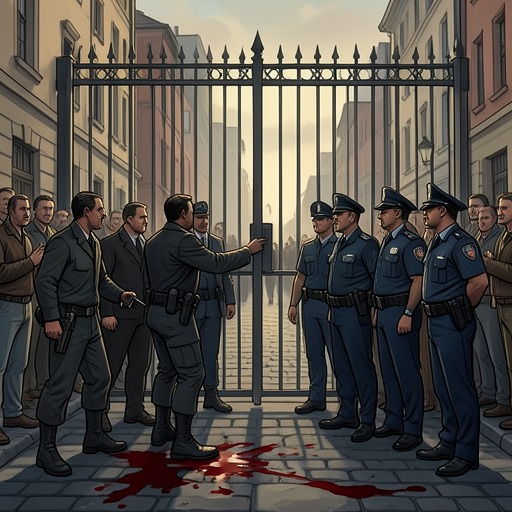
At Pinta’s school, Creasy assesses the site rather than assuming that its imposing appearance makes it safe. He notes the spike-topped walls, the open ground in front of the heavy gates, the watchman-controlled entrance, and the grounds surrounding the building. He judges the school reasonably secure, but his inspection cannot eliminate the risks of travel or of an attack elsewhere. The school’s elderly headmistress tells him that two of her own children have been kidnapped in the past. Neither was hurt, but she describes the experience as awful and says children take a long time to recover. Her account gives the threat a consequence beyond the ransom itself: even survival does not erase the experience.
When Pinta is abducted, the attack exploits precisely the exposure that protection planning tries to reduce. Creasy is waiting by the car while she approaches from the apartment. A black car rounds the corner, mounts the curb, and carries four men. Creasy recognizes the attempt and calls for Pinta to run. She evades one man and moves toward him, but another catches her and lifts her into the car. Creasy hesitates to fire while Pinta is between them, then shoots the man who turns toward him and fires. The moment shows both the value and the limits of a bodyguard: Creasy reacts, but the attackers create a situation in which protecting the child also restricts his use of force, and they escape with her.
The Insurance Fraud and Its Human Cost
The kidnapping’s apparent place within the ransom trade is radically altered when Creasy tells Rika what he has learned from Fossella. The abduction was an insurance job. Ettore had taken out a two-billion-lire policy with Lloyd's of London, and the agreement was for Fossella to return half the ransom to him. Vico Mansutti acted as intermediary, using his connections with organized crime and receiving a commission. The arrangement converts insurance from a means of managing the financial consequences of kidnapping into part of a plan to profit from it. The secret policy and the required concealment are not merely background details: the plot depends on the same opacity that makes this form of insurance possible.
The revelation also changes the meaning of Creasy’s employment. After the kidnapping, Guido visits the Balletto household and finds Vico and his wife there, with Vico apparently taking charge while Ettore is dazed. Rika has learned that Creasy was hired for a pittance merely to appease her, and calls him a drunk who was meant to protect her daughter. Her anger is directed not only at the failed defense but at the discovery that the promised protection was inadequate from the start. When Creasy later discloses the insurance scheme, Rika turns toward Ettore with hatred. The family’s financial arrangement is exposed as a betrayal of the very child whose safety it was supposed to secure.
The trade’s ultimate cost is confirmed by Pinta’s death. Guido explains that the ransom had been paid two days before she was found in the trunk of a stolen car, and that she had been expected to be released that night. A major police sweep targeting a Red Brigades gang is thought to have made the kidnappers nervous; they went to ground for several hours instead. Pinta’s hands and mouth were taped, and she had vomited, probably from petrol fumes. The autopsy determined that she choked to death. The ransom payment therefore did not bring her home: delay and confinement turned the promised exchange into a fatal outcome.
Significance
The episodes distinguish financial protection from physical safety. Insurance can shift the cost of a ransom, and a guard or secured school can influence an insurer’s assessment, but none of these mechanisms guarantees that a child will be recovered unharmed. In Pinta’s case, the distinction collapses into corruption: the insurance policy, criminal intermediary, and nominally cheap bodyguard belong to an arrangement that leaves her exposed and uses the kidnapping for profit.
The narrative also shows how the business depends on information and routine. Families debate whether their wealth makes them targets; kidnappers assess what they can learn; a child’s regular route becomes a security problem; and insurers price measures according to their stated presence rather than their proven effectiveness. Yet the numbers—ransom demands, premiums, commissions, and guard salaries—cannot contain the consequences. Valerio’s family is forced to scrape together a reduced demand, the headmistress recalls children’s long recovery, and Pinta dies after the ransom has already been paid. The trade is organized enough to calculate risk, but its calculations offer no reliable protection against the human damage they help set in motion.