Laura Schembri
Man on FireLaura Schembri is Nadia’s mother and Paul’s wife, and the novel’s clearest embodiment of practical, sustaining care. On Gozo, she welcomes Creasy into her household and helps restore his strength through food, work, and the quiet acceptance of family life. Later, when Nadia becomes pregnant and asks her parents not to tell him, Laura seeks counsel about a secret that binds intimate responsibility to the danger of Creasy’s violent mission.
Identity and Family
Laura lives with Paul and their family on Gozo. Her home is organized around the large kitchen, which serves as the household’s real center: meals and ordinary activity happen there, while the dining room and lounge are reserved for formal occasions. That distinction matters to Creasy. Though the presence of a family unit might have unsettled him, Laura’s bustling welcome and Paul’s easy greeting make him feel accepted rather than observed as an outsider.
Laura’s ties to Creasy began through her daughter Julia and son-in-law Guido. She had grown to love Guido as a natural son, and Julia’s death brought grief both for her daughter and for him. Eight years before Creasy’s return, Guido had spoken privately with Laura and Paul on the night before his wedding. He told them something of his past, of his love for Julia, and of the future they planned together in Naples. He also asked them to rely on Creasy if anything happened to him and Julia. Laura’s later actions emerge from that promise: for her, Creasy is not simply a wounded stranger but a friend of Guido’s whom the family has reason to receive.
Welcoming Creasy and Nursing His Recovery
When Creasy arrives at the farmhouse, Laura comes out from the kitchen, embraces him, and kisses his cheek. She gently scolds her son for the circumstances of the arrival, then takes Creasy inside. The welcome is affectionate without ceremony. Paul reinforces it by joining them from the fields and greeting Creasy; the visitor is folded into the household’s routine over coffee rather than asked to account for himself.
Laura’s care becomes concrete at breakfast. After Creasy’s swim, she serves him ham and eggs, warm bread with the island’s clear honey, and coffee. She watches with satisfaction as he eats, remembering how silent he had been on his earlier visit and seeing that he now looks older and profoundly weary. Guido had told the family by telephone how near Creasy had been to death. Laura responds not with questions or pity but with a plan: food, exercise, and hard work will help build him up again.
That plan is sustained through ordinary labor. Laura watches the physical change brought by good food and exercise, while Creasy works beside Paul in the fields, learning to build a dry stone wall and enduring the aching back and blistered hands that follow. Her hospitality is therefore more than a single generous meal. It provides a setting in which recovery can take the form of repeated meals, exertion, and accepted participation in family life.
Laura had helped bring Creasy back to Guido before this stay. When Julia was killed, it was Laura who sent a cable to the forwarding address Guido had given her in Brussels. The message brought Creasy from Africa to Naples to be with his friend. She had watched him at Guido and Julia’s wedding, where she sensed his pleasure in his friend’s happiness and trusted Guido’s assurance that he would help if needed. Her present effort to restore Creasy’s strength continues that earlier act of connection, though the purpose has changed from helping Guido and Julia to caring for Creasy himself.
Nadia’s Pregnancy and Laura’s Dilemma
Laura’s care also places her at the center of a difficult family secret. After Nadia speaks with her and Paul, Laura tells Creasy that Nadia had talked to them the previous night. His reaction—choking on his food—makes plain that the disclosure has startled him. Laura explains that the family is close and that Nadia would not act behind her parents’ backs; she presents the conversation as evidence of Nadia’s honesty, not as an invitation to intrude.
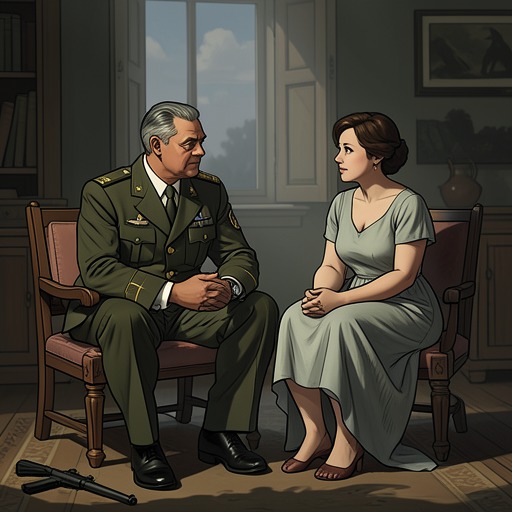
Later, Laura takes the problem to her parish priest, The Cowboy. She has never asked him for advice before, though she has often offered her own, and the departure from their customary roles gives the conversation unusual weight. Laura tells him that Nadia is pregnant but has not informed Creasy, and has forbidden either parent to tell him. She describes Nadia as having conceived deliberately, at first seeking Creasy as a provider of the seed, while admitting that she does not know how Nadia feels now. Nadia has changed, Laura says, and has told her about the child but little else.
The question Laura brings to the priest is direct: should she tell Creasy? Her uncertainty is not a lack of concern but the consequence of competing obligations. She knows Nadia has expressly forbidden disclosure, yet recognizes that the pregnancy affects Creasy as well. The priest also knows that Creasy is dealing out violent death, making the timing and consequences of disclosure harder to separate from the danger surrounding him. Laura does not resolve the dilemma in the conversation presented; the scene establishes the burden she carries and the limits of what she can confidently infer about her daughter’s feelings.
Care, Kinship, and Narrative Role
Laura’s character is developed through acts of attention rather than a separate account of her inner life. She remembers Creasy’s earlier silence, notices his weariness, feeds him, and helps structure his return to physical strength. She also listens to Nadia, takes her confidence seriously, and seeks guidance when the secret becomes too consequential to manage alone. These are distinct forms of care: hospitality for a family friend, practical support for a recovering man, and protective but uncertain counsel for a daughter.
Her relationship with Creasy rests on both affection and obligation. Guido’s request before the wedding gave Laura a reason to trust him; the cable she sent after Julia’s death turned that trust into action. Years later, welcoming Creasy into the farmhouse extends kinship beyond the immediate household. Yet Laura’s concern for Nadia shows that care does not produce easy answers. The same family closeness that makes disclosure possible also requires Laura to respect her daughter’s confidence, while Creasy’s involvement in lethal violence raises the stakes of telling him. Laura’s role thus connects the novel’s restorative domestic world to the danger of its revenge plot: the kitchen offers food and belonging, but it is also where the consequences of love, secrecy, and responsibility press into ordinary family life.