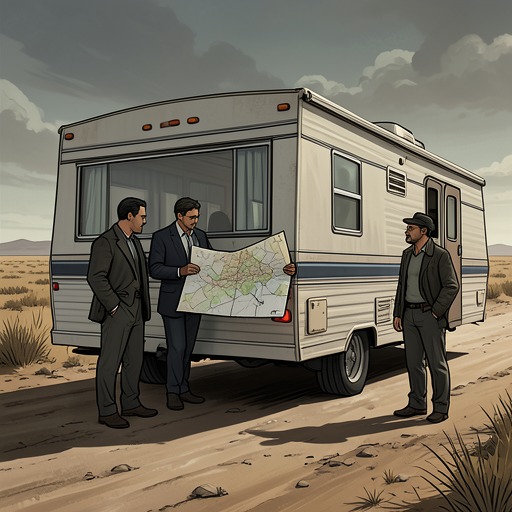
Mistral Parachute
Man on FireThe Mistral Parachute is the French wing-like canopy Creasy uses for his airborne approach to Villa Colacci. More than a means of descent, it shapes the method of entry: its steering capability makes a precise landing possible, but the load Creasy carries and the late opening required for his drop leave little margin for error. The parachute’s preparation, handling, and arrival give the assault a distinctive combination of technical control and physical danger.
Design and Preparation
After a forecast of milder weather over northern Sicily, Creasy opens the large suitcase and removes a parcel sent by the general to Marseilles. With Paddy Collins and Wally Wightman watching from the grass, he unwraps it to reveal voluminous folds of black fabric. Wally observes that it does not look like a parachute. Creasy answers, "It's more like a wing," and identifies it as a French Mistral. The exchange establishes the canopy’s defining feature in the scene: it is presented not simply as something that slows a fall, but as a wing that can be flown.
Creasy explains the difference in terms of control. As he puts it, "The old days of jumping out and trusting to luck are gone." A well-trained parachutist can steer the Mistral even upwind and land within yards of a target. The claim makes precision central to the object’s purpose: the intended landing point is something to approach deliberately, not merely a spot to hope for after the jump. That capability depends on both the parachute’s design and the jumper’s expertise; the canopy is not represented as making the descent automatic.
Paddy Collins and Wally Wightman help lay out the cords. Creasy then straightens and sorts them himself before folding the canopy. The sequence places skilled handling alongside the equipment’s advanced steering: before the parachute can guide a descent, its lines must be organized and its fabric correctly folded. The observers’ assistance is practical, but the detailed work remains Creasy’s, emphasizing his command of the preparation as well as the jump.
Weight and the Cost of Control
Wally asks whether Creasy has a reserve parachute, having seen images of parachutists with smaller packs strapped to their fronts. Creasy shakes his head: "I can't afford the weight." The answer makes the Mistral part of a larger calculation about everything he must carry. It offers a means of flying toward a precise target, but a second parachute would add weight that Creasy has decided he cannot spare.
Creasy explains that a parachutist would normally carry an equipment bag dangling five meters below on a cord. The bag would strike the ground first, reducing the force of the jumper’s landing, but the jumper might lose precious seconds retrieving it and taking out the weapons. Creasy intends to jump with his weapons ready instead. The usual arrangement therefore trades time for a gentler impact; his arrangement favors immediate access to weapons and accepts the harsher arrival. The Mistral’s precision does not remove that physical cost. The account states plainly that he will risk a heavy landing.
The Drop Plan
Before the descent, Creasy discusses the flight with Cesare Gravelli. The aircraft is at seven thousand feet; after crossing the beacon, Cesare is to take it up to twelve thousand. Creasy identifies his method as a "Halo" drop and explains the initials as "High altitude, low opening." The exchange gives the Mistral’s use a specific operational frame: Creasy will leave the aircraft high, then delay opening the canopy until close to the ground.
Asked about opening height, Creasy says, "Not more than two thousand feet, depending on my free-fall drift." He also takes account of the ten-knot easterly wind and plans to drop just short of the target. Cesare warns that a downdraft may come off the mountain, beginning below two thousand feet and escaping notice during free fall; he advises Creasy to move farther south. The warning shows how the descent depends on conditions the parachutist may encounter only at the point when he is preparing to open. The Mistral can be flown toward a target, but wind, terrain, and the timing of deployment still shape whether the intended approach succeeds.
Arrival at Villa Colacci
The narrative renders Creasy’s approach as a striking silhouette: seconds after Don Cantarella draws his curtains, Creasy floats over the wall "like a great, black, pregnant bat." The image makes the parachute’s black fabric visible within the darkness around the villa, turning a technical insertion into a sudden, ominous arrival. The canopy carries him across the perimeter before the action shifts immediately to the landing.
Creasy touches down on grass close to the orchard. His legs cushion the impact; he rolls, releases the parachute, and drags the canopy backward into the fruit trees. The sequence completes the trade-offs established before the jump: despite the anticipated hard landing, he comes down in control, then removes the conspicuous fabric from the immediate landing area. The account does not linger on the Mistral once it has served its purpose. Its importance lies in the approach it enables: a planned descent over the wall, a landing near the orchard, and an entry that begins with controlled movement but carries the danger of a fast, hard arrival.