Pensione Splendide
Man on FirePensione Splendide is the Naples residence and business that charts Guido Arrellio’s passage from a young operator in the postwar criminal economy to a hotelkeeper whose home becomes a point of contact in Creasy’s campaign. Its history is built into the property: acquired with illicit profits, converted for changing purposes, and eventually made into a family-run inn, it gathers the past around the men who return to it.
Origins and Early Uses
The building began as the spacious, well-built house of a moderately wealthy merchant, with a large terrace overlooking the bay. After the merchant died, his two sons—both Fascists—also died amid the confusion at the end of the war. The house then passed to a nephew, likewise a Fascist, who chose to leave for America; selling the property gave him money to arrange the necessary papers. Against this unsettled backdrop, Guido bought the house in his mother’s name because he was still a minor.
Guido partitioned its large rooms and turned it into a brothel serving American officers. The business prospered and became familiarly known as the Splendide. His mother, unaware of the source of its income, banked the profits and lit candles in church. The contrast between her piety and her son’s enterprise belongs to the building’s founding history: the house could appear respectable in family and religious life while its money came from Guido’s place in the postwar underworld.
From Commercial Premises to Family Inn
When Guido returned to Europe with his fellow mercenary, he found the Naples building in good repair and occupied by the Church as a dormitory for unwed mothers—a striking new use for a property whose earlier income had come from a very different business. He stayed with his mother in Positano, then returned to Naples with Julia, bought back the lease, and turned the premises into the Pensione Splendide. The change made the building both a livelihood and a home: Guido’s mother celebrated his safe return with candles at church, while the former commercial property became an inn run by the couple.
The small establishment had six rooms and drew local customers for lunch and dinner. Julia quickly earned a reputation for simple, well-cooked food; her Maltese-style rabbit stew became known in the district, and she mastered local dishes. After her death, Guido continued the work and discovered that he had a talent for cooking too. Customers may initially have stayed out of sympathy, but they continued because the food deserved it. The Pensione’s everyday routine thus outlasted bereavement without becoming merely a memorial to Julia: its trade rested on the ordinary, repeated labor of feeding its guests.
The inn also became a familiar stopping place for Creasy, who arrived without writing or telephoning, often while traveling to or from a war. He brought Julia considered, distinctive gifts, including a batik painting from Indonesia and natural aquamarine pearls from Japan. On one visit he stayed for more than a month, occupying himself with small repairs around the building, work that suited his preference for using his hands. After dinner, when the last customers had left, Guido, Julia, and Creasy gathered around the large kitchen table to watch television, read, or talk. The men’s shared past could make their exchanges remarkably compressed: a question about an old acquaintance might receive only a place-name in reply. In these scenes the Pensione is more than an address; it is the domestic setting where Creasy can return, be received without ceremony, and briefly take part in a life organized around meals, work, and friendship.
A Meeting Place Under Pressure
The Pensione Splendide’s role changed when Creasy returned to Naples. At dawn, Guido Arrellio watched him on the terrace, waiting for the growing light to reveal the friend he had not seen for five years. A bottle beside Creasy confirmed what Guido had heard: he had been drinking and was in decline. The terrace, facing the bay, became the scene of a reunion shadowed by the question of what had brought Creasy there. The inn offered him a familiar place to arrive without announcement, as he had done on earlier visits, but this time his return signaled a deeper crisis.
The Pensione also gave Guido a base from which to help Creasy prepare. They discussed the people and resources involved in Creasy’s plans, and Guido advised him how to deal with a potential supplier by invoking the threat of a conspicuous funeral. Creasy had assembled information from old newspapers and a journalist’s book, using the inn as a setting in which to explain what he had learned and what he intended to do next. The domestic ease of their old friendship persisted, but now it stood beside a practical alliance: the familiar rooms and conversations were part of the preparations for a dangerous undertaking.
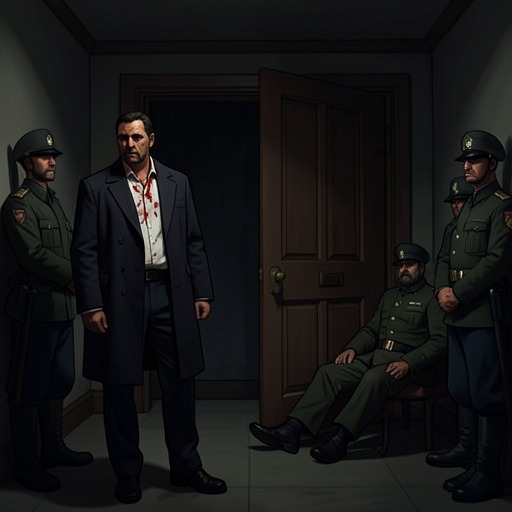
That connection drew the attention of Mario Satta. Investigating the killings, Satta and Massimo Bellu traced a possible link from the bodyguard once hired by the Balletto family to Guido and the Pensione Splendide. Satta’s inquiries established that Creasy had been a mercenary and that he had left Italy for Malta after leaving hospital. Satta then went to Naples, treating Guido as the person most likely to explain Creasy’s character and methods, not merely his movements. The Carabinieri arranged to monitor the Pensione’s telephone and intercept its mail, turning the inn into a watched address even as it remained a private home and business.
Guido initially told Satta that the Pensione was closed and directed him to a hotel. Yet the colonel’s warning made the danger difficult to dismiss: Don Cantarella’s organization could trace Creasy back to Guido, and its men would be less polite than the police. Guido had already heard from Elio that two covertly threatening visitors had questioned him in Milan about recommending Creasy to an agency. He therefore made Satta a room, while insisting that the colonel should not expect breakfast in bed. The exchange captures the Pensione’s double function at this point in the story: a place of hospitality, but also a vulnerable address exposed to pressure from both criminal and official investigators.
Satta’s stay turned that uneasy contact into a relationship. On his third day, he had eaten several excellent meals and sometimes helped in the kitchen; the regular customers did not know that a full colonel had tossed their salad. He had also lost more than three hundred thousand lire to Guido at backgammon, a defeat that deepened his respect for Guido’s skill and panache. Their contrasting temperaments—Guido taciturn and stocky, Satta elegant and talkative—gave way to an emerging friendship, strengthened by Satta’s recognition of Guido’s knowledge of his society and his dry humor. The Pensione thus became not only the place where the investigation reached Creasy’s closest friend, but where a policeman and a former criminal found grounds for mutual regard.
Pietro and the Inn’s Daily Life
The Pensione Splendide depended on a small working household as well as on Guido Arrellio’s past and friendships. Four years before the events of the novel, Guido caught Pietro stealing hubcaps from his car. He beat and questioned the boy, then learned that Pietro had no home and brought him back to the inn, where he gave him a meal and a cot beneath the stairs. Pietro became Guido’s practical right hand, helping him run the six-room establishment alongside two elderly waiters who came in for lunch and dinner service. Their relationship kept its affection deliberately out of sight: Guido remained gruff and abrupt, while Pietro answered with the cheeky disrespect he had shown from the beginning. The inn’s hospitality was therefore not only a service to paying guests; its routines also sustained a household shaped by an unspoken bond between its proprietor and a boy he had taken in.